

William of Worcester's Chronicle of England
William of Worcester, born around 1415, and died around 1482 was secretary to John Fastolf, the renowned soldier of the Hundred Years War, during which time he collected documents, letters, and wrote a record of events. Following their return to England in 1440 William was witness to major events. Twice in his chronicle he uses the first person: 1. when writing about the murder of Thomas, 7th Baron Scales, in 1460, he writes '… and I saw him lying naked in the cemetery near the porch of the church of St. Mary Overie in Southwark …' and 2. describing King Edward IV's entry into London in 1461 he writes '… proclaimed that all the people themselves were to recognize and acknowledge Edward as king. I was present and heard this, and immediately went down with them into the city'. William’s Chronicle is rich in detail. It is the source of much information about the Wars of the Roses, including the term 'Diabolical Marriage' to describe the marriage of Queen Elizabeth Woodville’s brother John’s marriage to Katherine, Dowager Duchess of Norfolk, he aged twenty, she sixty-five or more, and the story about a paper crown being placed in mockery on the severed head of Richard, 3rd Duke of York.
Available at Amazon in eBook and Paperback format.
Trinity House is in Crown.
John Evelyn's Diary. 25th January 1662. I dined with the Trinity Company at their house, that corporation being by charter fixed at Deptford, Kent [Map].
John Evelyn's Diary. 11th June 1666. Trinity Monday, after a sermon, applied to the remeeting of the Corporation of the Trinity-House, after the late raging and wasting pestilence: I dined with them in their new room in Deptford [Map], the first time since it was rebuilt.
John Evelyn's Diary. 25th May 1671. I dined at a feast made for me and my wife [aged 36] by the Trinity House, for our passing a fine of the land which Sir R. Browne [aged 66], my wife's father, freely gave to found and build their college, or almshouses on, at Deptford, Kent [Map], it being my wife's after her father's decease. It was a good and charitable work and gift, but would have been better bestowed on the poor of that parish, than on the seamen's widows, the Trinity House being very rich, and the rest of the poor of the parish exceedingly indigent.
John Evelyn's Diary. 26th March 1673. I was sworn a younger brother of the Trinity House, with my most worthy and long-acquainted noble friend, Lord Ossory [aged 38] (eldest son to the Duke of Ormond [aged 62]), Sir Richard Browne [aged 68], my father-in-law, being now Master of that Society; after which there was a great collation.


John Evelyn's Diary. 25th May 1673. My son [aged 18] was made a younger brother of the Trinity House. The new master was Sir J. Smith, one of the Commissioners of the Navy, a stout seaman, who had interposed and saved the Duke [aged 39] from perishing by a fire ship in the late war.


John Evelyn's Diary. 22nd May 1676. Trinity Monday. A chaplain of my Lord Ossory's [aged 41] preached, after which we took barge to Trinity House in London. Mr. Pepys [aged 43] (Secretary of the Admiralty) succeeded my Lord as Master.


John Evelyn's Diary. 12th February 1683. He gave to the Trinity Corporation that land in Deptford [Map] on which are built those almshouses for twenty-four widows of emerited seamen. He was born the famous year of the Gunpowder Treason, in 1605, and being the last [male] of his family, left my wife [aged 48], his only daughter, heir. His grandfather, Sir Richard Browne, was the great instrument under the great Earl of Leicester (favorite to Queen Elizabeth) in his government of the Netherland. He was Master of the Household to King James, and Cofferer; I think was the first who regulated the compositions through England for the King's [aged 52] household, provisions, progresses,49 etc., which was so high a service, and so grateful to the whole nation, that he had acknowledgments and public thanks sent him from all the counties; he died by the rupture of a vein in a vehement speech he made about the compositions in a Parliament of King James. By his mother's side he was a Gunson, Treasurer of the Navy in the reigns of Henry VIII., Queen Mary, and Queen Elizabeth, and, as by his large pedigree appears, related to divers of the English nobility. Thus ended this honorable person, after so many changes and tossings to and fro, in the same house where he was born. "Lord teach us so to number our days, that we may apply our hearts unto wisdom!".


John Evelyn's Diary. 12th February 1683. This morning I received the news of the death of my father-in-law, Sir Richard Browne [aged 78], Knt. and Bart., who died at my house at Sayes Court [Map] this day at ten in the morning, after he had labored under the gout and dropsy for nearly six months, in the 78th year of his age. The funeral was solemnized on the 19th at Deptford, with as much decency as the dignity of the person, and our relation to him, required; there being invited the Bishop of Rochester [aged 58], several noblemen, knights, and all the fraternity of the Trinity House, of which he had been Master, and others of the country. The vicar preached a short but proper discourse on Psalm xxxix. 10, on the frailty of our mortal condition, concluding with an ample and well-deserved eulogy on the defunct, relating to his honorable birth and ancestors, education, learning in Greek and Latin, modern languages, travels, public employments, signal loyalty, character abroad, and particularly the honor of supporting the Church of England in its public worship during its persecution by the late rebels' usurpation and regicide, by the suffrages of divers Bishops, Doctors of the Church, and others, who found such an asylum in his house and family at Paris, that in their disputes with the Papists (then triumphing over it as utterly lost) they used to argue for its visibility and existence from Sir R. Browne's chapel and assembly there. Then he spoke of his great and loyal sufferings during thirteen years' exile with his present Majesty [aged 52], his return with him in the signal year 1660; his honorable employment at home, his timely Recess to recollect himself, his great age, infirmities, and death.
John Evelyn's Diary. 20th July 1685. The Trinity House met this day, which should have ben on ye Monday after Trinity, but was put off by reason of the Royal Charter being so large that it could not be ready before. Some immunities were super-added. Mr. Pepys [aged 52], Secretary to ye Admiralty, was a second time chosen Master. There were present the Duke of Grafton [aged 21], Lord Dartmouth [aged 12], Master of ye Ordnance, the Commissioners of ye Navy, and brethren of the Corporation. We went to Church according to costome, and then took barge to the Trinity House [Map], in London, where we had a great dinner, above 80 at one table.

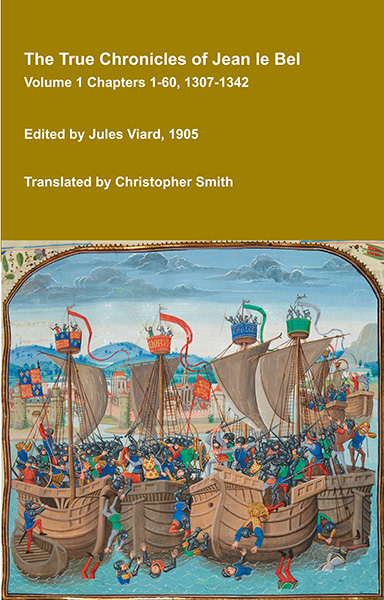
The True Chronicles of Jean le Bel Volume 1 Chapters 1-60 1307-1342
The True Chronicles of Jean le Bel offer one of the most vivid and immediate accounts of 14th-century Europe, written by a knight who lived through the events he describes, and experienced some of them first hand. Covering the early decades of the Hundred Years’ War, this remarkable chronicle follows the campaigns of Edward III of England, the politics of France and the Low Countries, and the shifting alliances that shaped medieval warfare. Unlike later historians, Jean le Bel writes with a strong sense of eyewitness authenticity, drawing on personal experience and the testimony of fellow soldiers. His narrative captures not only battles and sieges, but also the realities of military life, diplomacy, and the ideals of chivalry that governed noble society. A key source for Jean Froissart, Le Bel’s chronicle stands on its own as a compelling and insightful work, at once historical record and literary achievement. This translation builds on the 1905 edition published in French by Jules Viard, adding extensive translations from other sources Rymer's Fœdera, the Chronicles of Adam Murimuth, William Nangis, Walter of Guisborough, a Bourgeois of Valenciennes, Geoffrey le Baker of Swinbroke and Richard Lescot to enrich the original text and Viard's notes.
Available at Amazon in eBook and Paperback format.
John Evelyn's Diary. 25th May 1673. My son [aged 18] was made a younger brother of the Trinity House. The new master was Sir J. Smith, one of the Commissioners of the Navy, a stout seaman, who had interposed and saved the Duke [aged 39] from perishing by a fire ship in the late war.
John Evelyn's Diary. 31st May 1675. I went with Lord Ossory [aged 40] to Deptford, Kent [Map], where we chose him Master of the Trinity Company.
John Evelyn's Diary. 22nd May 1676. Trinity Monday. A chaplain of my Lord Ossory's [aged 41] preached, after which we took barge to Trinity House in London. Mr. Pepys [aged 43] (Secretary of the Admiralty) succeeded my Lord as Master.
John Evelyn's Diary. 12th February 1683. This morning I received the news of the death of my father-in-law, Sir Richard Browne [aged 78], Knt. and Bart., who died at my house at Sayes Court [Map] this day at ten in the morning, after he had labored under the gout and dropsy for nearly six months, in the 78th year of his age. The funeral was solemnized on the 19th at Deptford, with as much decency as the dignity of the person, and our relation to him, required; there being invited the Bishop of Rochester [aged 58], several noblemen, knights, and all the fraternity of the Trinity House, of which he had been Master, and others of the country. The vicar preached a short but proper discourse on Psalm xxxix. 10, on the frailty of our mortal condition, concluding with an ample and well-deserved eulogy on the defunct, relating to his honorable birth and ancestors, education, learning in Greek and Latin, modern languages, travels, public employments, signal loyalty, character abroad, and particularly the honor of supporting the Church of England in its public worship during its persecution by the late rebels' usurpation and regicide, by the suffrages of divers Bishops, Doctors of the Church, and others, who found such an asylum in his house and family at Paris, that in their disputes with the Papists (then triumphing over it as utterly lost) they used to argue for its visibility and existence from Sir R. Browne's chapel and assembly there. Then he spoke of his great and loyal sufferings during thirteen years' exile with his present Majesty [aged 52], his return with him in the signal year 1660; his honorable employment at home, his timely Recess to recollect himself, his great age, infirmities, and death.
John Evelyn's Diary. 11th June 1683. The Lord Dartmouth [aged 10] was elected Master of the Trinity House; son to George Legge [aged 36], late Master of the Ordnance, and one of the grooms of the bedchamber; a great favorite of the Duke's [aged 49], an active and understanding gentleman in sea affairs.
John Evelyn's Diary. 26th May 1684. Lord Dartmouth [aged 37] was chosen Master of the Trinity House, newly return'd with the fleete from blowing up and demolishing Tangier. In the sermon preach'd on this occasion, Dr. Can observ'd that, in the 27th chapter of the Acts of the Apostles, the casting anchor out of the fore-ship had been cavill'd at as betraying total Ignorance: that it is very true our seamen do not do so, but in the Mediterranean their ships were built differently from ours, and to this day it was the practice to do so there.