


Chronicle of a Bourgeois of Valenciennes
Récits d’un bourgeois de Valenciennes aka The Chronicle of a Bourgeois of Valenciennes is a vivid 14th-century vernacular chronicle written by an anonymous urban chronicler from Valenciennes in the County of Hainaut. It survives in a manuscript that describes local and regional history from about 1253 to 1366, blending chronology, narrative episodes, and eyewitness-style accounts of political, military, and social events in medieval France, Flanders, and the Low Countries. The work begins with a chronological framework of events affecting Valenciennes and its region under rulers such as King Philip VI of France and the shifting allegiances of local nobility. It includes accounts of conflicts, sieges, diplomatic manoeuvres, and the impact of broader struggles like the Hundred Years’ War on urban life in Hainaut. Written from the perspective of a burgher (bourgeois) rather than a monastery or royal court, the chronicle offers a rare lay viewpoint on high politics and warfare, reflecting how merchants, townspeople, and civic institutions experienced the turbulence of the 13th and 14th centuries. Its narrative style combines straightforward reporting of events with moral and civic observations, making it a valuable source for readers interested in medieval urban society, regional politics, and the lived experience of war and governance in pre-modern Europe.
Available at Amazon in eBook and Paperback format.
Worshipful Companies is in Societies.
In 1654 John Frederick (age 52) was elected Master of the Worshipful Company of Barber Surgeons.
In 1658 John Frederick (age 56) was elected Master of the Worshipful Company of Barber Surgeons.
In 1654 Richard Hill of Lime Street was appointed Alderman of the Worshipful Company of Cordwainers.
In 1655 Richard Hill of Lime Street was appointed Master of the Worshipful Company of Cordwainers.
On 10th July 1621 Edward Barkham (age 51) was translated to the Worshipful Company of Drapers.
From 1622 to 1623 Edward Barkham (age 52) was Master of the Worshipful Company of Drapers.
After 1623 Thomas Lawley 1st Baronet (age 42) joined as Worshipful Company of Drapers.
In 1642 Thomas Lawley 1st Baronet (age 61) was elected Master of the Worshipful Company of Drapers.
John Evelyn's Diary. 7th August 1679. Dined at the Sheriff's, when, the Company of Drapers and their wives being invited, there was a sumptuous entertainment, according to the forms of the city, with music, etc., comparable to any prince's service in Europe.
In 1668 William Warren was elected Master of the Drapers Company.
Before 1617 John Gayer (age 32) became a member of the Worshipful Company of Fishmongers.
In 1442 Matthew Philip was appointed Prime Warden of the Worshipful Company of Goldsmiths.
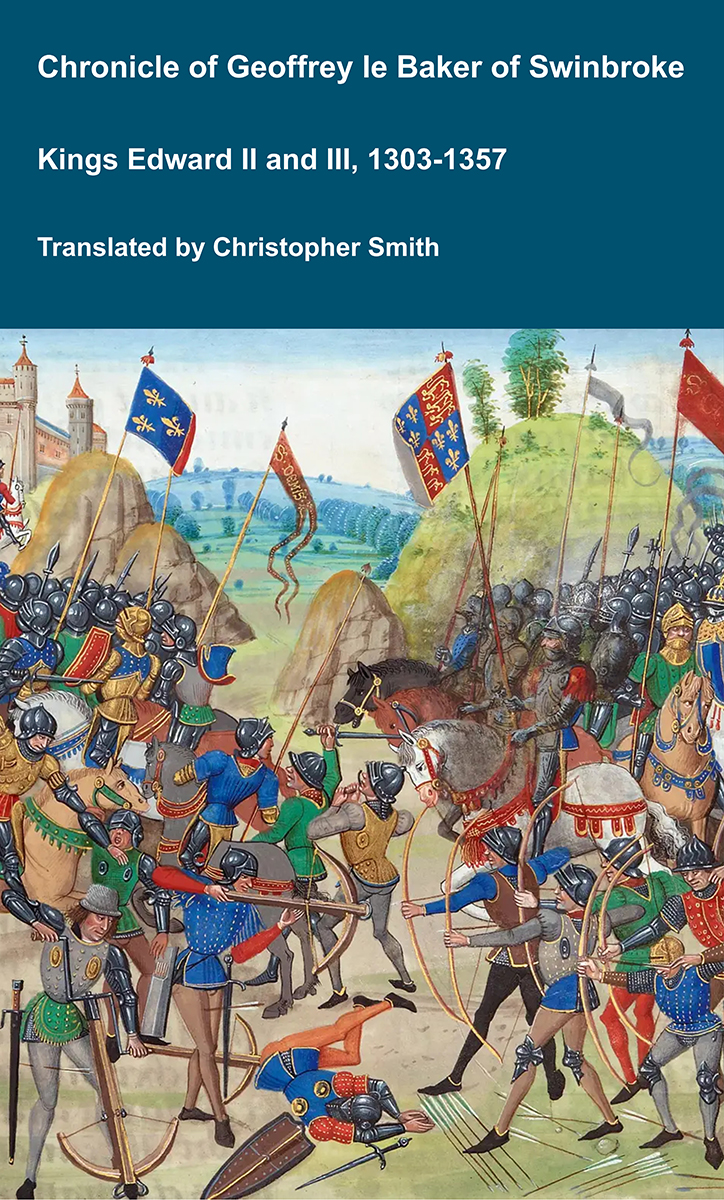
Chronicle of Geoffrey le Baker of Swinbroke
Baker was a secular clerk from Swinbroke, now Swinbrook, an Oxfordshire village two miles east of Burford. His Chronicle describes the events of the period 1303-1356: Gaveston, Bannockburn, Boroughbridge, the murder of King Edward II, the Scottish Wars, Sluys, Crécy, the Black Death, Winchelsea and Poitiers. To quote Herbert Bruce 'it possesses a vigorous and characteristic style, and its value for particular events between 1303 and 1356 has been recognised by its editor and by subsequent writers'. The book provides remarkable detail about the events it describes. Baker's text has been augmented with hundreds of notes, including extracts from other contemporary chronicles, such as the Annales Londonienses, Annales Paulini, Murimuth, Lanercost, Avesbury, Guisborough and Froissart to enrich the reader's understanding. The translation takes as its source the 'Chronicon Galfridi le Baker de Swynebroke' published in 1889, edited by Edward Maunde Thompson.
Available at Amazon in eBook and Paperback format.
On 20th May 1576 Robert "The Elder" Peake (age 25) became a Freeman of the Worshipful Company of Goldsmiths.
After 15th December 1588 Thomas Vyner 1st Baronet became a member of the Worshipful Company of Goldsmiths.
In 1555 John White was appointed Master of the Worshipful Company of Grocers.
In 1560 John White was appointed Master of the Worshipful Company of Grocers.
In 1679 Alderman William Hooker (age 67) was elected Master of the Worshipful Company of Grocers.
Before 1693 John Cutler 1st Baronet (age 89) was appointed Master of the Worshipful Company of Grocers four times.
In 1710 Samuel Garrard 4th Baronet (age 60) was elected Master of the Worshipful Company of Grocers.
In 1580 Thomas Smythe (age 22) was admitted to the Worshipful Company of Haberdashers and the Worshipful Company of Skinners.

In 1661 Thomas Vernon (age 29) was elected Freeman of the Worshipful Company of Haberdashers.
In 1665 Arthur Ingram (age 48) was appointed Master of the Worshipful Company of Haberdashers.
In 1685 Thomas Vernon (age 53) was elected Master of the Worshipful Company of Haberdashers.
Jean de Waurin's Chronicle of England Volume 6 Books 3-6: The Wars of the Roses
Jean de Waurin was a French Chronicler, from the Artois region, who was born around 1400, and died around 1474. Waurin’s Chronicle of England, Volume 6, covering the period 1450 to 1471, from which we have selected and translated Chapters relating to the Wars of the Roses, provides a vivid, original, contemporary description of key events some of which he witnessed first-hand, some of which he was told by the key people involved with whom Waurin had a personal relationship.
Available at Amazon in eBook and Paperback format.
On 19th June 1716 John Eyles 2nd Baronet (age 33) was appointed Master of the Worshipful Company of Haberdashers and Alderman of Vintry.
In 1717 Joseph Eyles (age 27) was elected Master of the Worshipful Company of Haberdashers which position he held until 1721.
In 1604 Thomas Cambell (age 68) was elected Master of the Worshipful Company of Ironmongers.
In 1613 Thomas Cambell (age 77) was elected Master of the Worshipful Company of Ironmongers.
Samuel Pepys' Diary. 6th August 1663. At noon I to the 'Change [Map], and meeting with Sir W. Warren, to a coffee-house, and there finished a contract with him for the office, and so parted, and I to my cozen Mary Joyce's at a gossiping, where much company and good cheer. There was the King's Falconer, that lives by Paul's, and his wife, an ugly pusse, but brought him money. He speaking of the strength of hawkes, which will strike a fowle to the ground with that force that shall make the fowle rebound a great way from ground, which no force of man or art can do, but it was very pleasant to hear what reasons he and another, one Ballard, a rich man of the same Company of Leathersellers of which the Joyces are, did give for this. Ballard's wife, a pretty and a very well-bred woman, I took occasion to kiss several times, and she to carve, drink, and show me great respect.
In 1702 Edward Stanton (age 21) was admitted to the Worshipful Company of Masons.
In 1709 Thomas Stayner (age 44) was elected Master of the Worshipful Company of Masons.
In 1719 Edward Stanton (age 38) was appointed Master of the Worshipful Company of Masons.
On 17th September 1499 William Holles (age 28) admitted as Worshipful Company of Mercers.
In 1507 Richard Gresham (age 22) admitted as Worshipful Company of Mercers.
Jean de Waurin's Chronicle of England Volume 6 Books 3-6: The Wars of the Roses
Jean de Waurin was a French Chronicler, from the Artois region, who was born around 1400, and died around 1474. Waurin’s Chronicle of England, Volume 6, covering the period 1450 to 1471, from which we have selected and translated Chapters relating to the Wars of the Roses, provides a vivid, original, contemporary description of key events some of which he witnessed first-hand, some of which he was told by the key people involved with whom Waurin had a personal relationship.
Available at Amazon in eBook and Paperback format.
In 1507 John Gresham (age 12) admitted as Worshipful Company of Mercers.
In 1547 John Thynne (age 32) was appointed Worshipful Company of Mercers.
Before 1656 John Dethick was appointed a member of the Worshipful Company of Mercers.
In 1656 Alderman William Barker was elected Master of the Worshipful Company of Mercers.

John Evelyn's Diary. 14th August 1662. I sat on the commission for Charitable Uses, the Lord Mayor and others of the Mercers' Company being summoned, to answer some complaints of the Professors, grounded on a clause in the will of Sir Thomas Gresham, the founder.
In 1672 Alderman William Barker was elected Master of the Worshipful Company of Mercers.
Thomas Edwards was appointed Worshipful Company of Mercers.
Before 1637 Jacob Garrard 1st Baronet (age 50) joined the Worshipful Company of Salters.
On 27th February 1599 John Milton (age 37) registered with the Worshipful Company of Scriveners.
In 1635 Robert Abbott Scrivener (age 25) became a member of the Worshipful Company of Scriveners. He established his own shop, the Flying Horse, in the parish of St Michael, Cornhill.
Abbot John Whethamstede’s Chronicle of the Abbey of St Albans
Abbot John Whethamstede's Register aka Chronicle of his second term at the Abbey of St Albans, 1451-1461, is a remarkable text that describes his first-hand experience of the beginning of the Wars of the Roses including the First and Second Battles of St Albans, 1455 and 1461, respectively, their cause, and their consequences, not least on the Abbey itself. His text also includes Loveday, Blore Heath, Northampton, the Act of Accord, Wakefield, and Towton, and ends with the Coronation of King Edward IV. In addition to the events of the Wars of the Roses, Abbot John, or his scribes who wrote the Chronicle, include details in the life of the Abbey such as charters, letters, land exchanges, visits by legates, and disputes, which provide a rich insight into the day-to-day life of the Abbey, and the challenges faced by its Abbot.
Available at Amazon in eBook and Paperback format.
In 1580 Thomas Smythe (age 22) was admitted to the Worshipful Company of Haberdashers and the Worshipful Company of Skinners.
In 1582 Robert Myddelton (age 19) was apprenticed to Eramus Harby 2nd Baronet of the Worshipful Company of Skinners.
Around 1590 Robert Bateman (age 28) was elected Freeman of the Worshipful Company of Skinners.
In 1620 Robert Bateman (age 58) was elected Master of the Worshipful Company of Skinners.
In 1658 Anthony Bateman (age 42) was elected Master of the Worshipful Company of Skinners.
In 1662 Alderman William Crow Upholster (age 45) was elected Master of the Worshipful Company of Skinners.
In 1877 Richard Knight Causton 1st Baron Southwark (age 33) was elected Master of the Worshipful Company of Skinners.
In 1921 Richard Knight Causton 1st Baron Southwark (age 77) was elected Master of the Worshipful Company of Skinners.
Stephen Slaney joined as Worshipful Company of Skinners.

On 7th July 1606 William Larkin (age 24) became a Freeman of Worshipful Company of Stainers under the patronage of Arabella Stewart (age 31) and Edward Seymour 1st Earl Hertford (age 67).
Chronicle of Geoffrey le Baker of Swinbroke
Baker was a secular clerk from Swinbroke, now Swinbrook, an Oxfordshire village two miles east of Burford. His Chronicle describes the events of the period 1303-1356: Gaveston, Bannockburn, Boroughbridge, the murder of King Edward II, the Scottish Wars, Sluys, Crécy, the Black Death, Winchelsea and Poitiers. To quote Herbert Bruce 'it possesses a vigorous and characteristic style, and its value for particular events between 1303 and 1356 has been recognised by its editor and by subsequent writers'. The book provides remarkable detail about the events it describes. Baker's text has been augmented with hundreds of notes, including extracts from other contemporary chronicles, such as the Annales Londonienses, Annales Paulini, Murimuth, Lanercost, Avesbury, Guisborough and Froissart to enrich the reader's understanding. The translation takes as its source the 'Chronicon Galfridi le Baker de Swynebroke' published in 1889, edited by Edward Maunde Thompson.
Available at Amazon in eBook and Paperback format.
On 7th July 1606 William Larkin (age 24) became a freeman of the Worshipful Company of Stainers.
On 12th October 1670 Thomas Rawlinson (age 23) was admitted a Freeman of the Worshipful Company of Vintners.
In 1687 Thomas Rawlinson (age 39) was elected Master of the Worshipful Company of Vintners.
In 1696 Thomas Rawlinson (age 48) was elected Master of the Worshipful Company of Vintners.