

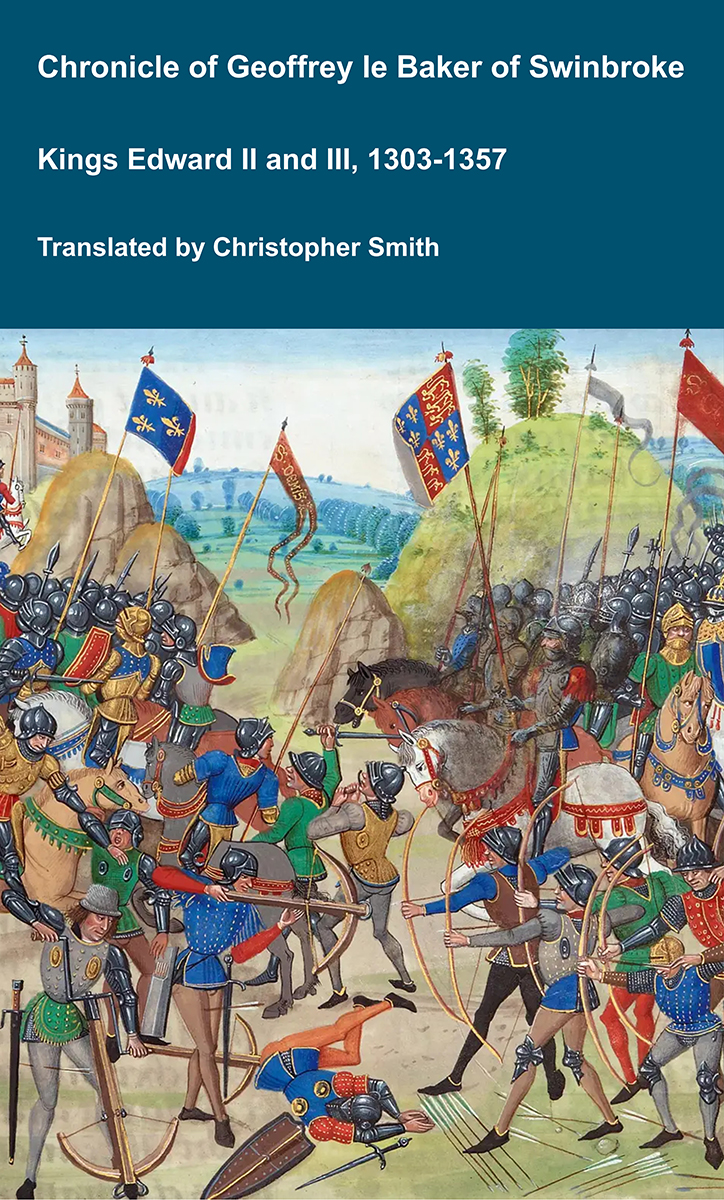
Chronicle of Geoffrey le Baker of Swinbroke
Baker was a secular clerk from Swinbroke, now Swinbrook, an Oxfordshire village two miles east of Burford. His Chronicle describes the events of the period 1303-1356: Gaveston, Bannockburn, Boroughbridge, the murder of King Edward II, the Scottish Wars, Sluys, Crécy, the Black Death, Winchelsea and Poitiers. To quote Herbert Bruce 'it possesses a vigorous and characteristic style, and its value for particular events between 1303 and 1356 has been recognised by its editor and by subsequent writers'. The book provides remarkable detail about the events it describes. Baker's text has been augmented with hundreds of notes, including extracts from other contemporary chronicles, such as the Annales Londonienses, Annales Paulini, Murimuth, Lanercost, Avesbury, Guisborough and Froissart to enrich the reader's understanding. The translation takes as its source the 'Chronicon Galfridi le Baker de Swynebroke' published in 1889, edited by Edward Maunde Thompson.
Available at Amazon in eBook and Paperback format.
Paternal Family Tree: Savoy
In 1272 [his father] Amadeus V "Great" Savoy [aged 22] and [his mother] Sybille Bagé were married. He the son of [his grandfather] Thomas Savoy II Count Flanders and [his grandmother] Beatrice Fieschi.
On 15th December 1291 Aymon "Peaceful" Savoy Count Savoy was born to [his father] Amadeus V "Great" Savoy [aged 42] and [his mother] Sybille Bagé.
In 1297 [his father] Amadeus V "Great" Savoy [aged 47] and Marie Brabant were married. He the son of [his grandfather] Thomas Savoy II Count Flanders and [his grandmother] Beatrice Fieschi.
In January 1297 Ralph Monthermer 1st Earl of Gloucester and Hertford [aged 27] and Joan of Acre Countess Gloucester and Hertford [aged 24] were married in secret greatly offending her father King Edward I of England [aged 57] who had been planning to marry her to Amadeus V "Great" Savoy [aged 47] in March. Ralph Monthermer 1st Earl of Gloucester and Hertford was imprisoned at Bristol Castle, Gloucestershire [Map]; he was released in August 1297. She the daughter of King Edward I of England and Eleanor of Castile Queen Consort England.
On 16th October 1323 [his father] Amadeus V "Great" Savoy [aged 74] died. His son [his brother] Edward [aged 39] succeeded Count Savoy.
In 1329 Edward "Liberal" Savoy Count Savoy [aged 45] died. His brother Aymon [aged 37] succeeded Count Savoy.
In 1330 Aymon "Peaceful" Savoy Count Savoy [aged 38] and Yolande Palaeologina Countess Savoy were married. She by marriage Countess Savoy.
In 1334 [his son] Amadeus "Green Count" Savoy VI Count Savoy was born to Aymon "Peaceful" Savoy Count Savoy [aged 42] and [his wife] Yolande Palaeologina Countess Savoy. He married 1355 Bonne Bourbon Countess Savoy and had issue.
In 1336 [his daughter] Bianca Savoy was born to Aymon "Peaceful" Savoy Count Savoy [aged 44] and [his wife] Yolande Palaeologina Countess Savoy. She married 1350 Galeazzo II Visconti and had issue.
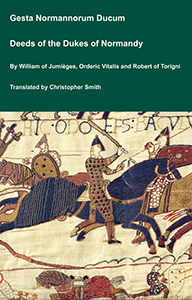
The Deeds of the Dukes of Normandy
The Gesta Normannorum Ducum [The Deeds of the Dukes of Normandy] is a landmark medieval chronicle tracing the rise and fall of the Norman dynasty from its early roots through the pivotal events surrounding the Norman Conquest of England. Originally penned in Latin by the monk William of Jumièges shortly before 1060 and later expanded at the behest of William the Conqueror, the work chronicles the deeds, politics, battles, and leadership of the Norman dukes, especially William’s own claim to the English throne. The narrative combines earlier historical sources with firsthand information and oral testimony to present an authoritative account of Normandy’s transformation from a Viking settlement into one of medieval Europe’s most powerful realms. William’s history emphasizes the legitimacy, military prowess, and governance of the Norman line, framing their expansion, including the conquest of England, as both divinely sanctioned and noble in purpose. Later chroniclers such as Orderic Vitalis and Robert of Torigni continued the history, extending the coverage into the 12th century, providing broader context on ducal rule and its impact. Today this classic work remains a foundational source for understanding Norman identity, medieval statesmanship, and the historical forces that reshaped England and Western Europe between 800AD and 1100AD.
Available at Amazon in eBook and Paperback format.
In 1338 [his son] John Savoy was born to Aymon "Peaceful" Savoy Count Savoy [aged 46] and [his wife] Yolande Palaeologina Countess Savoy. He died aged ten in 1348.
Deeds of King Edward III by Robert of Avesbury. "To all those who these present letters shall see or hear, John, by the grace of God king of Bohemia and count of Luxemburg, Adolphus bishop of Liége, Ralph duke of Lorraine, Aymon count of Savoy [aged 48], and John count of Armagnac, greeting and knowledge of the truth. Be it known to all that, to give and grant truce and respite between the high and mighty princes, the two kings of France and England, for them, their helpers and allies, whether prince, prelate, baron or other manner of men whatever, of holy church or secular, the which truce and respite the high and mighty lords, the duke of Brabant, the duke of Guelders, the marquis of Juliers, and the lord John of Hainault, lord of Beaumont, of the one party, and we the five abovesaid, of the other party, by power to us and to the others abovenamed given by the said kings, have granted, covenanted, and pledged by our faith, with hand in hand, on behalf of the said kings, their helpers, and allies, whoever they be, each on his side, from this day even to the day of the Nativity of Saint John the Baptist next coming, and through that day to the morrow even to sunrise, it hath been treated, granted, covenanted, agreed, and plighted, by advice of the said kings, by us in form and manner following:"
"Firstly, that, during the said truce, no innovation nor misprision be done by the one party upon the other, to the prejudice of the said truce and respite."
"Also, it is agreed in the said truce that the said lords, their aiders, helpers, and allies, whoever they be, remain in such possession and such seisin as they are in at this day of all the goods, lands, and possessions which they hold and have in what manner soever, during the said truce."
"Also, it is agreed that, during the said truce, the said lords, their aiders, helpers, and allies, whoever they be, shall be able to go in safety from the one country to the other; and all merchants with all their merchandise, and all manner of people, and purveyance of goods, as well by land as by sea and water, as freely as they were wont to come and go in time of the ancestors of the said kings: paying poisages and wine dues as hath been anciently accustomed; excepting the outlaws, which are banished from the said realms or either of them, for other cause than for the war of the said kings. Bat the barons of Gascony and of the duchy of Guienne, and other persons of Gascony and of the said duchy, be they banished or others, shall be included in the said truce, and shall be able to go and come from the one country to the other, during the said truce."
"Also, it is agreed that the two kings procure not, nor cause to be procured, by them nor by other, that any innovation or grievance be done by the church of Rome or by others of holy church, whoever they be, on either of the said kings, his helpers or allies, whoever they be, nor on their lands nor those of their subjects, by reason of the said war or for other cause, nor for service that the said ally or helper hath done to the said kings or either of them. And, if our most holy father the pope or others will do that, the two kings shall prevent it, as far as in them lies, without evil intent, during the said truce."
"Also, be it known that from now be the truce cried in the two hosts, and be they bound to hold and keep it, all who are present and others who can and ought to have knowledge thereof."
"Also, it is agreed that, within twenty days, reckoned from this day, each of the kings shall cause proclaim it in Gascony and in the duchy of Guienne, in the land which he doth hold, to the end that it be notoriously known."
"Also, it is agreed that, if by either of the said kings, by their people, their allies, or helpers, any siege be laid in Gascony, in the duchy of Guienne, or in other islands of the sea, in Guernsey, in Jersey, or elsewhere, the sieges shall be raised so soon as the truce shall come to their knowledge. And fourteen persons, to wit seven persons on behalf of either of the said kings, shall enter into the towns, castles, or strong-holds, where the sieges shall be, and shall view the garrisons, as well of men as of victuals, that shall be therein, to this end that, on the day of the ceasing of this truce, the said towns, castles, and strongholds which shall be besieged be set in such number and store of victuals and of men as they shall be found with by the said fourteen persons."
"Also, it is agreed that the thieves and runaways of the land of Flanders, which have been with the king of France, shall not be able, during the truce, to enter nor come into Flanders. And, if they do that any of such go, counter to the truce, within the realm and its power, justice shall be done on them, and what they have in Flanders shall be forfeit."
"Also, it is agreed that the debts due at Arras, to the Crespinois, or to others in the realm of France, be not sued nor executed, during the said truce."
"Also, it is agreed that, during the said truce, all prisoners taken in this war shall be released from their prison, to return thither, on their troth and oath, if so be that they be not ransomed before the date of this present truce; save also that the said prisoners come back, plighting their troth to return on failure of the said truce. And if it happened that any prisoner were in default, refusing to return to prison, the lord under whom he should be should constrain him to return to prison."
"Also, it is agreed that all levies, whatever they be, made before the said truce in time of war, be they on goods spiritual or otherwise, be levied, without restitution, during the said truce."
"Also, it is agreed that a truce be taken forthwith between the English and the Scots, their lords, their aiders and allies, on sufferance of the war which they have between them, to last even to the said Nativity of St. John; and that certain persons be deputed by the said parties to be at a certain day and place upon the marches of England and Scotland, in order to affirm the said truce upon such conditions as aforetime hath been accustomed in those parts; also that, during the said truce, the French nor their lord shall not comfort them with men of arms. And in case that the people of Scotland nor their lord wish not to assent unto the said truce, or should infringe the same, then shall not the French nor their lord comfort them, during the said truce."
"Also, it is agreed that this present truce be notified in England and in Scotland within six and twenty days from the date thereof."
"Also, it is agreed that in this truce be included the people of Spain, of Castille, of Genoa, and of Provence, the bishop and chapter of Cambray, the city of Cambray, the castles of Cambresis and all Cambresis, and also the lord of Albret, the viscount of Fronsac, Gaston de Lisle, the lord of Treubon, the lord John of Vervin, and the lord of Roye."
"In witness whereof we have sealed these present letters with our seals. Done, granted, and given in the church of Esplechin, on Monday, the 25th day of September, in the year of grace 1340."
Around 1341 [his daughter] Catherine Savoy died.
In 1341 [his daughter] Catherine Savoy was born to Aymon "Peaceful" Savoy Count Savoy [aged 49] and [his wife] Yolande Palaeologina Countess Savoy. She died aged less than one years old.
On 24th December 1342 [his son] Louis Savoy was born to Aymon "Peaceful" Savoy Count Savoy [aged 51] and [his wife] Yolande Palaeologina Countess Savoy. He died aged less than one years old.
Around 24th December 1342 [his son] Louis Savoy died.
On 22nd June 1343 Aymon "Peaceful" Savoy Count Savoy [aged 51] died. His son Amadeus [aged 9] succeeded VI Count Savoy.
Moreover, the king sent as earnestly as he could to the most noble King of Bohemia1, to Sir Adolphe de la Marck, Bishop of Liège2, to the Bishop of Metz, to the Duke of Lorraine, to the Count of Bar, to the Count of Savoy3, to the Count of Geneva4, to the Count of Saarbrücken5, to the Count of Montbéliard6, to the lord of Montfaucon7, and to Sir John of Chalon8, all of whom belonged to the Empire and not to his kingdom, and he so strongly requested them that they all came to Arras with as great a force as each could muster.
Et avecques ce, ledit roy envoya si affectueusement qu'il pœut envers le trés noble roy de Bohème et messire Adoulphe de la Marche, evesque de Liege, à l'evesque de Mès, au duc de Lorehaine, au conte de Bar, au conte de Savoy, au conte de Geneve, au conte de Sallebruge, au conte de Montbliaut, au seigneur de Montfaucon t et à messire Jehan de Chalon, qui tous sont de l'Empire, non pas de son royaume, et tant les requist qu'ilz vinrent tous à Arras à telle puissance que chascun peut avoir.
Note 1. We see in the accounts of Barthélemy du Drach for the host of Bouvines that Philip VI made to John, King of Bohemia, a gift of 3,000 livres "for the good and agreeable services" he rendered to him. (Bibliothèque nationale, ms. fr. nouv. acq. 9239, fol. 282v. Cf. Chronographia, vol. II, p. 149, and Grandes Chroniques, vol. V, p. 402.)
1. Nous voyons, dans les comptes de Barthélemy du Drach pour l'ost de Bouvines, que Philippe VI fit à Jean, roi de Bohême, nn don de 3,000 livres «pour les bons et agreables services» qu'il lui rendit. (Bibl. nat., ms. fr. nouv. acq. 9239, fol. 282 vo. Cf. Chronographia, t. II, p. 149, et Grandes Chroniques, t. V, p. 402.)
Note 2. Adolf, Bishop of Liège, served Philip of Valois with 500 men-at-arms for three months, that is, ninety days counted from the moment he left his country until the day he returned there. (Bibliothèque nationale, ms. fr. nouv. acq. 9239, fols. 246v–247.)
2. Adolphe, évêque de Liège, servit Philippe de Valois, avec 500 hommes d'armes, pendant trois mois, soit quatre-vingtdix jours comptés du moment où il quitta son pays jusqu'au jour où il y retourna. (Bibl. nat., ms. fr. nouv. acq. 9239, fol. 246 vo et 247.)
Note 3. Aymon, Count of Savoy, had brought with him, from Chambéry to Thun-l’Évêque and to the bridge of Bouvines, 17 bannerets, 47 bachelor knights, 537 squires mounted at full pay, and 19 mounted at lesser pay. All these men served until 27th September, some beginning from 16th June, others from various dates extending up to 20th September. (Bibliothèque nationale, ms. fr. nouv. acq. 9299, fol. 246r.)
3. Amé, comte de Savoie, avait amené avec lui, de Chambéry à Thun-l'Évêque et au pont de Bouvines, 17 bannerets, 47 chevaliers bacheliers, 537 écuyers montés au prix et 19 montés à moins de prix. Tous ces hommes servirent jusqu'au 27 septembre, les uns à partir du 16 juin, les autres à partir d'autres dates s'échelonnant jusqu'au 20 septembre. (Bibl. nat., ms. fr. nouv. acq. 9299, fol. 246 ro.)
Note 4. Amadeus, Count of Geneva, formed part of the company of the Count of Savoy. He had brought with him, from Annecy to Thun-l’Évêque and to the bridge of Bouvines, 6 banneret knights, 3 bachelor knights, 3 squires bannerets paid as bachelors, and 252 squires, who served from 16th June to 27th September. Some additional squires arrived at dates closer to 27th September. (Bibliothèque nationale, ms. fr. nouv. acq. 9239, fol. 246v.)
4. Amé, comte de Genève, faisait partie de la compagnie du comte de Savoie. Il avait amené avec lui, d'Annecy à Thunl'Évéque et au pont de Bouvines, 6 chevaliers bannerets, 3 chevaliers bacheliers, 3 écuyers bannerets, payés comme bacheliers, et 252 écuyers, qui servirent du 16 juin au 27 septembre. Quelques écuyers vinrent encore à des dates plus rapprochées du 27. (Bibl. nat., ms. fr. nouv. acq. 9239, fol. 246 ve.)
Note 5. Jean, Count of Saarbrücken, served in the "battle" of the Duke of Normandy with 3 bachelor knights and 28 squires, from 26th May to 27th September 1340. He came from Commercy to Escaudœuvres and returned from Bouvines to Commercy. (Bibliothèque nationale, ms. fr. nouv. acq. 9239, fol. 224v.)
5. Jean, comte de Sarrebrück, servit en «la bataille» du duc de Normandie avec 3 chevaliers bacheliers et 28 écuyers, du 26 mai au 27 septembre 1340. Il vint de Commercy à Escaudœuyres et retourna de Bouvines à Commercy. (Bibl. nat., ms. fr. nouv. acq. 9239, fol. 224 w.)
Note 6. Henri, Count of Montbéliard, served in the "battle" of Eudes, Duke of Burgundy, Count of Artois, with 5 bachelor knights and 51 squires, from 19 April to 27 September. Others joined him later, on 12 May and 2 July. (Bibliothèque nationale, ms. fr. nouv. acq. 9239, fol. 214r.)
6. Henri, comte de Montbéliard, servit dans «la bataille» d'Eudes, duc de Bourgogne, comte d'Artois, avec 5 chevaliers bacheliers et 51 écuvers, du 19 avril au 27 septembre. D'autres vinrent encore le rejoindre au 12 mai et au 2 juillet. (Bibl. nat., ms. fr, nouv. acq. 9239, fol. 214 ro.)
Note 7. Girard de Montfaucon, a banneret knight, served in the company of Louis de Poitiers, Count of Valentinois. (Ibid., fol. 283v.)
7. Girart de Montfaucon, chevalier banneret, servit en la compagnie de Louis de Poitiers, comte de Valentinois. (Ibid., fol, 283 ve.)
Note 8. Jean de Châlon, lord of Arlay, came in the company of the Duke of Burgundy and served under his command with 2 bannerets, 23 bachelor knights, and 111 squires. (Ibid., fol. 225r; see also fols. 214v and 215.)
8. Jean de Châlon, sire d'Arlay, vint en la compagnie du duc de Bourgogne et servit sous ses ordres, avec 2 bannerets, 23 chevaliers bacheliers et III écuyers. (Ibid., fol. 225 ro; voy. aussi fol, 214 ve et 215:
Kings Franks: Great x 16 Grand Son of Charles "Charlemagne aka Great" King of the Franks King Lombardy Holy Roman Emperor
Bianca Maria Sforza Holy Roman Empress [2]
Anne of Brittany Queen Consort France [1]
Germaine Foix Queen Consort Aragon [1]
Marguerite Valois Orléans Queen Consort Navarre [2]
Mary of Guise Queen Consort Scotland [1]
Maximilian "The Great" Wittelsbach I Duke Bavaria I Elector Bavaria [1]
Maria Anna Wittelsbach Holy Roman Empress [1]
Electress Louise Juliana of the Palatine Rhine [1]
Ferdinand of Spain II Holy Roman Emperor [1]
Margaret of Austria Queen Consort Spain [1]
Anna of Austria Holy Roman Empress [1]
Eleonora Gonzaga Queen Consort Bohemia [3]
Maria Leopoldine Habsburg Spain Queen Consort Bohemia [1]
Marie Françoise Élisabeth of Savoy Queen Consort of Portugal [2]
Great x 4 Grandfather: Humbert "Fat" Savoy II Count Savoy
Great x 3 Grandfather: Amadeus Savoy III Count Savoy
Great x 4 Grandmother: Gisela Ivrea Countess Savoy 
Great x 2 Grandfather: Humbert Savoy III Count Savoy
Great x 3 Grandmother: Mahaut Albon Countess Savoy
Great x 1 Grandfather: Thomas Savoy I Count Savoy
Great x 2 Grandmother: Beatrice Macon Countess Savoy
GrandFather: Thomas Savoy II Count Flanders
Great x 2 Grandfather: William I Count Geneva
Great x 1 Grandmother: Margaret Geneva Countess Savoy
Father: Amadeus V "Great" Savoy
GrandMother: Beatrice Fieschi
Aymon "Peaceful" Savoy Count Savoy
Mother: Sybille Bagé