

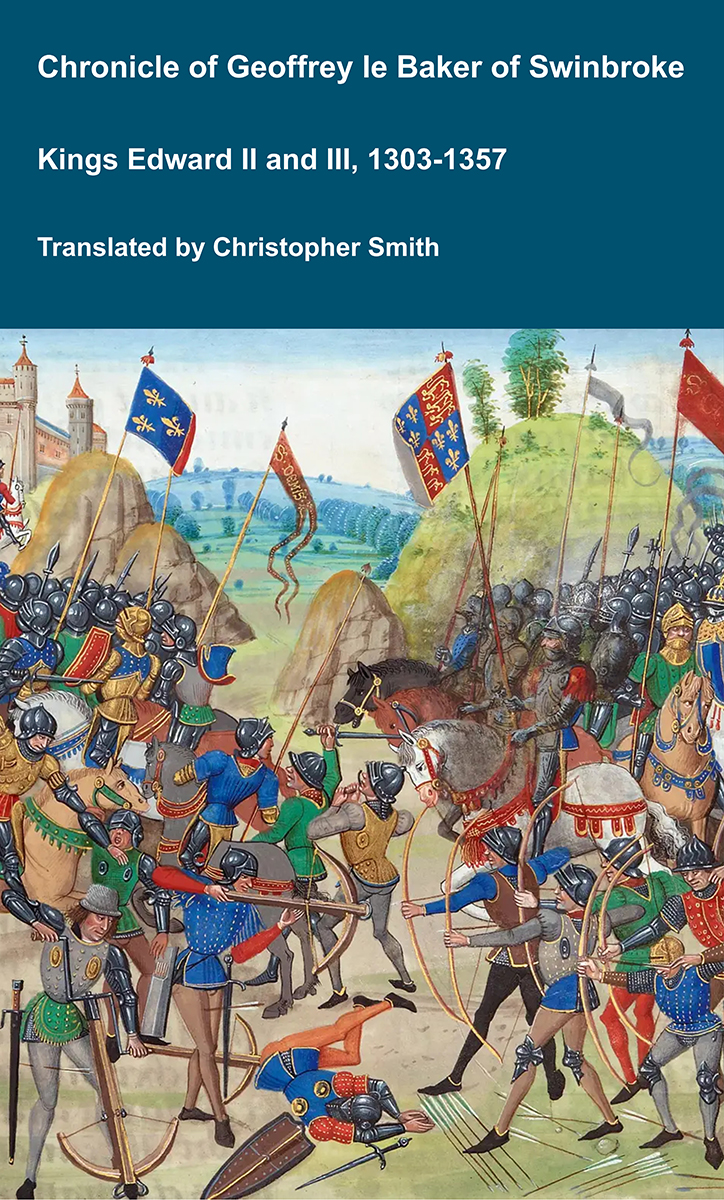
Chronicle of Geoffrey le Baker of Swinbroke
Baker was a secular clerk from Swinbroke, now Swinbrook, an Oxfordshire village two miles east of Burford. His Chronicle describes the events of the period 1303-1356: Gaveston, Bannockburn, Boroughbridge, the murder of King Edward II, the Scottish Wars, Sluys, Crécy, the Black Death, Winchelsea and Poitiers. To quote Herbert Bruce 'it possesses a vigorous and characteristic style, and its value for particular events between 1303 and 1356 has been recognised by its editor and by subsequent writers'. The book provides remarkable detail about the events it describes. Baker's text has been augmented with hundreds of notes, including extracts from other contemporary chronicles, such as the Annales Londonienses, Annales Paulini, Murimuth, Lanercost, Avesbury, Guisborough and Froissart to enrich the reader's understanding. The translation takes as its source the 'Chronicon Galfridi le Baker de Swynebroke' published in 1889, edited by Edward Maunde Thompson.
Available at Amazon in eBook and Paperback format.
Around 1320 Bertrand du Guesclin was born.
Bentleys Miscellany Volume 45. For men-at-arms of valour proved, Pembroke need not search far,
Within the English camp, I trow, a hundred such there are;
But he who holds the foremost place is resolute Croquart1.
Next Gaultier Lallemant stands forth; and Guillemin-le-Gaillard;
Then Daggeworth, nephew to the chief, agile as a pard2;
Helcoq and Isannay come next, and Jennequin Taillard,
Dardaine, Adès, Troussel3, and Rango-le-Couart,
De Gannelon and Helichon, Vitart and Mélipart.
Note 1. Froissart relates that Croquart "had the reputation of being the most expert man-at-arms of the country, was chosen to be one of the Thirty that engaged against a similar number, and was the most active combatant on the side of the English. King John of France made him the offer of knighting him, and marrying him very richly, if he would quit the English party, and promised to give him two thousand livres a year; but Croquart would never listen toit. It chanced one day, as he was riding a young horse, which he had just purchased for three hundred crowns, and was putting him to his full speed, that the horse ran away with him, and in leaping a ditch, stumbled into it, and broke his master's neck. Such was the ond of Croquart." In the Combat of the Thirty, Croquart obtained the prize of valour on the English side.
Note 2. This young champion subsequently won his spurs, and as Sir Nicholas Daggeworth, fought during the Siege of Rennes, in 1357, in single combat with the redoubted Bertrand du Guesclin (age 30). "The terms of the combat," according to Froissart, "were to be three courses with spears, three strokes with battle-axes, and three stabs with daggers. The two knights behaved most valiantly, and parted withont hurting cach other. They were seen with pleasure by both armies."
Note 3. Called John Russel, in the Histoire de Bretagne.
On 4th December 1370 Thomas Grandison 4th Baron Grandison (age 31) was captured by Bertrand Du Guesclin (age 50) and Olivier III de at Le Mans [Map].
On 4th December 1370 the Battle of Pontvallain was a French army under Bertrand du Guesclin (age 50) heavily defeated an English force at Pontvallain which had broken away from an army commanded by Robert Knollys (age 45).
Thomas Grandison 4th Baron Grandison (age 31) commanded.
Philip Courtenay (age 15) and Hugh Despencer (age 32) were captured.
Alan Buxhull (age 47) fought.
On 13th July 1380 Bertrand du Guesclin (age 60) died.
The Deposition of King Richard II. At the departure of winter, when spring hath restored verdure, when many a bush may be observed to blossom in the fields, and the birds sweetly to rejoice, the song of the nightingale is to be heard, that maketh many a lover joyous and gay; (just in that season) five days before the first day of May [i.e. [26th April 1399]], when every one ought to lay aside mourning and sorrow, a knight, whom I heartily loved with a most tender regard, said unto me, " Friend, I lovingly beseech you that you will cheerfully accompany me into England. It is my wish to go thither without delay." "Sir," I replied, "you may command me, nor doubt that I am ready to bend my will to your good pleasure." An hundred times did the knight thank me, saying, "Brother, we must very soon set out, for, be assured, it will be needful for us to make haste." It was in the year one thousand and four hundred, save one, that we quitted Paris, each full of joy, travelling late and early without stopping till we reached London. It came to pass that we took up our lodging there on a Wednesday, at the hour of dinner. There might you behold many a knight taking his departure from the city; for good king Richard had set out with his steward;a he was most anxious to journey day and night;
Note a. Sir Thomas Percy, second son of Henry Percy, by Mary daughter of Henry Earl of Lancaster, and younger brother to Henry first Earl of Northumberland; a statesman and soldier of distinguished ability and reputation, who had spent a very active life in the service of his country. He was at this time upwards of fifty years of age. He had been with the Black Prince in Aquitaine; was his high steward in 1369, and served under him with Chandos, Knolles, Trivet, and others of that school of chivalry.
He was at the skirmish in which Chandos was slain, on the morning of Dec. 31, 1370; assisted at various military operations in that country, and was at the barbarous sacking of Limoges, the last transaction in which the prince was engaged.2 When Sir Baldwin Freville, seneschal of Poitou, went into England, he succeeded him; and a contemporary thus speaks of him in this situation:
Monsr. Thomas Percy li vaillant
Yfuist ove honour moult grant.2
But, during his absence on an expedition, he had the misfortune to lose the town of Poitiers, where he officially resided, to Bertrand du Guesclin; and he was himself soon after taken prisoner by Evan of Wales, in an affair near the castle of Soubise.4 His captivity, however, was not of long duration, the castle of Limosin being given up5 for his ransom in the next year, 47 Ed. III. The prince of Wales and his father, in consideration of his services, granted him, 50 Ed. III. an annuity of an hundred marks out of the exchequer at Caernarvon, and the same sum out of the king's exchequer during his life.
He officiated at the Coronation of Richard the Second;6 and next appears, 2 R. II. as admiral of the northern seas, where he made several prizes.7 As he was passing over into France to the aid of the duke of Britanny, he narrowly escaped suffering shipwreck in the dreadful tempest in which Sir John Arundel and upwards of a thousand others were drowned. Scarcely had the storm ceased, when a Spanish vessel assailed him: he captured it by boarding, after an obstinate resistance, and returned with it into port; then proceeding upon his voyage, carried over his men and horses safely to Brest. He was joint governor of that place with Sir Hugh Calverley.8 About this time he was named one of the commissioners to settle the infractions of a treaty made with the Scots in the former reign. In 3 R. II. he attended the Earl of Buckingham in his expedition into France; and in the next year was employed with the same nobleman and the Earl of Warwick in suppressing the insurrection:9 he was in the retinue of the king when he met the rebels at Mile-end.10 Returning to France,11 he was at the siege of Nantes, and, 5 R. II. was made captain of the castle of Brest, and afterwards of the town, 6 R. II.
He is spoken of, 7 R. II. as being of the king's council; commissioned to act in treaties with Flanders and France, and to guard the East Marches. In 8 and 10 R. II. he was again made admiral; in which capacity he escorted the Duke of Lancaster into Castile, was at the storming of Ribadavia, and other conflicts in Spain: particularly at the barriers of Noya in Galicia he signalized himself by fighting hand to hand with Barrois des Barres, one of the ablest captains of France. Having been afflicted with the distemper that proved fatal to so many of the soldiers, he came home with the army.12 He was, 13 R. II. appointed vice-chamberlain of the royal household,13 and justice of South Wales; and successively obtained grants of two castles in the Principality.
We find him in 16 R. II. at the head of the embassy which brought about the peace with France, where he was much caressed and honoured by the French king: he was then steward of the household. He was retained to serve in the first campaign in Ireland, 18 R. II. The disputes between Richard and the Duke of Gloucester so disgusted him, that he prudently solicited permission to retire to his own estate, and obtained it with some reluctance on the part of the king.
At length, in 21 R. II. he was rewarded with the dignity of Earl of Worcester; though it is singular that the author of the narrative never mentions him by this title. He was also made captain of the town and castle and marches of Calais. His appointment to be admiral of Ireland is dated Jan. 16, 22 R. II. It was preparatory to this second Irish expedition, in which he was to take with him thirty-five men at arms, knights and esquires, and one hundred archers; to every twenty archers one carpenter and one mason.
The text sufficiently describes the part that he took at the close of the reign of Richard, and the beginning of that of his successor. His disaffection to his old master might arise from the banishment of the Earl of Northumberland and his son, at which he was much exasperated.17 When Henry ascended the throne, it was one of his first objects to conciliate and attach so valuable a servant. Accordingly he bestowed many high appointments upon him; made him ambassador to France, governor of Aquitaine, admiral of the fleet, lieutenant in North and South Wales; and retained him as governor to his eldest son. Polidore Vergil is quite at a loss to account for his defection from Bolingbroke, which, he says, no author of any credit has explained; and he ridiculously attributes it to envy. Carte affirms, that he detested Henry as the author of the murder of Richard, and as an usurper of the crown, to the prejudice of the right heir, Edmund Mortimer Earl of March. Whatever might be the real cause of the dispute between Henry IV. and the Percies, each party laid the blame upon the other. When the affair came to an open rupture, Sir Thomas joined his nephew Hotspur, was taken at the battle of Shrewsbury, him in Ireland, where they had put to death many of his faithful friends. Wherefore he would take no rest until he had fully avenged himself upon Macmore, who called himself excellent king and lord of great Ireland, where he hath but little territory of any kind. Upon speedily to send word that he is coming to Milford haven. This place hath a good market, and there we passed ten whole days pleasantly, waiting for the North wind that we might depart. Trumpets and the sound of minstrels might be heard day and night. Men at arms arrived from all quarters. Vessels took in their lading of bread, wine, cows, and calves, salt meat, and plenty of water. Excellent and beautiful horses were put on board. Every one made ready his baggage, and on the eleventh day the king, having taken leave of the ladies, set out gallantly accompanied.
Note 2. Froissart, vol. III. c. 259. IV. c. 9. 21, 28, 31, 39, 41.
Note 3. "Sir Thomas Percy the valiant was there, with very great honor." MS. Life of the Black Prince, by Chandos Herald. Froissart represents him as immediate successor of Sir John Chandos; but this was not the fact.
Note 4. Froiss. IV. c. 41, 42.
Note 5. Walsingham. Ypodigma Neustriæ in Anglica Scripta, Camden, p. 529. Dugdale has rendered Liziniacum by Lymosin: according to Baudraud, Geogr. p. 581, it is Saint Germain Leuroux.
Note 6. Walsing. Hist. Angl. p. 197.
Note 7. Stow, Annales by Howes, p. 280.
Note 8. Walsing, ut supra, p. 232, 235.
Note 9. Id. p. 260, et alibi.
Note 10. Stow, p. 287.
Note 11. Froiss. V. c. 42, 45, 46.
Note 12. Froiss. VIII. c. 3, 45. IX. c. 1, 4.
Note 13. Rymer, VII. p. 677.
John Evelyn's Diary. 12th November 1643. Hence we advanced to Beauvais, another town of good note, and having the first vineyards we had seen. The next day to Beaumont, and the morrow to Paris [Map], having taken our repast at St Denis, two leagues from that great city. St. Denis is considerable only for its stately cathedral, and the dormitory of the French kings, there inhumed as ours at Westminster Abbey. The treasury is esteemed one of the richest in Europe. The church was built by King Dagobert, but since much enlarged, being now 390 feet long, 100 in breadth, and 80 in height, without comprehending the cover: it has also a very high shaft of stone, and the gates are of brass. Here, while the monks conducted us, we were showed the ancient and modern sepulchers of their kings, beginning with the founder to Louis his son, with Charles Martel and Pepin, son and father of Charlemagne. These lie in the choir, and without it are many more: among the rest that of Bertrand du Guesclin, Constable of France; in the chapel of Charles V., all his posterity; and near him the magnificent sepulcher of Francis I., with his children, wars, victories, and triumphs engraven in marble. In the nave of the church lies the catafalque, or hearse, of Louis XIII., Henry II, a noble tomb of Francis II, and Charles IX. Above are bodies of several Saints; below, under a state of black velvet, the late Louis XIII., father of this present monarch. Every one of the ten chapels, or oratories, had some Saints in them; among the rest, one of the Holy Innocents. The treasury is kept in the sacristy above, in which are crosses of massy gold and silver, studded with precious stones, one of gold three feet high, set with sapphires, rubies, and great oriental pearls. Another given by Charles the Great, having a noble amethyst in the middle of it, stones and pearls of inestimable icon. Among the still more valuable relics are, a nail from our Savior's Cross, in a box of gold full of precious stones; a crucifix of the true wood of the Cross, carved by Pope Clement III., enchased in a crystal covered with gold; a box in which is some of the Virgin's hair; some of the linen in which our blessed Savior was wrapped at his nativity; in a huge reliquary, modeled like a church, some of our Savior's blood, hair, clothes, linen with which he wiped the Apostles' feet; with many other equally authentic toys, which the friar who conducted us would have us believe were authentic relics. Among the treasures is the crown of Charlemagne, his seven-foot high sceptre and hand of justice, the agraffe of his royal mantle, beset with diamonds and rubies, his sword, belt, and spurs of gold; the crown of St. Louis, covered with precious stones, among which is one vast ruby, uncut, of inestimable value, weighing 300 carats (under which is set one of the thorns of our blessed Savior's crown), his sword, seal, and hand of justice. The two crowns of Henry IV., his sceptre, hand of justice, and spurs. The two crowns of his son Louis. In the cloak-royal of Anne of Bretagne is a very great and rare ruby. Divers books covered with solid plates of gold, and studded with precious stones. Two vases of beryl, two of agate, whereof one is esteemed for its bigness, color, and embossed carving, the best now to be seen: by a special favour I was permitted to take the measure and dimensions of it; the story is a Bacchanalia and sacrifice to Priapus; a very holy thing truly, and fit for a cloister! It is really antique, and the noblest jewel there. There is also a large gondola of chrysolite, a huge urn of porphyry, another of calcedon, a vase of onyx, the largest I had ever seen of that stone; two of crystal; a morsel of one of the waterpots in which our Savior did his first miracle; the effigies of the Queen of Saba, of Julius, Augustus, Mark Antony, Cleopatra, and others, upon sapphires, topazes, agates, and cornelians: that of the queen of Saba16 has a Moorish face; those of Julius and Nero on agates are rarely colored and cut. A cup in which Solomon was used to drink, and an Apollo on a great amethyst. There lay in a window a mirror of a kind of stone said to have belonged to the poet Virgil. Charlemagne's chessmen, full of Arabic characters. In the press next the door, the brass lantern full of crystals, said to have conducted Judas and his company to apprehend our blessed Savior. A fair unicorn's horn, sent by a king of Persia, about seven feet long. In another press (over which stands the picture in oil of their Orléans Amazon with her sword), the effigies of the late French kings in wax, like ours in Westminster, covered with their robes; with a world of other rarities. PARISHaving rewarded our courteous friar, we took horse for Paris, where we arrived about five in the afternoon. In the way were fair crosses of stone carved with fleur-de-lis at every furlong's end, where they affirm St. Denis rested and laid down his head after martyrdom, carrying it from the place where this monastery is builded. We lay at Paris at the Ville de Venice; where, after I had something refreshed, I went to visit Sir Richard Browne (age 38), his Majesty's Resident with the French king.
Effigy of King Edward III. Enough has been said in this brief way to denote the energy and grandeur of his character as a monarch, and to show what he did in arms for his country. He was equally alive to her commercial interests and to the encouragement of the arts as they were practised in his day. The sun of Edward's glory, however, declined under a cloud. That vanquisher of the invincible, Death, laid the Black Prince low; and the sword of Bertram du Guesclin, Constable of France under Charles V redeemed his country's honour and dominion. Towards the close of Edward's reign, of all the English conquests and possessions in France only Calais remained. The King's character in the decline of life, after the death of Philippa his Queen, who deceased in 1369a, is not exempt from imputation of that frailty which has so often tarnished the silver honours of the aged head. Dame Alice Perers was taken into his highest favour about five years after the above event. She was a woman of exceeding beauty. At a tournament held in Smithheld by the King's command, she rode as "Lady of the Sun" from the Tower of London to Smithfield (the Campus Martius of the City), attended by a procession of knights armed for the jousts, each having his horse led by the bridle by a lady.
Note a. She died at Windsor, on the 15th of August, in the most pious spirit of resignation. Her husband and her youngest son, Thomas of Woodstock, were present at this parting scene, overwhelmed with grief she requested that her debts might be exactly paid, her donations for religious uses fulfilled, and that her body should be buried at Westminster. A sumptuous monument with her effigy was erected for her by her husband in the Abbey there. It is still extant, and is one of those few connected with the English monarchy, which the untimely end of the author of this work prevented him from delineating for his collection.
Archaeologia Volume 20 Section 5. The renowned Bertrand Du Guesclin, a fit competitor with the Prince of Wales for military glory, fought on the side of Don Henry. He was, however, captured by Sir John Chandos, and is reported to have expressed himself satisfied at "being in the hands of the most generous Prince living, and made prisoner by the most renowned Knight in the world."g
Note g. Froissart.
Bourgeois de Valenciennes. At that time the companies in France were so large that it would be marvellous to describe or even imagine. They spread throughout the land as far as Avignon, harrying, ravaging, and grievously troubling the pope, the cardinals, and their territories; for the wars everywhere had come to an end. The greater part of these companies no longer knew how to earn their living, for they had learned to pillage and live off others, and they could not restrain themselves. The wise men of the realm considered that unless some subtle remedy were found, these companies would destroy the kingdom and many neighbouring lands as well. It was therefore decided to send them into Spain to overthrow a king who ruled there, who, as rumor reported, was apostate, exceedingly cruel, and guilty of many evil deeds, and who had been excommunicated by Pope Urban V. Henry the Bastard of Spain, the illegitimate brother of that wicked king, called Don Pedro, was summoned; he was then near Avignon. Likewise the captains of the companies were called, and it was arranged with them that they would go into Spain to wage war against King Don Pedro, in order to obtain the kingdom of Spain for Henry if they could conquer it. These companies were therefore placed at his disposal to aid him. For this purpose, the pope and the King of France made great efforts to secure the release of Sir Bertrand du Guesclin, whom Sir John Chandos held prisoner from the battle of Auray. He was released upon payment of one hundred thousand francs, and Sir Bertrand was appointed supreme captain of all these men-at-arms, who numbered some thirty thousand, after the Lord of Bourbon, who made himself chief of the enterprise in order to avenge his sister, whom King Don Pedro had taken as wife and had caused to die miserably; and she was said to have been a very holy and good lady. With them went princes and knights, among them Sir Wauthier d’Aubrecicourt, Sir Hugh of Calveley, Sir Walter Huet, Sir Matthew de Gournay, Sir Perducas de Labret, and many others. The Lord of Beaujeu, named Anthony, also joined with a great company, as did many knights such as Sir Arnoul d’Audrehem, Marshal of France; Sir the Begue of Villaines; Sir the Begue of Villers; the Lord of Antoing; Sir Allart de Briffeul; Sir John of Neufville; Sir Gauvain de Bailleul; Sir John de Berguettes; the German of Saint-Venant; and many others, who acquitted themselves well, as you shall hear later.
En ce tamps estoient les compaignies sy grandes en France que merveilles seroit à dire, ne à penser, et s'espardoient par le pays toutjusques entour Avinguon, et herrioient, cuvrioient et tournioient moult durement le pappe et les cardinaulx et leurs terres; car les guerres estoient partout faillyes. Sy ne sçavoient la plus grande partye de ces compaignies où gaignier, car ils avoient apris à pillier et à vivre d'avantage: sy ne s'en pooient tenir. Sy s'avisèrent les sages hommes du royalme que, s'en n'y metoit remède par aulcune voye soubtille, qu'ils destruiroyent le royalme et assez des aultres pays marchissans. Sy fut advisé qu'on les envoieroit en Espaigne, pour destruire ung roy qui en estoit seigneur, lequel estoit, sycomme renommoit couroit, renoyës et plain de grant cruaulté et de très-mauvaises œuvres, et estoit excommeniés du pappe Urbain Ve de ce nom. Sy fut mandé Henry le Bastart d'Espaigne, qui estoit frère bastart de ce mauvais roy, qu'on nommoit damp Piètre, lequel Henry estoit autour Avingnon, et pareillement furent mandés les aultres capitaines des compaignies, et fut traittiet par devers eulx qu'ils yroient en Espaigne guerrier ce roy damp Piètre, affin d'obtenir le royaume d'Espaigne, se conquerre le pooient. Sy luy furent chargiés ces compaignies pour luy aidier. Et pour ceste cause misrent le pappe et le roy de France grant paine à la délivrance de monseigneur Ber tran de Claiquin, lequel monseigneur Jehan Chando tenoit prisonnier de le bataille d'Auroy. Sy fut délivrés parmy cent mille frans qu'ils en payèrent, et fut commis monseigneur Bertran capitaine souverain de tous ces gens d'armes, qui bien estoient XXX mille, après monseigneur de Bourbon, qui se faisoit chief de ceste besongne pour contrevengier sa suer que ce roy Piètre avoit eue à femme et qu'il avoit fait morir maisement, et sy estoit la dame moult sainte et bonne femme, sycorame on disoit. Et avoec eulx alèrent des princes, des chevaliers, c'est-assavoir monseigneur Witasse d'Aubrecicourt, monseigneur Hue de Cavrelée, monseigneur Gaultier Huet, monseigneur Mathieu de Gournay, monseigneur Perdieas de Labret et pluseurs aultres ossy. Et se s'y mist le seigneur de Beaugeu, qui s'appelloit Anthoinne, à grant routte, et pluseurs chevaliers, tels que monseigneur Ernoul d'Audrehem, mareschal de France, monseigneur le Besgue de Villaines, monseigneur le Besgue de Villers, le seigneur d'Antoing, monseigneur Allart de Briffeul, monseigneur Jehan de Noefville, monseigneur Gauvain de Bailleul, monseigneur Jehan de Ber guettes, l'Allemant de SaintVenant et moult d'aultres, lesquels exploitèrent assez bien, sycomme vous orez avant.
Bourgeois de Valenciennes. When the King of France learned of the defeat of the battle and of the death of Sir Charles of Blois and his men, he was greatly distressed; and especially at the capture of Sir Bertrand du Guesclin he felt deep displeasure. The king therefore sent his brother, the Duke of Anjou, to the borders of Brittany to support the country and the Duchess of Brittany, wife of Sir Charles of Blois, who was so desolate and distraught that she could scarcely endure it, both because of the death of her lord and because of the loss of her land and territory. The Duke of Anjou was well bound to do this, for he had married the daughter of the said Sir Charles of Blois and of the duchess; and he acquitted himself of this duty as well as he could.
Quant le roy de France sceult la desconâture de la bataille et la mort de monseigneur Charles de Blois et de ses gens, il en fut moult courchiés, et de la prinse monseigneur Bertram de Claiequin par espécial il en eult grant desplaisir. Sy envoia le roy son frère monseigneur le duc d'Ango sur les marches de Bretaingne, pour conforter le pays et la ducesse de Bretaingne, femme à monseigneur Charles de Blois, qui estoit sy désolée et sy desconfortée que plus n'en pooit, tant pour la mort de son seigneur que pour la perte de son pays et de sa terre qu'elle perdoit. Ad ce estoit le dac d'Anjo bien tenu de faire, car il avoit à femme la fille du dit monseigneur Charles de Blois et de ladite madame; sy s'en acquitta moult bien selon son pooir.