

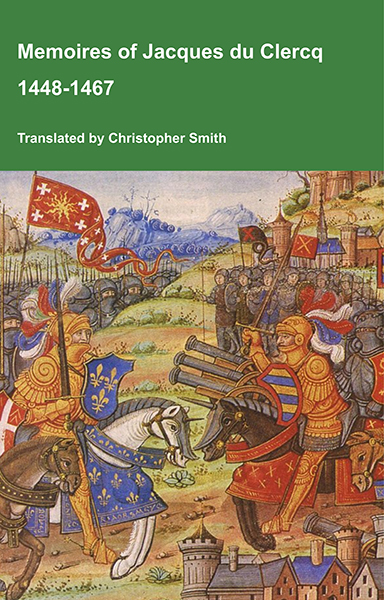
This is a translation of the 'Memoires of Jacques du Clercq', published in 1823 in two volumes, edited by Frederic, Baron de Reissenberg. In his introduction Reissenberg writes: 'Jacques du Clercq tells us that he was born in 1424, and that he was a licentiate in law and a counsellor to Philip the Good, Duke of Burgundy, in the castellany of Douai, Lille, and Orchies. It appears that he established his residence at Arras. In 1446, he married the daughter of Baldwin de la Lacherie, a gentleman who lived in Lille. We read in the fifth book of his Memoirs that his father, also named Jacques du Clercq, had married a lady of the Le Camelin family, from Compiègne. His ancestors, always attached to the counts of Flanders, had constantly served them, whether in their councils or in their armies.' The Memoires cover a period of nineteen years beginning in in 1448, ending in in 1467. It appears that the author had intended to extend the Memoirs beyond that date; no doubt illness or death prevented him from carrying out this plan. As Reissenberg writes the 'merit of this work lies in the simplicity of its narrative, in its tone of good faith, and in a certain air of frankness which naturally wins the reader’s confidence.' Du Clercq ranges from events of national and international importance, including events of the Wars of the Roses in England, to simple, everyday local events such as marriages, robberies, murders, trials and deaths, including that of his own father in Book 5; one of his last entries.
Available at Amazon in eBook and Paperback format.
Aquitaine is in France.
Chronicle of Gregory. 1439. And the same year the Erle of Huntyngdone (age 43) wente unto Gyenne whythe a grete navy. And the same year went Syr Richard Woodevyle (age 54) in to Normandy and Syr Wylliam Peytowe, and many moo othyr, whythe a fayre mayne.
On 21st March 1373 John Devereux 1st Baron Devereux (age 36) was captured during the Battle of Chiset at Chizé at which the English were defeated by the French forces commanded by Bertrand Geusclin (age 53). The battle brought an end to English control in Poitou.
On 19th November 1569 Sébastien de Luxembourg Duke of Penthièvre (age 39) was killed at the Siege of Saint-Jean-d'Angély.
On 31st December 1369 John Chandos (age 49) was killed. Chandos' force retreated towards the bridge across the Vienne at Lussac-les-Châteaux, along the route to Poitiers through Chauvigny. The French, unaware of their presence, had decided to follow the same route to harass any English troops. The adversaries met at the bridge of Lussac. In the battle, Chandos' long coat made him slip on the frost. James de Saint-Martin, a squire in the house of Sir Bagnac (or Guillaume Boitel, according to Paul Hay du Chastelet) struck Chandos with his lance, piercing his face below the eye. Chandos' uncle Edward Twyford, standing over his wounded nephew, repulsed the attackers. One of his squires pierced both legs of James Saint-Martin with his sword; Saint-Martin died three days later at Poitiers. John Chandos was carried on a large shield to Morthemer, the nearest English fortress. He was buried at Les Aubeniaux, Mazerolles where there is a monument.


