

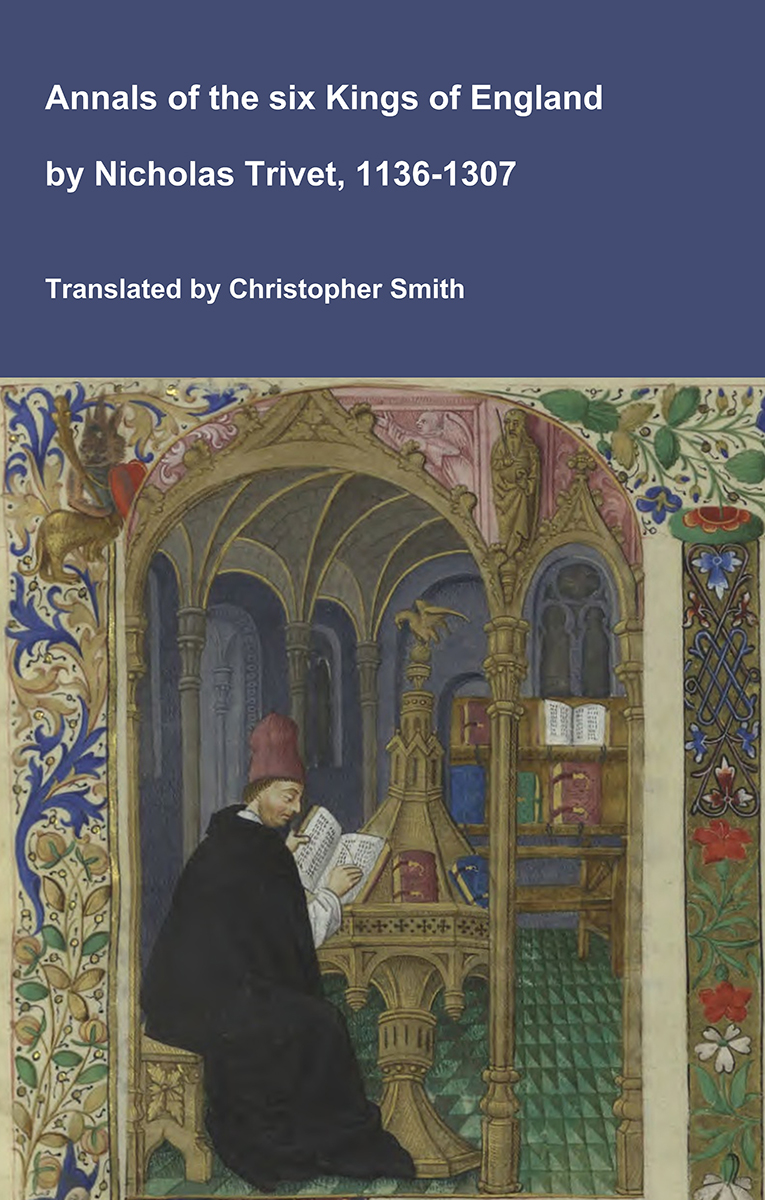
Annals of the six Kings of England by Nicholas Trivet
Translation of the Annals of the Six Kings of England by that traces the rise and rule of the Angevin aka Plantagenet dynasty from the mid-12th to early 14th century. Written by the Dominican scholar Nicholas Trivet, the work offers a vivid account of English history from the reign of King Stephen through to the death of King Edward I, blending political narrative with moral reflection. Covering the reigns of six monarchs—from Stephen to Edward I—the chronicle explores royal authority, rebellion, war, and the shifting balance between crown, church, and nobility. Trivet provides detailed insight into defining moments such as baronial conflicts, Anglo-French rivalry, and the consolidation of royal power under Edward I, whose reign he describes with particular immediacy. The Annals combines careful year-by-year reporting with thoughtful interpretation, presenting history not merely as a sequence of events but as a moral and political lesson. Ideal for readers interested in medieval history, kingship, and the origins of the English state, this chronicle remains a valuable and accessible window into the turbulent world of the Plantagenet kings.
Available at Amazon in eBook and Paperback format.
Boulogne sur Mer is in Picardy.
On 18th September 1060 Godfrey Flanders Lord Bouillon was born to Eustace II Count Boulogne and Ida of Lorraine Countess Boulogne at Boulogne sur Mer. He married Beatrice Mandeville Lady Bouillon and had issue.
On 28th January 1308 King Edward II of England and Isabella of France Queen Consort England were married at Boulogne sur Mer. She the daughter of King Philip IV of France and Joan Blois I Queen Navarre. He the son of King Edward I of England and Eleanor of Castile Queen Consort England.
Murimuth and Avesbury. In the year of our Lord one thousand three hundred and seven [eight], in the second year of Pope Clement V, beginning from the feast of Saint Michael [29th September], Edward aforementioned of Carnarvon, in the first year of his reign, took Isabella, the daughter of King Philip of France, as his wife at Bologna by the sea on the twenty-second day, on Sunday in Quinquagesima, namely the twenty-fifth day of January [1308]. And at Westminster, on the Sunday of Quinquagesima, that is, on the twenty-fifth day of February, both he and the queen were crowned by Henry, bishop of Winchester, by commission of Lord Robert, archbishop of Canterbury. Present at that coronation were Charles, the queen's brother, who afterwards became king of France; the duke of Brittany; Henry, count of Luxemburg, who afterwards became emperor; and Piers de Gaveston, who appeared splendidly, surpassing all others and thereby incurring the envy and hatred of everyone. Also Louis, brother of the king of France, was present there.
Anno Domini millesimo CCCVII, pape Clementis V anno secundo, inchoando a festo sancti Michaelis, Edwardus prædictus de Carnervan, anno regni sui Primo, duxit lsabellam, filiam regis Philippi Franciæ, in uxorem apud Bononiam supra mare XXI, die Dominica in Quinquagesima, scilicet XXV die Februarii, tam ipse quam ipsa regina fuerunt coronati per episcopum Wyntoniensem Henricum, ex commissione domini Roberti archiepiscopi Cantuariensis. Et dicte coronationi interfuerunt Karolus, frater regine, qui postea fuit rex Francie, dux Britanniæ, Henricus comes Luceburgiæ, qui postea fuit imperator, et Petrus de Gavestone, qui nobiliter apparuit omnes transcendens, invidiam et odium omnium incurrebat. Item, Lodowycus, frater regis Francis, fuit ibidem.
Fine Rolls. On 7th February 1308 King Edward II of England and Isabella of France Queen Consort England returned from their wedding in Boulogne sur Mer to Dover, Kent.
7th February 1308. Be it remembered that on Wednesday after the Purification, Edward II, the king, returning from beyond seas, to wit, from Boulogne sur Mer, where he took to wife Isabel, daughter of the king of France, touched at Dover, Kent in his barge about the ninth hour [1500], Hugh le Despenser and the lord of Castellione of Gascony being in his company, and the Queen a little afterward touched there with certain ladies accompanying her, and because the great seal which had been taken with him beyond seas then remained in the keeping of the keeper of the wardrobe who could not arrive on that day, no writ was sealed from the hour of the king's coming until Friday following on which day the bishop of Chichester, chancellor, about the ninth hour [1500] delivered to the king in his chamber in Dover castle the seal used in England during the king's absence, and the king, receiving the same, delivered it to William de Melton, controller of the wardrobe, and forthwith delivered with his own hand to the chancellor the great seal under the seal of J. de Benstede, keeper of the wardrobe, and Master John Painter Fraunceis, in the presence of Thomas, Earl of Lancaster, Peter, Earl of Cornwall, and Hugh le Despenser, William Martyn and William Inge, knights, and Adam de Osgodby, clerk; and the chancellor on that day after lunch in his room (hospicio) in God's House, Dover, sealed writs with the great seal.
Chronicle of Edward Hall [1496-1548]. While the commissioners were thus consulting on the marches of France, the King of England, as you have heard, was arrived at Calais, where he prepared all things necessary for such a journey. And from thence he removed in four battles, near to the town of Boulogne , and there pitched his tents before the town, in a place propitious and convenient and determined to gene a great assault to the town. In the which fortress was such a garrison of warlike soldiers, that valiantly defended the town, and the same so replenished with artillery, and munitions of war, that the loss of the Englishmen assaulting the toun, should be greater damage to the realm of England, then the conquering and gaining of the same should be emolument or profit. Howbeit the King's daily shot, razed and defaced the walls of the said town: but when every man was pressed and ready to give the assault, a sudden rumour rose in the army, that a peace was by the commissioners taken and concluded, which brute as it was pleasant and mellifluous to the Frenchmen, so it was to the English nation bitter, sore and dolorous because they were pressed and ready at all times to set on their enemies, and refused never to attempt any enterprise, which might seem either to be for their laud or profit: they were in great fumes, angry and evil content, railing and murmuring amongst themselves, that the occasion of so glorious a victory to them manifestly offered, was by certain conditions to no man, nor yet to the King commodious or profitable, refused, put by and shamefully slacked: But above all other diverse lords and captains, encouraged with desire of fame and honour, trusting in this journey to have won their spurs, which for to set themselves and their band the more gorgeously forward had mutuate [borrowed], and borrowed diverse and sundry sums of money, and for the repayment of the same, had mortgaged and impignorated [pawned] their lands and possessions, sore grudged and lamented this sudden peace, and return of them unthought of, and spoke largely against the Kinge's doings, saying and affirming, that he as a man fearing and dreading the force and puissance of his enemies, had concluded an inconvenient peace without cause or reason: But the King as a wise man and most prudent prince, to assuage the indignation and pacify the murmur of the people, declared what damage and detriment, what loss and perdition of many noble Captains and strong soldiers must of necessity happen and ensue at the assault of a town, and especially when it is so well fortified with men and munitions, as the town of Boulogne at that present time was: protesting farther, that he might be justly accused and condemned of iniquity and untruth, except he did prefer the safeguard of their lives, before his own wealth, health and advantage.


In July 1544 English forces commenced the Siege of Boulogne at Boulogne sur Mer. John Chichester, William Godolphin, Henry Dudley and Anthony Wingfield fought. Henry Strangeways were killed.
In September 1544 Thomas Cawarden of Bletchingly and Nonsuch was knigted at Boulogne sur Mer during the Siege of Boulogne.
On 17th August 1545 Thomas Poynings 1st Baron Poynings died at Boulogne sur Mer. Baron Poynings extinct.
Henry Machyn's Diary. 22nd May 1551. The xxij day of Maij was bered my lade Mores, wyff of sir Crystoffer Mores knyght, and the M. of [the Ordnance] by kyng Henry the viijth, the wyche he ded of the h .. at Bullayn, and she ded in saynt Peters in Cornhyll ... in saynt Towlles in the Oll' Jury, and ther she ... her first husband, with ij harolds; and she gayff ... men and women vijxx mantylls, fryse gownes, and o[ther] gownes and cotts a iiijxx, and then cam the corse [with banners] of armes borne abowt her, with iiij morners .... dyd pryche the Skott the curett, and a gret dolle and a gret [dinner] as I have sene off fysse and odur thynges.
Note. Funeral of lady Morice. Stowe mentions the interment at St. Peter's Cornhill of sir Christopher Morice, master gunner of England, temp. Henry VIII. His lady appears to have had a previous husband, and, though she lived and died in that parish, was removed to the church of St. Olave's to be laid by his side. There was a family connection between sir Christopher Morice and Arthur Plantagenet, viscount Lisle: see Miss Wood's Letters of Royal and Illustrious Ladies, ii. 76, iii. 35. "The Skott the curate" was of St. Peter's in Cornhill; see p. 13, and note hereafter.
John Evelyn's Diary. 12th November 1643. After dinner we took horse with the Messagere, hoping to have arrived at Boulogne that night; but there fell so great a snow, accompanied with hail, rain, and sudden darkness, that we had much ado to gain the next village; and in this passage, being to cross a valley by a causeway, and a bridge built over a small river, the rain that had fallen making it an impetuous stream for near a quarter of a mile, my horse slipping had almost been the occasion of my perishing. We none of us went to bed; for the soldiers in those parts leaving little in the villages, we had enough to do to get ourselves dry, by morning, between the fire and the fresh straw. The next day early, we arrived at Boulogne.

Samuel Pepys' Diary. 7th September 1666. So to Creed's lodging, near the New Exchange, and there find him laid down upon a bed; the house all unfurnished, there being fears of the fire's coming to them. There borrowed a shirt of him, and washed. To Sir W. Coventry, at St. James's, who lay without curtains, having removed all his goods; as the King at White Hall, and every body had done, and was doing. He hopes we shall have no publique distractions upon this fire, which is what every body fears, because of the talke of the French having a hand in it. And it is a proper time for discontents; but all men's minds are full of care to protect themselves, and save their goods: the militia is in armes every where. Our fleetes, he tells me, have been in sight one of another, and most unhappily by fowle weather were parted, to our great losse, as in reason they do conclude; the Dutch being come out only to make a shew, and please their people; but in very bad condition as to stores; victuals, and men. They are at Bullen; and our fleete come to St. Ellen's. We have got nothing, but have lost one ship, but he knows not what.
Samuel Pepys' Diary. 8th September 1666. Up and with Sir W. Batten and Sir W. Pen by water to White Hall and they to St. James's. I stopped with Sir G. Carteret to desire him to go with us, and to enquire after money. But the first he cannot do, and the other as little, or says, "when we can get any, or what shall we do for it?" He, it seems, is employed in the correspondence between the City and the King every day, in settling of things. I find him full of trouble, to think how things will go. I left him, and to St. James's, where we met first at Sir W. Coventry's chamber, and there did what business we can, without any books. Our discourse, as every thing else, was confused. The fleete is at Portsmouth, Hampshire, there staying a wind to carry them to the Downes, or towards Bullen, where they say the Dutch fleete is gone, and stays. We concluded upon private meetings for a while, not having any money to satisfy any people that may come to us. I bought two eeles upon the Thames, cost me six shillings.

On 19th September 1769 Robert MacCarty died at Boulogne sur Mer.
In 1777 George Colebrooke 2nd Baronet moved to Boulogne sur Mer where he relied on an East India Company pension.
On 23rd January 1824 Brooke Boothby 6th Baronet died at Boulogne sur Mer. William Boothby 7th Baronet succeeded 7th Baronet Boothby of Broadlow Ash in Derbyshire. On 3rd February 1824 he was buried at St Oswald's Church, Ashbourne.
On 23rd January 1841 Benoît Constant Coquelin was born at Boulogne sur Mer.

On 28th July 1915 Lieutenant Theodore William Warlow died from wounds received whilst trying to take a wounded man into safety on 19th July 1915. He was buried at Boulogne Eastern Cemetery. Memorial in All Saints Church, Ledsham.
Lieutenant Theodore William Warlow: Around 1895 he was born to Reverend George Edmund Warlow and Ellen Constance Eiloart. Before 19th July 1915 he was appointed Lieutenant of the 6th Battalion King's Own Yorkshire Light Infantry.
In 1546 Ralph Ellerker died. He was buried at St Mary's Church, Boulogne.