

The Deeds of the Dukes of Normandy
The Gesta Normannorum Ducum [The Deeds of the Dukes of Normandy] is a landmark medieval chronicle tracing the rise and fall of the Norman dynasty from its early roots through the pivotal events surrounding the Norman Conquest of England. Originally penned in Latin by the monk William of Jumièges shortly before 1060 and later expanded at the behest of William the Conqueror, the work chronicles the deeds, politics, battles, and leadership of the Norman dukes, especially William’s own claim to the English throne. The narrative combines earlier historical sources with firsthand information and oral testimony to present an authoritative account of Normandy’s transformation from a Viking settlement into one of medieval Europe’s most powerful realms. William’s history emphasizes the legitimacy, military prowess, and governance of the Norman line, framing their expansion, including the conquest of England, as both divinely sanctioned and noble in purpose. Later chroniclers such as Orderic Vitalis and Robert of Torigni continued the history, extending the coverage into the 12th century, providing broader context on ducal rule and its impact. Today this classic work remains a foundational source for understanding Norman identity, medieval statesmanship, and the historical forces that reshaped England and Western Europe between 800AD and 1100AD.
Available at Amazon in eBook and Paperback format.
Gavrinis Burial Mound is in Gavrinis, Prehistoric Brittany Burials.
Archaeologia Volume V32 1847 Appendix. Further Notice of the Monument at Gaur' Innis [Map] in Britanny.
29th April, 1847 - William Bromet, Esq. M.D. F.S.A. in another Letter to the Director, communicated a further explanation of the Monument at Gaur' Innis in Britanny — together with some rubbings from those of its sculptured stones which he considered the most interesting. A remarkable peculiarity in this Monument consists in the interior faces of several of its component stones being engraved with concentric curves resembling eels or serpents: and others with those instruments called celts, or small ovals pointed at one end, but so placed as to give an appearance of their being hieroglyphic characters. There are only two other instances of the kind on record, viz. one formerly near Gavr' Innis called the "Pierres Plates" now destroyed, and the one at New Grange, in Ireland. Another distinctive feature is a sort of staple made in the stone at about three feet from the ground, by three holes communicating with each other at the back, and indicating much friction by the internal smoothness, as if by the action of ropes passed through.
Llewellynn Jewitt 1870. Another of the more remarkable structures of the Channel Islands is that of Gavr Innis [Map], in the Morbihan, Brittany. The tumulus is about thirty feet high, and its circumference at the base about 300 feet. The cromlech is entered from the south end (fig. 55), fig. 56 being the opening on the north, and consists of 14 upright stones on the east side, 13 on the west, and 2 on the north, supporting, in all, 10 capstones. In general features it bears a strong resemblance to those at New Grange, Dowth, and other places. The remarkable feature of this chambered tumulus is that the stones composing the passage are for the most part sculptured in lines and patterns, which have been described as very similar to the patterns tattooed on their faces and bodies by the New Zealanders. Examples of these will be seen on the accompanying engravings, which exhibit some of the more marked and distinct of the patterns noticed and copied by Mr. Lukis, in his examination of this mound, and described by him in the journal of the British Archaeological Association, to the Council of which I am indebted for these illustrations.


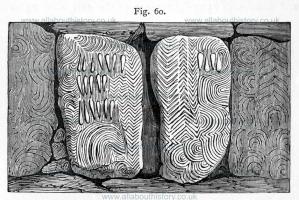
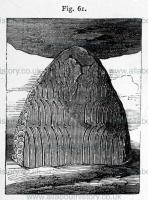
Dorset Natural History and Archaeological Society Volume 15 1894 Pages 52-54. The most interesting and perfect is that of Gavr Innis [Map] in the Morbihan. The mound is 197 feet in diameter and 30 feet high; it is entered by a passage 44 feet long, leading into a chamber nine feet by eight feet. Both passage and chamber are lined by stones curiously sculptured with wavy, circular, and spiral lines. Probably the largest known of these dolmens is the one on the banks of the Boyne at New Grange, near Drogheda. It has a diameter of 316 feet, a height of 70 feet, with a passage 63 feet long, and many of the stones are there also sculptured with spirals and zig-zags. The gigantic monument is further distinguished by a circle of stones standing round it. These circles of stones were generally used to indicate places of interment, and consisted of large stones in the Stone Age, as we see at the AVinterbourne circle and also at that near Abbotsbury, not far from the Gorwell dolmen. These circles were smaller at a later date, as I found in opening a barrow on Mr. John Mayo's farm near Upwey (No. 4 on my plan of these barrows). This circle was hid under the turf and enclosed two Kistvaens with cremations in urns.