

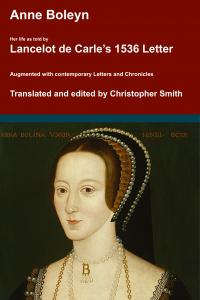
Anne Boleyn. Her Life as told by Lancelot de Carle's 1536 Letter.
In 1536, two weeks after the execution of Anne Boleyn, her brother George and four others, Lancelot du Carle, wrote an extraordinary letter that described Anne's life, and her trial and execution, to which he was a witness. This book presents a new translation of that letter, with additional material from other contemporary sources such as Letters, Hall's and Wriothesley's Chronicles, the pamphlets of Wynkyn the Worde, the Memorial of George Constantyne, the Portuguese Letter and the Baga de Secrets, all of which are provided in Appendices.
Available at Amazon in eBook and Paperback format.
1161-1174 Becket is in 12th Century Events.
In 1159 Hamon Fitzrobert was killed during the Siege of Toulouse 1159.
On 23rd May 1162 Archbishop Thomas Becket [aged 42] was elected Archbishop of Canterbury by King Henry "Curtmantle" II of England [aged 29].
On 2nd June 1162 Archbishop Thomas Becket [aged 42] was ordained.
On 3rd June 1162 Archbishop Thomas Becket [aged 42] was consecrated Archbishop of Canterbury by Bishop Henry of Blois [aged 64].
Annals of Six Kings of England by Nicholas Trivet [1258-1328]. Thomas [of Becket], chancellor of the king of the English, became archbishop of Canterbury [on 23rd May 1162]; and after he had assumed the office of shepherd, he became devoted to God beyond human expectation. For when he was consecrated he secretly put on a hairshirt and also wore garments of haircloth reaching to his knees; and, concealing a monastic habit beneath the respectable clothing of a cleric, he strove to please God through the practice of every virtue. In the month of July, in greater Brittany, namely at Rethel, it rained blood, and from the streams of a certain spring there blood flowed out.
Thomas, regis Anglorum cancellarius, fit archiepiscopus Cantuariensis; qui, post susceptum Canterbury. pastoris officium, super humanam æstimationem factus est DEO devotus. Consecratus enim cilicium clam induit, femoralibus etiam usus est usque ad poplites cilicinis; et, sub vestis clericalis honestate habitum celans monachalem, DEO studuit omnium virtutum exercitio placere. Mense Julio in Britannia majori, scilicet in Retello, pluit sanguis, et de rivis cujusdam fontis ibidem effluxit.
On 10th February 1163 Baldwin III King Jerusalem [aged 33] died at Beirut. His brother Almaric [aged 27] succeeded I King Jerusalem.
On 25th January 1164 King Henry "Curtmantle" II of England [aged 30] attempted to constrain ecclesiastical privileges by the sixteen articles of the Constitutions of Clarendon. Archbishop Thomas Becket [aged 44] rejected the articles.
In October 1164 Archbishop Thomas Becket [aged 44] was put on trial in Northampton [Map] by King Henry "Curtmantle" II of England [aged 31] on a charge of contempt. After a week of discussion Becket fled to Flanders with Bishop John of Salisbury [aged 46].
In 26th December 1164 King Henry "Curtmantle" II of England [aged 31] banished all of Thomas Becket's [aged 45] relatives from England. Around 400 people were affected. They were stripped of their possessions and shipped to Flanders.
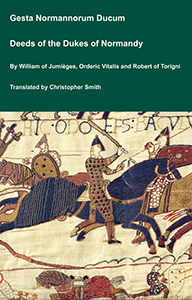
The Deeds of the Dukes of Normandy
The Gesta Normannorum Ducum [The Deeds of the Dukes of Normandy] is a landmark medieval chronicle tracing the rise and fall of the Norman dynasty from its early roots through the pivotal events surrounding the Norman Conquest of England. Originally penned in Latin by the monk William of Jumièges shortly before 1060 and later expanded at the behest of William the Conqueror, the work chronicles the deeds, politics, battles, and leadership of the Norman dukes, especially William’s own claim to the English throne. The narrative combines earlier historical sources with firsthand information and oral testimony to present an authoritative account of Normandy’s transformation from a Viking settlement into one of medieval Europe’s most powerful realms. William’s history emphasizes the legitimacy, military prowess, and governance of the Norman line, framing their expansion, including the conquest of England, as both divinely sanctioned and noble in purpose. Later chroniclers such as Orderic Vitalis and Robert of Torigni continued the history, extending the coverage into the 12th century, providing broader context on ducal rule and its impact. Today this classic work remains a foundational source for understanding Norman identity, medieval statesmanship, and the historical forces that reshaped England and Western Europe between 800AD and 1100AD.
Available at Amazon in eBook and Paperback format.
On 22nd August 1165 King Philip II of France was born to Louis VII King of the Franks [aged 45] and Adèle Queen of the Franks in Gonesse. The much longed for heir to the crown of France. He was also given the name 'Dieu Donné' meaning God Given. He a great x 2 grandson of King William "Conqueror" I of England. He married (1) 28th April 1180 his half third cousin Isabelle Flanders Queen Consort France, daughter of Baldwin Flanders V Count Hainaut and Margaret Metz Countess Hainaut and Flanders, and had issue (2) 15th August 1193 Ingeborg Estridsen Queen Consort France (3) 7th May 1196 Agnes of Merania Queen Consort France, daughter of Berthold Andechs Duke Merania and Agnes Rochlitz, and had issue.
Around August 1165 King Henry "Curtmantle" II of England [aged 32] commenced his affair with Rosamund Clifford [aged 29] daughter of Walter Clifford 1st Baron Clifford [aged 52]. The location is reported by some sources to have been, possibly, Walter's house, or Rosamund's town, of Bredelais the location of which is unknown.

On 9th December 1165 King Malcolm IV of Scotland [aged 24] died. His brother William [aged 22] succeeded I King Scotland, 6th Earl Huntingdon.
On 24th December 1165 King William I of Scotland [aged 22] was crowned I King Scotland.
On 24th December 1166 King John of England was born to King Henry "Curtmantle" II of England [aged 33] and Eleanor of Aquitaine Queen Consort Franks and England [aged 44]. He was given the nickname "Sans Terre", aka "without land", or in English "Lackland" as a consequence of his being the youngest son. He married (1) 29th August 1189 his half second cousin Isabella Fitzrobert 3rd Countess Gloucester and Essex, daughter of William Fitzrobert 2nd Earl Gloucester and Hawise Beaumont Countess Gloucester (2) 24th August 1200 his fourth cousin once removed Isabella of Angoulême Queen Consort England, daughter of Aymer Angoulême I Count Angoulême and Alice Courtenay Countess Angoulême, and had issue.
On 27th March 1168 Eleanor of Aquitaine Queen Consort Franks and England [aged 46] and her party were ambushed by brothers Guy I King Jerusalem [aged 18] and Geoffrey Lusignan [aged 18].
Patrick of Salisbury 1st Earl Salisbury [aged 46] was killed. He was buried at the Church of St Hilary, Poitiers. His son William [aged 18] succeeded 2nd Earl Salisbury.
William Marshal 1st Earl Pembroke [aged 22] held off the enemy, was wounded and captured whilst Eleanor escaped. Eleanor subsequently paid his ransom.
On 13th July 1174 a small army commanded by Ranulf Glanville [aged 62] with Hugh de Kevelioc Gernon 5th Earl Chester [aged 27] surprised King William [aged 31] army in a dawn raid known as the Battle of Alnwick near Alnwick, Northumberland [Map]. King William was captured and imprisoned initially in Newcastle upon Tyne Castle. He was subsequently moved to the more remote, and secure, Falaise Castle [Map].
Images of Histories by Ralph Diceto. [13th July 1174] Who could doubt that he has now made the martyr favorable to himself, and that we may safely proclaim his sin transferred? For on the very Saturday on which he was begging the martyr to grant him pardon, frequently kissing the martyr's tomb, God delivered William, king of the Scots [aged 31], into his hands, imprisoned under guard at Richmond, so that the prophetic word might be fulfilled: 'A bridle will be given into his jaws, which will be fashioned in the Armorican gulf2,' calling the castle of Richmond the 'Armorican gulf'—a castle held by Armorican lords both now and in ancient times by hereditary right. Also, on that very Saturday, the king's son, having had the ships he had gathered for crossing to England scattered, began to return to France.
Quin martyrem sibi placabilem jam reddiderit, quin peccatum ejus translatum possimus prædicare securi, non est qui dubitet. Nam ipsa die sabbati, qua indulgentiam sibi dari postulabat a martyre, sepulchrum martyris frequenter deosculans, tradidit Deus Willelmum regem Scottorum in manus suas, custodis mancipatum apud Richemunt, ut adimpleretur illud propheticum "Dabitur maxillis ejus freenum quod in Armorico sinu fabricabitur," sinum vocans Armoricum castellum de Richemunt, ab Armoricis principibus et nunc et ab antiquis temporibus hæreditario jure possessum. Ipsa etiam die sabbati rex filius, navibus quas congregaverat ad transfretandum in Angliam dissipatis, cœpit redire in Galliam.
Note 1. Part of Merlin's prophecyl Geoffrey of Monmouth.
In December 1174 King William I of Scotland [aged 31], imprisoned at Falaise Castle [Map], signed the Treaty of Falaise by which he agreed King Henry "Curtmantle" II of England [aged 41] was overlord of Scotland. He also agreed to marry a bride of Henry's choosing. He married Ermengarde Beaumont Sarthe Queen Consort Scotland [aged 4] twelve years later.
Simon Senlis 7th Earl Huntingdon 6th Earl of Northampton [aged 36] succeeded 7th Earl Huntingdon, 6th Earl of Northampton.
On 5th September 1186 King William I of Scotland [aged 43] and Ermengarde Beaumont Sarthe Queen Consort Scotland [aged 16] were married at Woodstock Palace, Oxfordshire [Map] by Archbishop Baldwin of Forde [aged 61]. She by marriage Queen Consort Scotland at Woodstock Palace, Oxfordshire [Map]. His bride had been chosen by King Henry "Curtmantle" II of England [aged 53] as part of the Treaty of Falaise. William received Edinburgh Castle [Map] as a wedding gift from King Henry "Curtmantle" II of England. The difference in their ages was 27 years. He the son of Henry Dunkeld 3rd Earl Huntingdon 1st Earl of Northumbria and Ada Warenne Countess Huntingdon and Northumbria. They were half fourth cousins. She a great granddaughter of King Henry I "Beauclerc" England.