

The Deeds of the Dukes of Normandy
The Gesta Normannorum Ducum [The Deeds of the Dukes of Normandy] is a landmark medieval chronicle tracing the rise and fall of the Norman dynasty from its early roots through the pivotal events surrounding the Norman Conquest of England. Originally penned in Latin by the monk William of Jumièges shortly before 1060 and later expanded at the behest of William the Conqueror, the work chronicles the deeds, politics, battles, and leadership of the Norman dukes, especially William’s own claim to the English throne. The narrative combines earlier historical sources with firsthand information and oral testimony to present an authoritative account of Normandy’s transformation from a Viking settlement into one of medieval Europe’s most powerful realms. William’s history emphasizes the legitimacy, military prowess, and governance of the Norman line, framing their expansion, including the conquest of England, as both divinely sanctioned and noble in purpose. Later chroniclers such as Orderic Vitalis and Robert of Torigni continued the history, extending the coverage into the 12th century, providing broader context on ducal rule and its impact. Today this classic work remains a foundational source for understanding Norman identity, medieval statesmanship, and the historical forces that reshaped England and Western Europe between 800AD and 1100AD.
Available at Amazon in eBook and Paperback format.
1380-1389 Peasants' Revolt and Lords Appellant is in 14th Century Events.
On 20th January 1382 King Richard II of England [aged 15] and Anne of Bohemia Queen Consort England [aged 15] were married at Westminster Abbey [Map] by Bishop Robert Braybrooke. She by marriage Queen Consort England. She the daughter of Charles IV King Bohemia Holy Roman Emperor Luxemburg and Elizabeth Pomerania Holy Roman Empress Luxemburg [aged 35]. He the son of Edward "Black Prince" and Joan "Fair Maid of Kent" Princess Wales [aged 53]. They were fourth cousins. He a grandson of King Edward III of England.
It was the first royal wedding that including a Royal Procession from the Tower of London [Map] to Westminster Abbey [Map].
Arranged by Michael de la Pole 1st Earl Suffolk [aged 52] the marriage not popular since it brought no dowry and little prospect of increased trade since Bohemia not a primary English trade partner.


On 22nd January 1382 Anne of Bohemia Queen Consort England [aged 15] was crowned Queen Consort England by Archbishop William Courtenay [aged 40] (even though he had not received his Pall from the Pope.)
On 12th April 1385 a double wedding of the Burgundian Court was celebrated with two sets of siblings:
John "Fearless" Valois Duke Burgundy [aged 13] and Margaret Wittelsbach Duchess Burgundy [aged 22] were married. She the daughter of Albert Wittelsbach I Duke Lower Bavaria [aged 48] and Margaret of Silesia Duchesa Lowwer Bavaria [aged 43]. He the son of Philip "Bold" Valois II Duke Burgundy [aged 43] and Margaret Dampierre Duchess Burgundy [aged 37]. They were third cousins. He a great x 3 grandson of King Edward I of England. She a great x 5 granddaughter of King Henry "Curtmantle" II of England.
William Wittelsbach IV Count Holland VI Count Hainaut V Count Zeeland [aged 20] and Margaret Valois Countess Holland [aged 10] were married. She the daughter of Philip "Bold" Valois II Duke Burgundy and Margaret Dampierre Duchess Burgundy. He the son of Albert Wittelsbach I Duke Lower Bavaria and Margaret of Silesia Duchesa Lowwer Bavaria. They were third cousins. He a great x 5 grandson of King Henry "Curtmantle" II of England. She a great x 3 granddaughter of King Edward I of England.
On 6th August 1385 Edmund of Langley 1st Duke of York [aged 44] was created 1st Duke York by King Richard II of England [aged 18]. Isabella of Castile Duchess York [aged 30] by marriage Duchess York.
Thomas of Woodstock 1st Duke of Gloucester [aged 30] was created 1st Duke Albemarle, and around the same time, 1st Duke Gloucester. Eleanor Bohun Duchess Gloucester [aged 19] by marriage Duchess Albemarle and Duchess Gloucester.
Around September 1386 the Wonderful Parliament sought to reform the administration of King Richard II of England [aged 19]. Michael de la Pole 1st Earl Suffolk [aged 56] was impeached for his failures in France.
Chronicle of Adam of Usk [~1352-1430]. September 1386. Owing to the many ill-starred crises of king Richard's [aged 19] reign, which were caused by his youth, a solemn parliament was holden at Westminster, wherein twelve of the chief men of the land were advanced, by full provision of parliament, to the government of the king and the kingdom, in order to bridle the wantonness and extravagance of his servants and flatterers, and, in short, to reform the business of the realm; but alas! only to lead to the weary deeds which are hereinafter written1.
Note 1. The actual number of the commissioners appointed by the Wonderful Parliament of 1386 was eleven, or fourteen if the three principal officers of state be included. The eleven were: the archbishops of Canterbury [aged 44] and York [aged 45], the dukes of York [aged 45] and Gloucester [aged 31], the bishops of Winchester [aged 66] and Exeter, the abbot of Waltham, the earl of Arundel, John de Cobham, Richard le Scrope, and John Devereux. Thomas Arundel [aged 33], bishop of Ely, had replaced Michael de la Pole [aged 25], earl of Suffolk, as chancellor; John Gilbert, bishop of Hereford, was treasurer; and John de Waltham, keeper of the privy seal. It will be remembered that John of Gaunt [aged 46] was at this time in Spain, as a reason for his name not appearing on the commission.
On 6th January 1387 Peter IV King Aragon [aged 67] died. His son John [aged 36] succeeded I King Aragon.
On 11th March 1387 the Battle of Castagnaro was fought between the army of Verona, commanded by Giovanni Ordelaffi and Ostasio II da Polenta, and the victorious Paduans commanded by John Hawkwood [aged 67] [Giovanni Acuto i.e. John the Astute] and Francesco Novello da Carrara [aged 27], son of Francesco I, lord of Padua [aged 61]. Castagnaro is hailed as Sir John Hawkwood's greatest victory. Following a Fabian-like strategy, Hawkwood goaded the Veronese into attacking him on a field of his own choosing, by laying waste to the Veronese lands nearby.
On 6th August 1388 Ulrich of Württemberg was killed at the Battle of Döffingen.
In September 1389 the Scrope vs Grosvenor Case was brought to the Court of Chivalry. Up to that time two families, Scrope and Grosvenor, had been using the armorial  Scrope Arms: Azure, a bend or.
Several hundred witnesses were called including John of Gaunt 1st Duke Lancaster [aged 49], Geoffrey Chaucer [aged 46] and John Savile of Shelley and Golcar [aged 64].
On 3rd September 1386 Owain ap Gruffudd "Glyndŵr" Mathrafal Prince Powys [aged 27] gave evidence at the Church of John the Baptist, Chester [Map].
The Court decided in favour of Scrope.
Neither party was happy with the decision so King Richard II [aged 22] was called upon to give his personal verdict.
On 27th May 1390 he confirmed that Grosvenor could not bear the undifferenced arms.
As a consequence of the case the Grosvenor has for many years used the name Bendor for horses and nicknames.
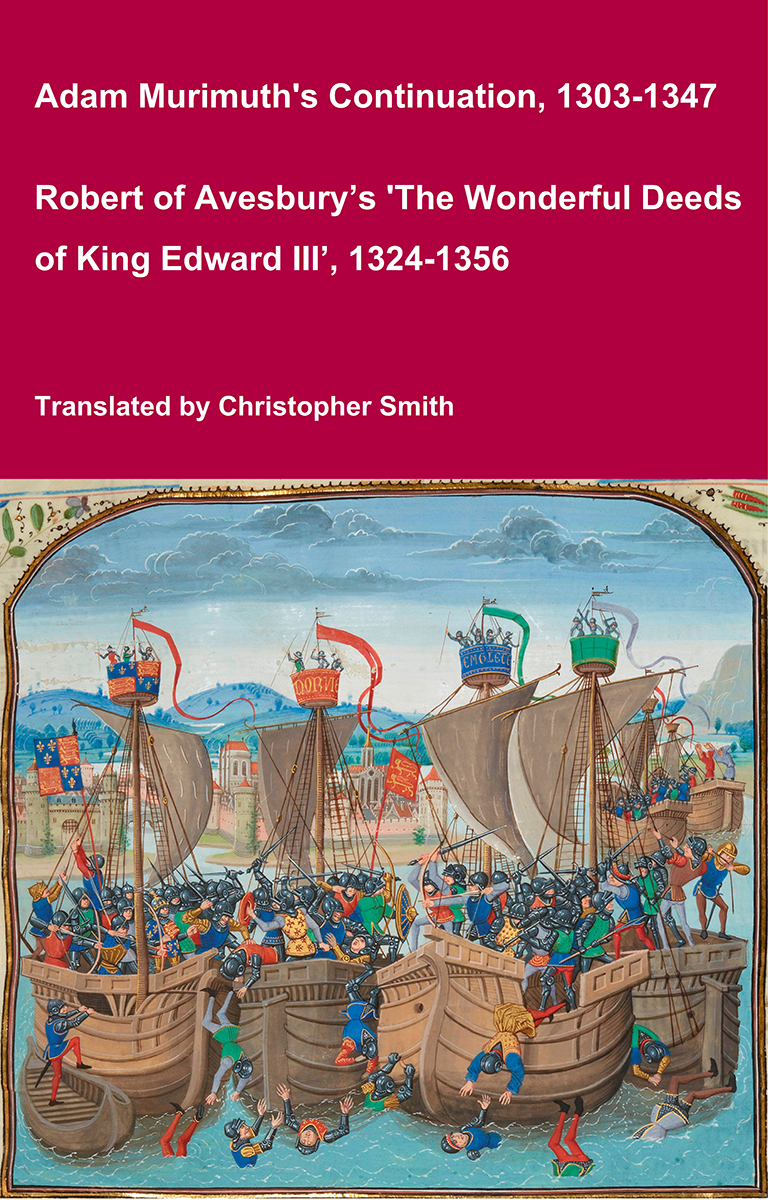
Adam Murimuth's Continuation and Robert of Avesbury’s 'The Wonderful Deeds of King Edward III'
This volume brings together two of the most important contemporary chronicles for the reign of Edward III and the opening phases of the Hundred Years’ War. Written in Latin by English clerical observers, these texts provide a vivid and authoritative window into the political, diplomatic, and military history of fourteenth-century England and its continental ambitions. Adam Murimuth Continuatio's Chronicarum continues an earlier chronicle into the mid-fourteenth century, offering concise but valuable notices on royal policy, foreign relations, and ecclesiastical affairs. Its annalistic structure makes it especially useful for establishing chronology and tracing the development of events year by year. Complementing it, Robert of Avesbury’s De gestis mirabilibus regis Edwardi tertii is a rich documentary chronicle preserving letters, treaties, and official records alongside narrative passages. It is an indispensable source for understanding Edward III’s claim to the French crown, the conduct of war, and the mechanisms of medieval diplomacy. Together, these works offer scholars, students, and enthusiasts a reliable and unembellished account of a transformative period in English and European history. Essential for anyone interested in medieval chronicles, the Hundred Years’ War, or the reign of Edward III.
Available at Amazon in eBook and Paperback format.
In December 1389 King Richard II of England [aged 22] held his Christmas Court at Woodstock Palace, Oxfordshire [Map].
On 30th December 1389 John Hastings 3rd Earl Pembroke [aged 17] was killed in a tournament during the Christmas Court at Woodstock Palace, Oxfordshire [Map]. Earl Pembroke and Baron Manny, Baron Abergavenny Feudal Creation extinct. He was struck in the groin by the lance of Sir John Des.
John Hastings 6th Baron Hastings [aged 61] de jure 6th Baron Hastings. His claim was contested by Reginald Grey 3rd Baron Grey Ruthyn [aged 27] who was the son of Elizabeth Hastings Baroness Grey Ruthyn daughter of John Hastings 13th Baron Abergavenny 1st Baron Hastings his case being that he was of the full blood whereas John Hastings 6th Baron Hastings was of the half-blood ie Reginald Grey 3rd Baron Grey Ruthyn, like John Hastings 3rd Earl Pembroke, was descended from John Hastings 13th Baron Abergavenny 1st Baron Hastings and Isabel Valence Baroness Bergavenny Baroness Hastings, whereas John Hastings 6th Baron Hastings was descended from John Hastings 13th Baron Abergavenny 1st Baron Hastings and Isabel Despencer Baroness Hastings and Bergavenny.