

Abbot John Whethamstede’s Chronicle of the Abbey of St Albans
Abbot John Whethamstede's Register aka Chronicle of his second term at the Abbey of St Albans, 1451-1461, is a remarkable text that describes his first-hand experience of the beginning of the Wars of the Roses including the First and Second Battles of St Albans, 1455 and 1461, respectively, their cause, and their consequences, not least on the Abbey itself. His text also includes Loveday, Blore Heath, Northampton, the Act of Accord, Wakefield, and Towton, and ends with the Coronation of King Edward IV. In addition to the events of the Wars of the Roses, Abbot John, or his scribes who wrote the Chronicle, include details in the life of the Abbey such as charters, letters, land exchanges, visits by legates, and disputes, which provide a rich insight into the day-to-day life of the Abbey, and the challenges faced by its Abbot.
Available at Amazon in eBook and Paperback format.
1540-1543 Catherine Howard and Cromwell's Execution is in 16th Century Events.
On 28th July 1540 Henry VIII [aged 49] and Catherine Howard [aged 17] were married at Oatlands Palace [Map] by Bishop of London Edmund Bonner [aged 40]. She by marriage Queen Consort England. The difference in their ages was 31 years. He the son of King Henry VII of England and Ireland and Elizabeth York Queen Consort England. They were fifth cousin once removed.
Catherine Carey [aged 16] and Eleanor Paston Countess Rutland [aged 45] were appointed Lady in Waiting to Queen Catherine Howard of England.
The date of the marriage derived from the Baga de Secrets Pouch XIII.


Spanish Chronicle Chapter 35. [28th July 1540] Some were of the Duke's opinion, and some thought that the King might find a lady to his liking in his own country; so when they had had their say, the King continued, "Gentlemen, I have seen the lady I wish to take;" and they all held their peace to know whom he would mention. "You know Katharine Howard," he said; "she is the one I have chosen." Then they replied, "If your Majesty so wills it we shall be content; what pleases your Majesty pleases us." The King announced his desire to be married the next day, and sent for the Bishop of London to come and marry him.
So the next day they were married with great state, and very grand rejoicings were held.1
Note 1. Little or no public rejoicings were held on this occasion according to the English Chronicles.
Chronicle of Edward Hall [1496-1548]. The eight day of August [8th August 1540], was the Lady Catherine Howard [aged 17], niece to the duke of Norfolk [aged 67], and daughter to the Lord Edmund Howard, showed openly as Queen at Hampton Court [Map], which dignity she enjoyed not long, as after you shall hear.
Wriothesley's Chronicle [1508-1562]. This yeare, the eight daie of Awgust [1540], being Sondaie, the King [aged 49] was maried to [Note. The marriage was made public] Katherin Hawarde [aged 17], daughter of the late Edmond Hawarda deceased, and brother to the Duke of Norfolke [aged 67]b, at his manner of Hampton Court [Map], and that dale she dined in her great chamber under the cloath of estate, and was their proclaymed Queene of Englande.
Note a. By Joyce, daughter of Sir Richard Culpepper, knt. She was also cousin to Anne Boleyn, but of very different character and persuasion, being a zealous partisan of the Church of Rome, and wholly under the guidance of her bigoted uncle the Duke of Norfolk.
Note b. Lord Edmund Howard was son of Thomas second Duke of Norfolk, and brother to Thomas third Duke.
Chronicle of Edward Hall [1496-1548]. 30th July 1540. The thirtieth day of July, were drawn on hurdles out of the Tower to Smithfield, Robert Barnes Doctor in Divinity, Thomas Garard, and William Jerome Bachelors in Divinity, Powell, Fetherston, and Abell. The first three were drawn to the stake, there before set up, and were burned: and the latter three drawn to the gallows, likewise there set up, and were hanged, beheaded, and quartered. Here you must note, that the first three, were men that professed the Gospel of Jesus Christ, and were preachers thereof. But wherefore they were now thus cruelly executed, I know not, although I have searched to know the truth. But this I find in their attainder, for you must understand, that after they had Preached at Saint Mary Spittle, as before I have declared, Barnes for learning his lesson no better was committed to the schoolhouse before prepared, which was the Tower, where he was kept, and never called to examination, till his rod that he should be beaten withall, was made, which was a sharp and great fire in Smithfield and for company sake, was sent to the schoolhouse with him, the afore named Caret, and Jerome, which drunk all of one cup. And as I said before, thus much I find in their attainder, that they were detestable and abominable heretics, and that they had taught many heresies, the number whereof was to great in the attainder to be recited, so that there is not one alleged, which I have often wondered at, that their heresies were so many, and not one there alleged, as special cause of their death. And indeed at their death, they asked the Sheriffs, wherefore they were condemned, who answered, they could not tell. But if I may say the truth, most men said it was for preaching against the Doctrine of Stephen Gardiner [aged 57] Bishop of Winchester, who chiefly procured this their death, God and he knows, but great pity it was, that such learned men should so be cast away, without examination, neither knowing what was laid to their charge, nor never called to answer.
The last three which were Powell, Fetherston, and Abell, were put to death for treason, and in their attainder, is special mention made of their offences, which was for the denying of the King's Supremacy, and affirming that his marriage with the Lady Katherine was good. These with other were the treasons, that they were attainted of, and suffered death for.
Chronicle of Greyfriars. 30th July 1540. And the 30th day of the same monyth was Doctor Barnes, Jerome and Garrard drawn from the Tower into Smithfield, and there burned for their herisies. And that same day also was drawn from the Tower with them Doctor Powell with two other priests1, and there was a gallows set up at St Bartholemews Gate, and there were hanged, headed, and quartered that same day, and their quarters set about the city.
Note 1. Abell, Powell, and Featherstone. Their religious tenets were directly opposed to those of the victims of the preceding day; but they were equally offensive to king Henry in denying his supremacy.
Wriothesley's Chronicle [1508-1562]. 30th July 1540. This yeare, the thirtith daie of Julie, 1540,g were drawen from the Tower of London into Smythfield theise persons follwinge, that is to saie: Doctor Barnes,h Richard Fetherston, William Jerome, Vicar of Stepney, Doctor Edward Powell, Thomas Jerrard, Parson of Honi Lane, and Thomas Abell,a priestes, of which three of them, that is to say, Barnes, Jherome, and Garrarde, were brent for heresie,b condemned by the whole bodie of the Perliament,c and Fetherston, Powell, and Abell were hanged, their bowells brenned, headed and quartered, in the said place of Smythfield, for treason against the Kinges Majestie,d and condemned of the same by the whole Perliament.
Note g. The King's councils being at this time directed by Norfolk and Gardiner, the law of the Six Articles was enforced with rigour against the Protestants.
Note h. Robert Barnes, D.D. who had been the cause of Lambert's execution. He had drawn upon himself the resentment of Bishop Gardiner by his sermon at Paul's Cross, in which he had bitterlj inreighed against that prelate as a bigoted Roman Catholic.
Note a. Thomas Abley in Fuller's Church History.
Note b. A stranger, standing by, did wonder, as well he might, of what religion the King was, his sword cutting on both sides, Protestants being burnt for heretics, and Papists hanged for traitors.— Fuller's Church History, p. 285.
Note c. They were condemned by a bill of attainder in parliament, without trial.
Note d. For denying the King's supremacy, and affirming his marriage with Queen Katharine to be good, of the which argument Dr. Powell wrote a book, printed in quarto, and I'have seen it. — Stow.
In 1541, probably around St George's Day, 23rd April 1541, King Henry VIII of England and Ireland [aged 49] created four new Knights of the Garter:
306th. Edward Seymour 1st Duke of Somerset [aged 41].
307th. Henry Howard Earl of Surrey [aged 25].
308th. John Gage [aged 61].
309th. Anthony Wingfield [aged 54].


Chronicle of Edward Hall [1496-1548]. [28th June 1541]. In this season was arraigned and condemned three gentlemen, called Mantell, Roydon, and Frowdes, and were hanged at Saint Thomas of Wateringes [Map]. Likewise was Thomas Fiennes [aged 26] Lord Dacres of the South, arraigned before the Lord Audley of Walden [aged 53], then Chancellor of England, and that day High Steward of the same at Westminster, and there before the said Lord Chancellor and his Peers, he confessed the inditement, and so had judgement to be hanged.
And so the twenty and nine day of June , being Saint Peter's day at afternoon, he was led on foot, between the two Sheriffs of London, from the Tower through the city to Tyburn [Map], where he was strangled, as common murderers are, and his body buried in the Church of Saint Sepulchres. The cause of the death of this noble man, and the other gentlemen, was a murder of a simple man and an unlawful assembly made in Sussex. Great moan was made for them all, but most especially for Mantell, who was as witty, and toward a gentleman, as any was in the realm, and a man able to have done good service.


Letters and Papers Foreign and Domestic Henry VIII 1541. That afternoon [Chapus appears here to have the wrong day; other sources say 29th June 1541 i.e. St Peter's Day] two gentlemen were hung [the other being either John Mantell, John Frowds, George Roidon, Thomas Isleie, and two yeomen Richard Middleton and John Goldwell], one of whom had an income of over 12,000 ducats a year, and was the handsomest and best bred man in England, only 25 years old and married to a niece of the Duke of Norfolk [aged 68]. He was sentenced for having belonged to a set of eight rakish youths, one of whom had killed a poor old man in an unpremeditated fray. For the same cause lord Dacres [aged 26] also, son1 of the Duke of Norfolk's sister, and cousin of this Queen [aged 18], 23 years old and possessing a property of about 5,000 ducats a year, was hung from the most ignominious gibbet, and for greater shame dragged through the streets to the place of execution, to the great pity of many people, and even of his very judges, who wept when they sentenced him, and in a body asked his pardon of the King. But the thing which astonished people most was, that, the same day lord Dacres was hung, another young man [aged 28], son of the Treasurer of the Royal household [aged 56], who was one of those present at the old man's death, was freely pardoned, though he had been already tried for some like misdemeanour.
At the same time in the North, Sir John Neville [deceased] and about 60 more, among whom at least 25 were ecclesiastics, were executed for the conspiracy of which Chapuys wrote some time ago. Has just heard of the arrival of a Polish gentleman with eight or ten servants. Will endeavour to discover who he is and what he comes for. London, 2 July 1541. Original at Vienna.
Note 1. Thomas Fiennes 9th Baron Dacre Gilsland, Lord Dacre, was the grandson of Anne Bourchier Baroness Dacre of Gilsland who was the maternal half-sister of Thomas Howard 3rd Duke of Norfolk; Anne and Thomas' mother was Elizabeth Tilney Countess of Surrey.
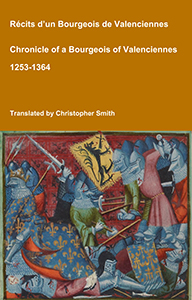
Chronicle of a Bourgeois of Valenciennes
Récits d’un bourgeois de Valenciennes aka The Chronicle of a Bourgeois of Valenciennes is a vivid 14th-century vernacular chronicle written by an anonymous urban chronicler from Valenciennes in the County of Hainaut. It survives in a manuscript that describes local and regional history from about 1253 to 1366, blending chronology, narrative episodes, and eyewitness-style accounts of political, military, and social events in medieval France, Flanders, and the Low Countries. The work begins with a chronological framework of events affecting Valenciennes and its region under rulers such as King Philip VI of France and the shifting allegiances of local nobility. It includes accounts of conflicts, sieges, diplomatic manoeuvres, and the impact of broader struggles like the Hundred Years’ War on urban life in Hainaut. Written from the perspective of a burgher (bourgeois) rather than a monastery or royal court, the chronicle offers a rare lay viewpoint on high politics and warfare, reflecting how merchants, townspeople, and civic institutions experienced the turbulence of the 13th and 14th centuries. Its narrative style combines straightforward reporting of events with moral and civic observations, making it a valuable source for readers interested in medieval urban society, regional politics, and the lived experience of war and governance in pre-modern Europe.
Available at Amazon in eBook and Paperback format.
Chronicle of Greyfriars. 29th June 1541. And the 29th of the same monyth was Lord Dacres of the South [aged 26] led with the sheriffs of London unto Tyborne at after-none, and there hanged for the new acte that was made, and browte home agayne in the carte unto St Sepulchres and ther buried.
Note. Lord Dacre was hung for a murder committed in Sussex, as were his three companions named in the next paragraph.
Wriothesley's Chronicle [1508-1562]. 29th June 1541. The 29th daie of June, being Sainct Peeters daie, at 11 of the clocke in the afternoune, the sherives were at the Towre of London to have had the Lord Dacres [aged 26] to execution on the gallowes at Towre Hill, and, as the prisonner should have come out of the Tower, the Controwler of my Lord Chauncelors howse, called Mr. Heyre, came and commanded, in the Kinges name, to stay the execution till tow of the clocke in the afternoune, which caused the people to hope that the King would pardon him; nevertheles at three of the clocke in the afternoune the said Lord Dacres was had from the Tower to Tiburne [Map], led betwene the sherives of London on foote till he came to the place of execution, where he was hanged till he was dead, and then ymediatlie he was cutt downe and laid in the cart, and had from thence to Sainct Sepulchers church by Newgate, and their buried.
On 29th June 1541 Thomas Fiennes 9th Baron Dacre Gilsland [aged 26] was hanged at Tyburn [Map]. He was buried at St Sepulchre without Newgate Church. Baron Dacre Gilsland, Baron Multon of Gilsland forfeit. His son Gregory [aged 2] would be restored to the title in 1558.
Note. Hall's Chronicle says strangled.
On 24th November 1542 Thomas Wharton 1st Baron Wharton [aged 47] commanded the English forces at Battle of Solway Moss at Solway Moss, Cumberland [Map]. John Thynne [aged 27] fought. Of the Scottish army Malcolm Fleming 3rd Lord Fleming [aged 48], Gilbert Kennedy 3rd Earl Cassilis [aged 27] and Laurence Oliphant 3rd Lord Oliphant fought.
William Graham 3rd Earl Menteith [aged 42] was captured. He was ransomed in 1453.
William Cunningham 4th Earl Glencairn [aged 49] was captured and committed to the custody of Thomas Howard 3rd Duke of Norfolk [aged 69]. He was released on payment of a ransom of a thousand pounds and subscribing by his own hand to support Henry VIII's [aged 51] project of a marriage between the young King Edward VI of England and Ireland [aged 5] and the Mary Queen of Scots.
Malcolm Fleming 3rd Lord Fleming was captured.


In 1544 Thomas Wharton 1st Baron Wharton [aged 49] was created 1st Baron Wharton for his success at the Battle of Solway Moss. Eleanor Stapleton Baroness Wharton by marriage Baroness Wharton.
On 14th December 1542 King James V of Scotland [aged 30] died at Falkland Palace [Map]. His daughter Mary succeeded I Queen Scotland. She was six days old.

