

Abbot John Whethamstede’s Chronicle of the Abbey of St Albans
Abbot John Whethamstede's Register aka Chronicle of his second term at the Abbey of St Albans, 1451-1461, is a remarkable text that describes his first-hand experience of the beginning of the Wars of the Roses including the First and Second Battles of St Albans, 1455 and 1461, respectively, their cause, and their consequences, not least on the Abbey itself. His text also includes Loveday, Blore Heath, Northampton, the Act of Accord, Wakefield, and Towton, and ends with the Coronation of King Edward IV. In addition to the events of the Wars of the Roses, Abbot John, or his scribes who wrote the Chronicle, include details in the life of the Abbey such as charters, letters, land exchanges, visits by legates, and disputes, which provide a rich insight into the day-to-day life of the Abbey, and the challenges faced by its Abbot.
Available at Amazon in eBook and Paperback format.
1696 Plot to Assassinate King William III is in 1685-1699 Glorious Revolution.
In April 1696 John Friend and William Parkyns [aged 47] were executed for taking part in a plot to assassinate King William III.
A TRUE ACCOUNT OF THE DYING BEHAVIOUR OF AMBROSE ROOKWOOD [aged 31], CHARLES CRANBURNE, AND MAJOR LOWICK, WHO WERE EXECUTED AT TYBURN FOR HIGH TREASON, ON WEDNESDAY, APRIL 29 [1696]. WITH MR. CRANBURN'S SPEECH AT THE PLACE OF EXECUTION.
About 11 this Morning, the three Prisoners were put together in a Sledge, and being come to the place of Execution, went out of the Sledge into the Cart; Major Lowick first, who turning round to all the Spectators, who were numerous, desired them all to pray for him. Then he and Mr. Rookwood kneeled down together on one side of the Cart, and Cranburne on the other, and prayed about a quarter of an hour, or more; Cranburne had first done, and the Executioner coming to fix the Halter, in opening his Bosom, took out a Paper, which the Executioner delivered to the Sheriff; but Cranburn coming forward, desir'd it again, and having receiv'd it, he spoke to this effect, sometimes reading.
I am come here to Dye, and shall shortly appear before the Dreadful Tribunal of God the Searcher of all Hearts. I confess my self a great Sinner, and that I have mispent my Youth, but hope for Mercy in and through the Blood of my Saviour Jesus Christ.
Gentlemen, I advise you all to take warning by me, and do not mispend your time, but learn to be truly Religious, for he that is truly Religious, will be Loyal to his lawful King,
&c. or words to that effect. Then he said, that for his Loyalty to his Lawful King he came there to Die, and acknowledged the late King James to be his Rightful King, and hoped he would be restored to his Throne in Gods due time.
As to the Assassination, said he, of the Prince of Orange, I confess I came to the Knowledge thereof from Mr. Chernock between 10 and 11 a Clock on the 22th of February;
here the Sherriff spoke to him, and some Discourse passed, which was not so loud as before; Then he went on again, and said as before, that he came to the Knowledge thereof between 10 and 11 the 22th. of February, and that between 11 and 12 the whole Design was over, or words to that effect, and this he repeated several times, as if he would have created a Belief thereof in the Auditory: As for his Religion, he said he was Baptised and Educated, and now Dyed an unworthy Member of the Church of England, that what he had Learned from that Church, was truly to serve God, and to be Loyal to his King: Mr. Sheriff asked whether that Religion had taught him to Murder Kings, or to that effect; which he did not positively answer, but seemed to evade. And soon after Kneeling down he pray'd for King James, Queen Mary his Consort, Katharine the Queen Dowager, his Royal Highness the Prince of Wales (to give you his own words) and then re-delivered his Paper to Mr. Sheriff. He seemed very composed and little concerned, Prayed several times, and kept his Countenance to the last; he wished their Blood might be the last that should be shed, and that the Nation might never come under a Foreign Power. He said an Aspersion had been cast upon him, as if he had behaved himself Irreverently on some occasion, which he disowned, and appealed to some persons, whom he said very well knew the contrary.
The two others were all this time on their Knees, and then rising up Major Lowick, who appeared very composed and penitent, address'd him to the Sheriffs, and delivered them a Paper. He protested he dyed in Charity with all the World, and begg'd, that all who should happen to suffer any thing on his account, would forgive him; he said, he had liv'd, and now dyed a Roman Catholick; he had a little Book in his hand, out of which he prayed, and often kiss't a Crucifix in it, and gave it to Mr. Rookwood, who did the like: He gave the Book away to one of the Spectators, and sometime after called for it again; and he and Rookwood having kiss't the Crucifix, he restor'd it again.
Mr. Rookwood semed the most dejected, scarce said any thing, but prayed heartily, he delivered a Paper to the Sheriff and wept much. Major Lowick also Wept. After they were Tyed up and had prayed some time, the Executioner asked them for a Sign, Mr Cranburn desired Major Lowick to give a Sign, which he declining, Mr. Cranburn said we will give no Sign, Draw away when you please.
They all gave Money to the Executioner.
London, Printed for R. Green. 1696.
On 28th January 1697 John Fenwick 3rd Baronet [aged 52] was beheaded. He was buried at St Martin in the Fields Church [Map]. Baronet Fenwick of Fenwick in Northumberland extinct. He was the last person to be executed under an Act of Attainder.
Robert Burdett 3rd Baronet [aged 57] had spoken against the attainder in Parliament.
John Evelyn's Diary. 26th February 1696. There was now a conspiracy of about thirty knights, gentlemen, captains, many of them Irish and English Papists, and Nonjurors or Jacobites (so called), to murder King William [aged 45] on the first opportunity of his going either from Kensington, or to hunting, or to the chapel; and upon signal of fire to be given from Dover Cliff to Calais [Map], an invasion was designed. In order to it there was a great army in readiness, men-of-war and transports, to join a general insurrection here, the Duke of Berwick [aged 25] having secretly come to London to head them, King James [aged 62] attending at Calais with the French army. It was discovered by some of their own party. £1,000 reward was offered to whoever could apprehend any of the thirty named. Most of those who were engaged in it, were taken and secured. The Parliament, city, and all the nation, congratulate the discovery; and votes and resolutions were passed that, if King William should ever be assassinated, it should be revenged on the Papists and party through the nation; an Act of Association drawing up to empower the Parliament to sit on any such accident, till the Crown should be disposed of according to the late settlement at the Revolution. All Papists, in the meantime, to be banished ten miles from London. This put the nation into an incredible disturbance and general animosity against the French King and King James. The militia of the nation was raised, several regiments were sent for out of Flanders, and all things put in a posture to encounter a descent. This was so timed by the enemy, that while we were already much discontented by the greatness of the taxes, and corruption of the money, etc., we had like to have had very few men-of-war near our coasts; but so it pleased God that Admiral Rooke [aged 46] wanting a wind to pursue his voyage to the Straits, that squadron, with others at Portsmouth, Hampshire [Map] and other places, were still in the Channel, and were soon brought up to join with the rest of the ships which could be got together, so that there is hope this plot may be broken. I look on it as a very great deliverance and prevention by the providence of God. Though many did formerly pity King James's condition, this design of assassination and bringing over a French army, alienated many o£ his friends, and was likely to produce a more perfect establishment of King William.


John Evelyn's Diary. 8th March 1696. Divers of the conspirators tried and condemned. Vesuvius [Map] breaking out, terrified Naples. Three [Note. Robert Charnock, Edward King, and Thomas Keys] of the unhappy wretches, whereof one was a priest, were executed for intending to assassinate the King; they acknowledged their intention, but acquitted King James of inciting them to it, and died very penitent. Divers more in danger, and some very considerable persons.
On 18th March 1696 Robert Charnock [aged 33] was hanged for his involvement in the 1696 Plot to Assassinate King William III.
John Evelyn's Diary. 10th April 1696. The quarters of Sir William Perkins [deceased] and Sir John Friend, lately executed on the plot, with Perkins's head, were set up at Temple Bar, a dismal sight, which many pitied. I think there never was such at Temple Bar till now, except once in the time of King Charles II, namely, of Sir Thomas Armstrong.
John Evelyn's Diary. 19th April 1696. Great offense taken at the three ministers who absolved Sir William Perkins [deceased] and Friend at Tyburn [Map]. One of them (Snatt) was a son of my old schoolmaster. This produced much altercation as to the canonicalness of the action.
John Evelyn's Diary. 28th April 1696. The Venetian Ambassador made a stately entry with fifty footmen, many on horseback, four rich coaches, and a numerous train of gallants. More executions this week of the assassins. Oates [aged 46] dedicated a most villainous, reviling book against King James [aged 62], which he presumed to present to King William [aged 45], who could not but abhor it, speaking so infamously and untruly of his late beloved Queen's own father.


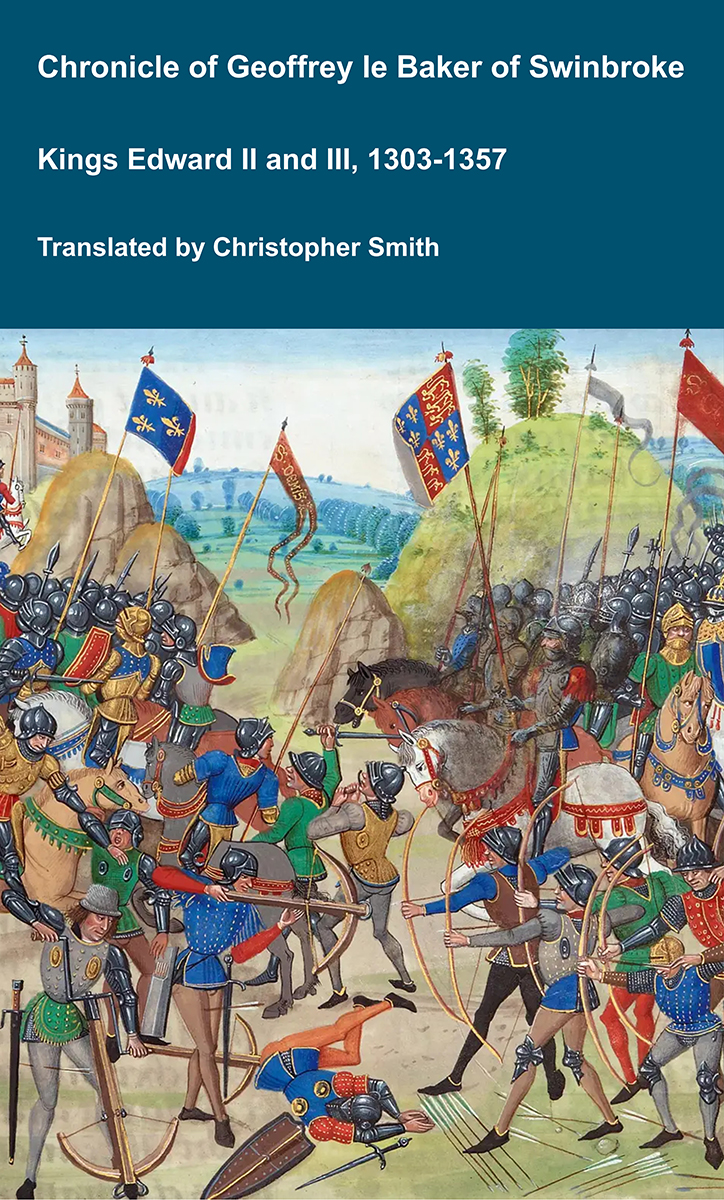
Chronicle of Geoffrey le Baker of Swinbroke
Baker was a secular clerk from Swinbroke, now Swinbrook, an Oxfordshire village two miles east of Burford. His Chronicle describes the events of the period 1303-1356: Gaveston, Bannockburn, Boroughbridge, the murder of King Edward II, the Scottish Wars, Sluys, Crécy, the Black Death, Winchelsea and Poitiers. To quote Herbert Bruce 'it possesses a vigorous and characteristic style, and its value for particular events between 1303 and 1356 has been recognised by its editor and by subsequent writers'. The book provides remarkable detail about the events it describes. Baker's text has been augmented with hundreds of notes, including extracts from other contemporary chronicles, such as the Annales Londonienses, Annales Paulini, Murimuth, Lanercost, Avesbury, Guisborough and Froissart to enrich the reader's understanding. The translation takes as its source the 'Chronicon Galfridi le Baker de Swynebroke' published in 1889, edited by Edward Maunde Thompson.
Available at Amazon in eBook and Paperback format.
On 25th November 1696 Michael Biddulph 2nd Baronet [aged 42] and Richard Dowdeswell of Pull Court, Bushley, Worcestershire [aged 43] voted for the attainder of John Fenwick 3rd Baronet [aged 51].
John Evelyn's Diary. 17th January 1697. The severe frost and weather relented, but again froze with snow. Conspiracies continue against King William. Sir John Fenwick [aged 52] was beheaded.
John Evelyn's Diary. 13th May 1696. I went to London to meet my son [aged 41], newly come from Ireland, indisposed. Money still continuing exceedingly scarce, so that none was paid or received, but all was on trust, the mint not supplying for common necessities. The Association with an oath required of all lawyers and officers, on pain of Praemunire, whereby men were obliged to renounce King James as no rightful king, and to revenge King William's death, if happening by assassination. This to be taken by all the Counsel by a day limited, so that the Courts of Chancery and King's Bench hardly heard any cause in Easter Term, so many crowded to take the oath. This was censured as a very entangling contrivance of the Parliament in expectation, that many in high office would lay down, and others surrender. Many gentlemen taken up on suspicion of the late plot, were now discharged out of prison.