

Abbot John Whethamstede’s Chronicle of the Abbey of St Albans
Abbot John Whethamstede's Register aka Chronicle of his second term at the Abbey of St Albans, 1451-1461, is a remarkable text that describes his first-hand experience of the beginning of the Wars of the Roses including the First and Second Battles of St Albans, 1455 and 1461, respectively, their cause, and their consequences, not least on the Abbey itself. His text also includes Loveday, Blore Heath, Northampton, the Act of Accord, Wakefield, and Towton, and ends with the Coronation of King Edward IV. In addition to the events of the Wars of the Roses, Abbot John, or his scribes who wrote the Chronicle, include details in the life of the Abbey such as charters, letters, land exchanges, visits by legates, and disputes, which provide a rich insight into the day-to-day life of the Abbey, and the challenges faced by its Abbot.
Available at Amazon in eBook and Paperback format.
Death of Antony and Cleopatra is in 1st Century BC Events.
On 10th August 30BC Cleopatra VII Philopator 69BC 30BC [aged 39] committed suicide.
On 1st August 30BC Mark Antony 83BC 30BC [aged 53] stabbed himself with his sword in the mistaken belief that Cleopatra had already done so. When he found out that Cleopatra was still alive, his friends brought him to Cleopatra's monument in which she was hiding, and he died in her arms.
Cassius Dio Roman History Book 51 Chapter 15. 1st August 30BC. 4. Antony, having hoped, killed himself. Cleopatra, insatiable in her desires for Aphrodite (love) and wealth, driven by great ambition for honor and fame and by bold contempt, acquired the throne of Egypt through love and hoped to obtain that of Rome through it. But she failed in this, and she lost the former as well. She conquered two of the greatest Roman men for herself, but through the third, she destroyed herself.
4. ἐλπίσας αὐτὸς ἑαυτὸν ἀπέκτεινε. Κλεοπάτρα δὲ ἄπληστος μὲν Ἀφροδίτης ἄπληστος δὲ χρημάτων γενομένη, καὶ πολλῇ μὲν φιλοτιμίᾳ φιλοδόξῳ πολλῇ δὲ καὶ περιφρονήσει θρασείᾳ χρησαμένη, τήν τε βασιλείαν τὴν τῶν Αἰγυπτίων ὑπ᾽ ἔρωτος ἐκτήσατο, καὶ τὴν τῶν Ῥωμαίων λήψεσθαι δι᾽ αὐτοῦ ἐλπίσασα ταύτης τε ἐσφάλη καὶ ἐκείνην προσαπώλεσε, δύο τε ἀνδρῶν Ῥωμαίων τῶν καθ᾽ ἑαυτὴν μεγίστων κατεκράτησε, καὶ διὰ τὸν τρίτον ἑαυτὴν κατεχρήσατο.
Cassius Dio Roman History Book 51 Chapter 13. 10th August 30BC. 5. She [Cleopatra VII Philopator 69BC 30BC [aged 39]] gave orders to Epaphroditus, so that under the pretext of taking him away, she could have something else cleared from her path, and thus she attended to the task. After putting on her most splendid clothing, arranging herself in the most becoming manner, and assuming her entire royal appearance, she died.
5. Ἐπαφροδίτῳ σεσημασμένον, ὅπως προφάσει τῆς ἀποκομιδῆς αὐτοῦ ὡς καὶ ἄλλο τι ἔχοντος ἐκποδών οἱ γένηται, δοῦσα ἔργου εἴχετο. τήν τε γὰρ ἐσθῆτα τὴν περικαλλεστάτην ἐνδῦσα, καὶ ἑαυτὴν εὐπρεπέστατα εὐθετήσασα, τό τε σχῆμα τὸ βασιλικὸν πᾶν ἀναλαβοῦσα, ἀπέθανε.
Cassius Dio Roman History Book 51 Chapter 14. 10th August 30BC. 1. And no one knows clearly by what means she [Cleopatra VII Philopator 69BC 30BC [aged 39]] was destroyed: for only small punctures were found around her arm: some say that an asp was brought to her in a water jar or even in some flowers.
1. καὶ τὸ μὲν σαφὲς οὐδεὶς οἶδεν ᾧ τρόπῳ διεφθάρη: κεντήματα γὰρ λεπτὰ περὶ τὸν βραχίονα αὐτῆς μόνα εὑρέθη: λέγουσι δὲ οἱ μὲν ὅτι ἀσπίδα ἐν ὑδρίᾳ ἢ καὶ ἐν ἄνθεσί τισιν ἐσκομισθεῖσάν οἱ.
On 23rd August 30BC Marcus Antonius aka Antyllus 47BC 30BC [aged 17] was beheaded following the suicide of his father Mark Antony 83BC 30BC [deceased] and stepmother Cleopatra VII Philopator 69BC 30BC [deceased].
On 29th August 30BC Ptolemy XV Ceasar aka Caesarion 47BC 30BC [aged 17] died.
Cassius Dio Roman History Book 51 Chapter 15. 29th August 30BC. 6. And he [Ptolemy XV Ceasar aka Caesarion 47BC 30BC [aged 17]] was captured and killed on the way. Cleopatra [aged 10] (the daughter of Antony [deceased] and Cleopatra [deceased]) was married to Juba, the son of Juba. For Caesar, having raised him in Italy and having campaigned with him, gave her and the paternal kingdom to him, and he also granted Alexander and Ptolemy to them.
6. τε ἐν τῇ ὁδῷ καὶ διεφθάρη. ἥ τε Κλεοπάτρα Ἰούβᾳ τῷ τοῦ Ἰούβου παιδὶ συνῴκησε: τούτῳ γὰρ ὁ Καῖσαρ τραφέντι τε ἐν τῇ Ἰταλίᾳ καὶ συστρατευσαμένῳ οἱ ταύτην τε καὶ τὴν βασιλείαν τὴν πατρῴαν ἔδωκε, καὶ αὐτοῖς καὶ τὸν Ἀλέξανδρον καὶ τὸν Πτολεμαῖον ἐχαρίσατο.

Around 1635. Pierre Mignard [aged 22]. "The Death of Cleopatra".
The History of William Marshal was commissioned by his son shortly after William’s death in 1219 to celebrate the Marshal’s remarkable life; it is an authentic, contemporary voice. The manuscript was discovered in 1861 by French historian Paul Meyer. Meyer published the manuscript in its original Anglo-French in 1891 in two books. This book is a line by line translation of the first of Meyer’s books; lines 1-10152. Book 1 of the History begins in 1139 and ends in 1194. It describes the events of the Anarchy, the role of William’s father John, John’s marriages, William’s childhood, his role as a hostage at the siege of Newbury, his injury and imprisonment in Poitou where he met Eleanor of Aquitaine and his life as a knight errant. It continues with the accusation against him of an improper relationship with Margaret, wife of Henry the Young King, his exile, and return, the death of Henry the Young King, the rebellion of Richard, the future King Richard I, war with France, the death of King Henry II, and the capture of King Richard, and the rebellion of John, the future King John. It ends with the release of King Richard and the death of John Marshal.
Available at Amazon in eBook and Paperback format.
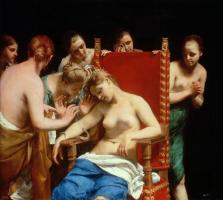
1658. Guido Cagnacci [aged 56]. "The Death of Cleopatra".
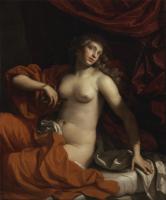
1674 to 1675. Benedetto Gennari II [aged 40]. "Cleopatra".
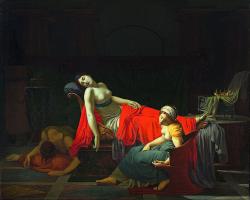
1797. Jean-Baptiste Regnault [aged 42]. "The Death of Cleoptra".
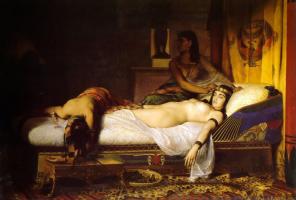
1874. Jean-André Rixens [aged 27]. "The Death of Cleopatra".
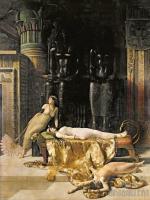
1890. John Collier [aged 39]. The Death of Cleopatra.
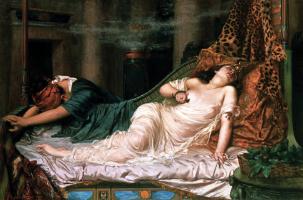
1892. Reginald Arthur Smith [aged 21]. "Cleopatra".
Life of Antony by Plutarch Chapter 86. 1. It is said that the asp was brought with those figs and leaves and lay hidden beneath them, for thus Cleopatra had given orders, that the reptile might fasten itself upon her body without her being aware of it. But when she took away some of the figs and saw it, she said: 'There it is, you see,' and baring her arm she held it out for the bite.
λέγεται δὲ τὴν ἀσπίδα κομισθῆναι σὺν τοῖς σύκοις ἐκείνοις καὶ τοῖς θρίοις ἄνωθεν ἐπικαλυφθεῖσαν, οὕτω γὰρ τὴν Κλεοπάτραν κελεῦσαι, μηδὲ αὐτῆς ἐπισταμένης τῷ σώματι προσπεσεῖν τὸ θηρίον: ὡς δὲ ἀφαιροῦσα τῶν σύκων εἶδεν, εἰπεῖν: 'ἐνταῦθα ἦν ἄρα τοῦτο:' καὶ τὸν βραχίονα παρασχεῖν τῷ δήγματι γυμνώσασαν.