

The History of William Marshal was commissioned by his son shortly after William’s death in 1219 to celebrate the Marshal’s remarkable life; it is an authentic, contemporary voice. The manuscript was discovered in 1861 by French historian Paul Meyer. Meyer published the manuscript in its original Anglo-French in 1891 in two books. This book is a line by line translation of the first of Meyer’s books; lines 1-10152. Book 1 of the History begins in 1139 and ends in 1194. It describes the events of the Anarchy, the role of William’s father John, John’s marriages, William’s childhood, his role as a hostage at the siege of Newbury, his injury and imprisonment in Poitou where he met Eleanor of Aquitaine and his life as a knight errant. It continues with the accusation against him of an improper relationship with Margaret, wife of Henry the Young King, his exile, and return, the death of Henry the Young King, the rebellion of Richard, the future King Richard I, war with France, the death of King Henry II, and the capture of King Richard, and the rebellion of John, the future King John. It ends with the release of King Richard and the death of John Marshal.
Available at Amazon in eBook and Paperback format.
Henry Fuseli is in Painters.
On 7th February 1741 Henry Fuseli was born at Zurich, Switzerland.

1778. James Northcote [aged 31]. Portrait of Henry Fuseli [aged 36].

1780 to 1782. Henry Fuseli [aged 38]. "The two murderers of the Duke of Clarence".

1781. Henry Fuseli [aged 39]. "The Nightmare".

1781. Henry Fuseli [aged 39]. "The Nightmare". The painting was first shown in 1782 at the Royal Academy of London after which it became widely known. Fuseli painted other versions; the original was sold for twenty guineas.

In 1788 Henry Fuseli [aged 46] and Sophia Rawlins were married. She originally one of his models.

In or after 1788. Henry Fuseli [aged 46]. Portrait of Sophia Rawlins, the artist's wife.

1789. Henry Fuseli [aged 47]. "Silence".
Around 1789 Henry Fuseli [aged 47] and Mary Wollstonecraft [aged 29] planned a trip with him to Paris. His wife Sophia Rawlins stopped any communication between the two.


Abbot John Whethamstede’s Chronicle of the Abbey of St Albans
Abbot John Whethamstede's Register aka Chronicle of his second term at the Abbey of St Albans, 1451-1461, is a remarkable text that describes his first-hand experience of the beginning of the Wars of the Roses including the First and Second Battles of St Albans, 1455 and 1461, respectively, their cause, and their consequences, not least on the Abbey itself. His text also includes Loveday, Blore Heath, Northampton, the Act of Accord, Wakefield, and Towton, and ends with the Coronation of King Edward IV. In addition to the events of the Wars of the Roses, Abbot John, or his scribes who wrote the Chronicle, include details in the life of the Abbey such as charters, letters, land exchanges, visits by legates, and disputes, which provide a rich insight into the day-to-day life of the Abbey, and the challenges faced by its Abbot.
Available at Amazon in eBook and Paperback format.

1790. Henry Fuseli [aged 48]. "Thor Battering the Midgard Serpent". Fuseli's diploma work for the Royal Academy

Around 1790. Henry Fuseli [aged 48]. Portrait of the artist's wife Sophia Rawlins.
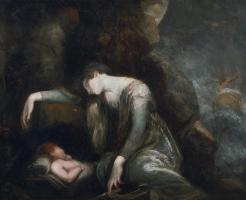
1790. Henry Fuseli [aged 48]. "Danaë and Perseus on Seriphos".

1792. Henry Fuseli [aged 50]. "The Apotheosis of Penelope Boothby".
Penelope Boothby: On 11th April 1785 she was born to Brooke Boothby 6th Baronet in Lichfield, Staffordshire [Map]. On 19th March 1791 Penelope Boothby died at Ashbourne Hall, Derbyshire [Map]. She was buried in St Oswald's Church, Ashbourne [Map].

1794. Henry Fuseli [aged 52]. "Milton Dictating to His Daughter".
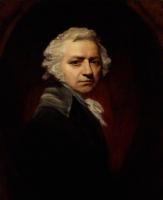
1794. John Opie [aged 32]. Portrait of Henry Fuseli [aged 52].

1796. Henry Fuseli [aged 54]. "The Night-Hag Visiting Lapland Witches". Hecate, the Greek goddess who presided over witchcraft and magical rites, was historically known as the "Night-Hag," hence the title that the artist gave this work. It illustrates a passage from Paradise Lost by the English poet John Milton
In 1799 Henry Fuseli [aged 57] was appointed Professor of Painting at the Royal Academy.

31st May 1800. Henry Fuseli [aged 59]. Sophia Rawlins, the artist's wife, in profile.

Around 1805. Henry Fuseli [aged 63]. "Ariel".
The Deeds of the Dukes of Normandy
The Gesta Normannorum Ducum [The Deeds of the Dukes of Normandy] is a landmark medieval chronicle tracing the rise and fall of the Norman dynasty from its early roots through the pivotal events surrounding the Norman Conquest of England. Originally penned in Latin by the monk William of Jumièges shortly before 1060 and later expanded at the behest of William the Conqueror, the work chronicles the deeds, politics, battles, and leadership of the Norman dukes, especially William’s own claim to the English throne. The narrative combines earlier historical sources with firsthand information and oral testimony to present an authoritative account of Normandy’s transformation from a Viking settlement into one of medieval Europe’s most powerful realms. William’s history emphasizes the legitimacy, military prowess, and governance of the Norman line, framing their expansion, including the conquest of England, as both divinely sanctioned and noble in purpose. Later chroniclers such as Orderic Vitalis and Robert of Torigni continued the history, extending the coverage into the 12th century, providing broader context on ducal rule and its impact. Today this classic work remains a foundational source for understanding Norman identity, medieval statesmanship, and the historical forces that reshaped England and Western Europe between 800AD and 1100AD.
Available at Amazon in eBook and Paperback format.

1817. George Henry Harlow [aged 29]. Portrait of Henry Fuseli [aged 75].
On 17th April 1825 Henry Fuseli [aged 84] died at the house of the Countess of Guildford [aged 55], on Putney Hill