

The History of William Marshal was commissioned by his son shortly after William’s death in 1219 to celebrate the Marshal’s remarkable life; it is an authentic, contemporary voice. The manuscript was discovered in 1861 by French historian Paul Meyer. Meyer published the manuscript in its original Anglo-French in 1891 in two books. This book is a line by line translation of the first of Meyer’s books; lines 1-10152. Book 1 of the History begins in 1139 and ends in 1194. It describes the events of the Anarchy, the role of William’s father John, John’s marriages, William’s childhood, his role as a hostage at the siege of Newbury, his injury and imprisonment in Poitou where he met Eleanor of Aquitaine and his life as a knight errant. It continues with the accusation against him of an improper relationship with Margaret, wife of Henry the Young King, his exile, and return, the death of Henry the Young King, the rebellion of Richard, the future King Richard I, war with France, the death of King Henry II, and the capture of King Richard, and the rebellion of John, the future King John. It ends with the release of King Richard and the death of John Marshal.
Available at Amazon in eBook and Paperback format.
In 1641 Louis Duras 2nd Earl Feversham was born to [his father] Guy Aldonce Marquis of Duras and Count of Rozan [aged 36].
In 1665 [his father] Guy Aldonce Marquis of Duras and Count of Rozan [aged 60] died.
Samuel Pepys' Diary. 1st September 1667. Lord's Day. Up, and betimes by water from the Tower, and called at the Old Swan [Map] for a glass of strong water, and sent word to have little Michell and his wife come and dine with us to-day; and so, taking in a gentleman and his lady that wanted a boat, I to Westminster. Setting them on shore at Charing Cross [Map], I to Mrs. Martin's, where I had two pair of cuffs which I bespoke, and there did sit and talk with her.... [Missing text: "and no mas, ella having aquellos [ those ] upon her"] and here I did see her little girle my goddaughter, which will be pretty, and there having staid a little I away to Creed's chamber, and when he was ready away to White Hall, where I met with several people and had my fill of talk. Our new Lord-keeper, Bridgeman [aged 61], did this day, the first time, attend the King [aged 37] to chapel with his Seal. Sir H. Cholmly [aged 35] tells me there are hopes that the women will also have a rout, and particularly that my Baroness Castlemayne [aged 26] is coming to a composition with the King to be gone; but how true this is, I know not. Blancfort [aged 26] is made Privy-purse to the Duke of York [aged 33]; the Attorney-general [aged 69] is made Chief justice, in the room of my Lord Bridgeman; the Solicitor-general [aged 45] is made Attorney-general; and Sir Edward Turner [aged 50] made Solicitor-general.
Samuel Pepys' Diary. 4th March 1669. Up, and a while at the office, but thinking to have Mr. Povy's [aged 55] business to-day at the Committee for Tangier, I left the Board and away to White Hall, where in the first court I did meet Sir Jeremy Smith, who did tell me that Sir W. Coventry [aged 41] was just now sent to the Tower, about the business of his challenging the Duke of Buckingham [aged 41], and so was also Harry Saville [aged 27] to the Gate-house; which, as [he is] a gentleman, and of the Duke of York's [aged 35] bedchamber, I heard afterwards that the Duke of York is mightily incensed at, and do appear very high to the King [aged 38] that he might not be sent thither, but to the Tower [Map], this being done only in contempt to him. This news of Sir W. Coventry did strike me to the heart, and with reason, for by this and my Lord of Ormond's [aged 58] business, I do doubt that the Duke of Buckingham will be so flushed, that he will not stop at any thing, but be forced to do any thing now, as thinking it not safe to end here; and, Sir W. Coventry being gone, the King will have never a good counsellor, nor the Duke of York any sure friend to stick to him; nor any good man will be left to advise what is good. This, therefore, do heartily trouble me as any thing that ever I heard. So up into the House, and met with several people; but the Committee did not meet; and the whole House I find full of this business of Sir W. Coventry's, and most men very sensible of the cause and effects of it. So, meeting with my Lord Bellassis [aged 54], he told me the particulars of this matter; that it arises about a quarrel which Sir W. Coventry had with the Duke of Buckingham about a design between the Duke and Sir Robert Howard, to bring him into a play at the King's house, which W. Coventry not enduring, did by H. Saville send a letter to the Duke of Buckingham, that he had a desire to speak with him. Upon which, the Duke of Buckingham did bid Holmes [aged 47], his champion ever since my Lord Shrewsbury's business1, go to him to know the business; but H. Saville would not tell it to any but himself, and therefore did go presently to the Duke of Buckingham, and told him that his uncle Coventry was a person of honour, and was sensible of his Grace's liberty taken of abusing him, and that he had a desire of satisfaction, and would fight with him. But that here they were interrupted by my Lord Chamberlain's [aged 67] coming in, who was commanded to go to bid the Duke of Buckingham to come to the King, Holmes having discovered it. He told me that the King did last night, at the Council, ask the Duke of Buckingham, upon his honour, whether he had received any challenge from W. Coventry? which he confessed that he had; and then the King asking W. Coventry, he told him that he did not owne what the Duke of Buckingham had said, though it was not fit for him to give him a direct contradiction. But, being by the King put upon declaring, upon his honour, the matter, he answered that he had understood that many hard questions had upon this business been moved to some lawyers, and that therefore he was unwilling to declare any thing that might, from his own mouth, render him obnoxious to his Majesty's displeasure, and, therefore, prayed to be excused: which the King did think fit to interpret to be a confession, and so gave warrant that night for his commitment to the Tower. Being very much troubled at this, I away by coach homewards, and directly to the Tower, where I find him in one Mr. Bennet's house, son to Major Bayly, one of the Officers of the Ordnance, in the Bricke Tower [Map]2 where I find him busy with my Lord Halifax [aged 35] and his brother [aged 50]; so I would not stay to interrupt them, but only to give him comfort, and offer my service to him, which he kindly and cheerfully received, only owning his being troubled for the King his master's displeasure, which, I suppose, is the ordinary form and will of persons in this condition. And so I parted, with great content, that I had so earlily seen him there; and so going out, did meet Sir Jer. Smith going to meet me, who had newly been with Sir W. Coventry. And so he and I by water to Redriffe [Map], and so walked to Deptford, Kent [Map], where I have not been, I think, these twelve months: and there to the Treasurer's house, where the Duke of York is, and his Duchess [aged 31]; and there we find them at dinner in the great room, unhung; and there was with them my Lady Duchess of Monmouth, the Countess of Falmouth [aged 24], Castlemayne [aged 28], Henrietta Hide [aged 23] (my Lady Hinchingbroke's [aged 24] sister), and my Lady Peterborough [aged 47]. And after dinner Sir Jer. Smith and I were invited down to dinner with some of the Maids of Honour, namely, Mrs. Ogle [aged 17], Blake [aged 16], and Howard [aged 18], which did me good to have the honour to dine with, and look on; and the Mother of the Maids, and Mrs. Howard [aged 43], the mother of the Maid of Honour of that name, and the Duke's housekeeper here. Here was also Monsieur Blancfort [aged 28], Sir Richard Powell, Colonel Villers [aged 48], Sir Jonathan Trelawny [aged 46], and others. And here drank most excellent, and great variety, and plenty of wines, more than I have drank, at once, these seven years, but yet did me no great hurt. Having dined and very merry, and understanding by Blancfort how angry the Duke of York was, about their offering to send Saville to the Gate-house, among the rogues; and then, observing how this company, both the ladies and all, are of a gang, and did drink a health to the union of the two brothers, and talking of others as their enemies, they parted, and so we up; and there I did find the Duke of York and Duchess, with all the great ladies, sitting upon a carpet, on the ground, there being no chairs, playing at "I love my love with an A, because he is so and so: and I hate him with an A, because of this and that:" and some of them, but particularly the Duchess herself, and my Baroness Castlemayne, were very witty. This done, they took barge, and I with Sir J. Smith to Captain Cox's; and there to talk, and left them and other company to drink; while I slunk out to Bagwell's; and there saw her, and her mother, and our late maid Nell, who cried for joy to see me, but I had no time for pleasure then nor could stay, but after drinking I back to the yard, having a month's mind para have had a bout with Nell, which I believe I could have had, and may another time.
Note 1. Charles II wrote to his sister [aged 24] (Henrietta, Duchess of Orléans), on March 7th, 1669: "I am not sorry that Sir Will. Coventry has given me this good occasion by sending my Lord of Buckingham a challenge to turne him out of the Councill. I do intend to turn him allso out of the Treasury. The truth of it is, he has been a troublesome man in both places and I am well rid of him" (Julia Cartwright's "Madame", 1894, p. 283).
Note 2. The Brick Tower [Map] stands on the northern wall, a little to the west of Martin tower, with which it communicates by a secret passage. It was the residence of the Master of the Ordnance, and Raleigh was lodged here for a time.
On 19th January 1673 Louis Duras 2nd Earl Feversham [aged 32] was created 1st Baron Duras.
John Evelyn's Diary. 24th October 1675. Dined at Lord Chamberlain's [aged 57] with the Holland Ambassador L. Duras [aged 34], a valiant gentleman whom his Majesty [aged 45] made an English Baron, of a cadet, and gave him his seat of Holmby, in Northamptonshire.


In 1676 Louis Duras 2nd Earl Feversham [aged 35] and Mary Sondes Countess Feversham [aged 18] were married. She the daughter of George Sondes 1st Earl Feversham [aged 76].
On 16th April 1677 [his father-in-law] George Sondes 1st Earl Feversham [aged 77] died. His son-in-law Louis Duras 2nd Earl Feversham [aged 36] succeeded 2nd Earl Feversham. [his wife] Mary Sondes Countess Feversham [aged 20] by marriage Countess Feversham.
John Evelyn's Diary. 18th December 1684. I went with Lord Cornwallis [aged 28] to see the young gallants do their exercise, Mr. Faubert having newly rail'd in a manage, and fitted it for the academy. There were the Dukes of Norfolk [aged 29] and Northumberland [aged 18], Lord Newburgh, and a nephew of (Duras) Earle of Feversham [aged 43]. The exercises were, 1. running at the ring; 2. flinging a javelin at a Moor's head; 3. discharging a pistol at a mark; lastly, taking up a gauntlet with the point of a sword; all these perform'd in full speede. The D. of Northumberland hardly miss'd of succeeding in every one, a dozen times, as I think. The D. of Norfolk did exceeding bravely. Lords Newburgh and Duras seem'd nothing so dextrous. Here I saw the difference of what ye French call "belle homme a cheval", and "bon homme a cheval;" the Duke of Norfolk being the first, that is, rather a fine person on a horse, the Duke of Northumberland being both in perfection, namely, a graceful person and excellent rider. But the Duke of Norfolk told me he had not ben at this exercise these 12 yeares before. There were in the field ye Prince of Denmark [aged 31], and the Lord Landsdown [aged 23], sonn of ye Earle of Bath [aged 56], who had ben made a Count of ye Empire last Summer for his service before Vienna.


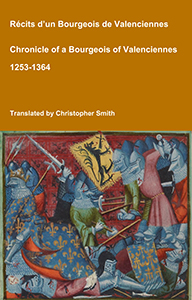
Chronicle of a Bourgeois of Valenciennes
Récits d’un bourgeois de Valenciennes aka The Chronicle of a Bourgeois of Valenciennes is a vivid 14th-century vernacular chronicle written by an anonymous urban chronicler from Valenciennes in the County of Hainaut. It survives in a manuscript that describes local and regional history from about 1253 to 1366, blending chronology, narrative episodes, and eyewitness-style accounts of political, military, and social events in medieval France, Flanders, and the Low Countries. The work begins with a chronological framework of events affecting Valenciennes and its region under rulers such as King Philip VI of France and the shifting allegiances of local nobility. It includes accounts of conflicts, sieges, diplomatic manoeuvres, and the impact of broader struggles like the Hundred Years’ War on urban life in Hainaut. Written from the perspective of a burgher (bourgeois) rather than a monastery or royal court, the chronicle offers a rare lay viewpoint on high politics and warfare, reflecting how merchants, townspeople, and civic institutions experienced the turbulence of the 13th and 14th centuries. Its narrative style combines straightforward reporting of events with moral and civic observations, making it a valuable source for readers interested in medieval urban society, regional politics, and the lived experience of war and governance in pre-modern Europe.
Available at Amazon in eBook and Paperback format.
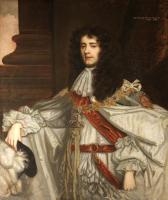
In 1685 Louis Duras 2nd Earl Feversham [aged 44] was appointed 493rd Knight of the Garter by King James II of England Scotland and Ireland [aged 51]..
John Evelyn's Diary. 6th February 1685. Prayers were solemnly made in all the Churches, especialy in both ye Court Chapells, where the Chaplaines reliev'd one another every halfe quarter of an houre from the time he began to be in danger till he expir'd, according to the forme prescrib'd in the Church Offices. Those who assisted his Majesty's [aged 54] devotions were, the Abp. of Canterbury [aged 68], the Bishops of London [aged 53], Durham [aged 52], and Ely [aged 47], but more especialy Dr. Ken, the Bp. of Bath and Wells [aged 47] receiving the Holy Sacrament, but his Ma* told them he would consider of it, which he did so long 'till it was too late. Others whisper'd that the Bishops and Lords, except the Earles of Bath [aged 56] and Feversham [aged 44], being order'd to withdraw the night before, Hurlston, the 'Priest, had presumed to administer the Popish Offices. He gave his breeches and keys to ye Duke [aged 51], who was almost continually kneeling by his bed-side, and in teares. He also recommended to him the care of his natural children, all except the Duke of Monmouth [aged 35], now in Holland, and in his displeasure. He intreated the Queene [aged 46] to pardon him (not without cause); who a little before had sent a Bishop to excuse her not more frequently visiting him, in reguard of her excessive griefe, and withall, that his Ma* would forgive it if at any time she had offended him. He spake to ye Duke to be kind to the Dutchesse of Cleaveland [aged 44], and especialy Portsmouth [aged 35], and that Nelly [aged 35] might not starve.
John Evelyn's Diary. 8th July 1685. Came news of Monmouth's [aged 36] utter defeate, and the next day of his being taken by Sr Wm Portman [aged 41] and Lord Lumley [aged 35] with the militia of their counties. It seemes the horse, commanded by Lord Grey [aged 29], being newly rais'd and undisciplin'd, were not to be brought in so short a time to endure the fire, which expos'd the foote to the King's, so as when Monmouth had led the foote in greate silence and order, thinking to surprize Lieut Gen Lord Feversham [aged 44] newly encamp'd, and given him a smart charge, interchanging both greate and small shot, the horse, breaking their owne ranks, Monmouth gave it over, and fled with Grey, leaving their party to be cut in pieces to the number of 2000. The whole number reported to be above 8,000, the King's but 2,700. The slaine were most of them Mendip-miners, who did greate execution with their tooles, and sold their lives very dearely, whilst their leaders flying were pursu'd and taken the next morning, not far from one another. Monmouth had gone 16 miles on foote, changing; his habite for a poore coate, and was found by Lord Lumley in a dry ditch cover'd with fern-brakes, but without sword, pistol, or any weapon, and so might have pass'd for some countryman, his beard being grown so long and so grey as hardly to be known, had not his George [Note. This is possible a reference to the Small St George Pendant] discover'd him, which was found in his pocket. 'Tis said he trembl'd exceedingly all over, not able to speake. Grey was taken not far from him. Most of his party were anabaptists and poore cloth workers of yu country, no gentlemen of account being come in to him. The arch-boutefeu Ferguson, Matthews, *&c. were not yet found. The £5,000 to be given to whoever should bring Monmouth in, was to be distributed among the militia by agreement between Sr Wm Portman and Lord Lumley. The battail ended, some words, first In jest, then in passion, pass'd between Sharington Talbot [deceased] (a worthy gent. son to Sr John Talbot [aged 55], and who had behav'd himselfe very handsomely) and one Capt. Love, both commanders of the militia, as to whose souldiers fought best, both drawing their swords and passing at one another. Sharington was wounded to death on the spot, to the greate regret of those who knew him. He was Sir John's only son.


John Evelyn's Diary. 16th September 1685. The next morning setting out early, we ariv'd soon enough at Winchester [Map] to waite on the King [aged 51], who was lodg'd at the Dean's (Dr. Meggot). I found very few with him besides my Lords Feversham [aged 44], Arran [Note. Not clear which Earl of Arran], Newport [aged 65], and the Bishop of Bath and Wells [aged 48]. His Ma* was discoursing with the Bishops concerning miracles, and what strange things the Saludadors would do in Spaine, as by creeping into heated ovens without hurt, and that they had a black crosse in the roofe of their mouthes, but yet were commonly notorious and profane wretches; upon which his Majesty further said, that he was so extreamly difficult of miracles, for feare of being impos'd upon, that if he should chance to see one himselfe, without some other witness, he should apprehend it a delusion of his senses. Then they spake of ye boy who was pretended to have a wanting leg restor'd him, so confidently asserted by Fr. de Sta Clara and others. To all which the Bishop added a greate miracle happening In Winchester to his certaine knowledge, of a poor miserably sick and decrepit child (as I remember long kept unbaptiz'd), who immediately on his baptism recover'd; as also of ye salutary effect of K. Charles his Ma*s father's blood, in healing one that was blind.


John Evelyn's Diary. 13th December 1688. The Prince of Orange [aged 38] is advanced to Windsor, Berkshire [Map], is invited by the King [aged 55] to St. James's [Map], the messenger sent was the Earl of Faversham [aged 47], the General of the Forces, who going without trumpet, or passport, is detained prisoner by the Prince, who accepts the invitation, but requires his Majesty to retire to some distant place, that his own guards may be quartered about the palace and city. This is taken heinously and the King goes privately to Rochester, Kent [Map]; is persuaded to come back; comes on the Sunday; goes to mass, and dines in public, a Jesuit saying grace (I was present).


On 19th April 1709 Louis Duras 2nd Earl Feversham [aged 68] died without issue. Earl Feversham and Baron Duras extinct.