William of Worcester's Chronicle of England
William of Worcester, born around 1415, and died around 1482 was secretary to John Fastolf, the renowned soldier of the Hundred Years War, during which time he collected documents, letters, and wrote a record of events. Following their return to England in 1440 William was witness to major events. Twice in his chronicle he uses the first person: 1. when writing about the murder of Thomas, 7th Baron Scales, in 1460, he writes '… and I saw him lying naked in the cemetery near the porch of the church of St. Mary Overie in Southwark …' and 2. describing King Edward IV's entry into London in 1461 he writes '… proclaimed that all the people themselves were to recognize and acknowledge Edward as king. I was present and heard this, and immediately went down with them into the city'. William’s Chronicle is rich in detail. It is the source of much information about the Wars of the Roses, including the term 'Diabolical Marriage' to describe the marriage of Queen Elizabeth Woodville’s brother John’s marriage to Katherine, Dowager Duchess of Norfolk, he aged twenty, she sixty-five or more, and the story about a paper crown being placed in mockery on the severed head of Richard, 3rd Duke of York.
Available at Amazon in eBook and Paperback format.
Greece is in Europe.

In 1844 Joannes Gennadius was born to George Gennadius at Athens. He married 1902 Florence Elisabeth "Anthi" Laing.
On 11th June 1903 Olga Glücksburg was born to Prince Nicholas Glücksburg [aged 31] and Elena Vladimirovna Holstein Gottorp Romanov [aged 21] in Athens. Coefficient of inbreeding 1.74%. She married 22nd October 1923 Paul Karađorđević.
On 13th December 1906 Princess Marina Glücksburg Duchess Kent was born to Prince Nicholas Glücksburg [aged 34] and Elena Vladimirovna Holstein Gottorp Romanov [aged 24] at Athens. Coefficient of inbreeding 1.74%. She married 29th November 1934 her second cousin Prince George Windsor 1st Duke Kent, son of King George V of the United Kingdom and Victoria Mary Teck Queen Consort England, and had issue.


On 10th March 1921 King Carol II Hohenzollern Sigmaringen [aged 27] and Helen Glücksburg [aged 24] were married at Athens. She the daughter of Constantine I King Greece [aged 52] and Sophia Hohenzollern Queen Consort Greece [aged 50]. They were second cousins. He a great grandson of Queen Victoria of the United Kingdom. She a great granddaughter of Queen Victoria of the United Kingdom.
On 2nd February 1882 Andrew Glücksburg was born to George I King Greece [aged 36] and Olga Constantinovna Holstein Gottorp Romanov Queen Consort Greece [aged 30] at Old Royal Palace. He a great x 4 grandson of King George II of Great Britain and Ireland. He married 6th October 1903 his fourth cousin once removed Princess Alice of Battenburg, daughter of Prince Louis of Battenburg 1st Marquess Milford Haven and Victoria Hesse Darmstadt Marchioness Milford Haven, and had issue.
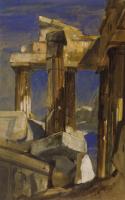
1838. William James Müller [aged 25]. "The Parthenon, Athens".
On 9th October 1192 King Richard "Lionheart" I of England [aged 35] left the Holy Land for England. Bad weather forced him to land at Corfu [Map]. Richard sailed from Corfu but his ship was wrecked at Aquileia [Map] from where he travelled overland.
On 10th December 1825 Henry Ponsonby was born to Frederick Cavendish Ponsonby [aged 42] and Emily Bathurst [aged 27] at Corfu [Map]. He a great x 4 grandson of King Charles II of England Scotland and Ireland. He married 30th April 1861 his third cousin once removed Mary Elizabeth Bulteel and had issue.

On 10th June 1921 Philip Mountbatten Duke Edinburgh was born to Andrew Glücksburg [aged 39] and Princess Alice of Battenburg [aged 36] at Mon Repos. He a great x 2 grandson of Queen Victoria of the United Kingdom. He married 20th November 1947 his second cousin once removed Queen Elizabeth II of the United Kingdom and had issue.
On 19th April 1824 George "Lord Byron" 6th Baron Byron [aged 36] died at Missolonghi. He was buried at Hucknall Torkard, Nottinghamshire. His first cousin George [aged 35] succeeded 7th Baron Byron of Rochdale in Lancashire.


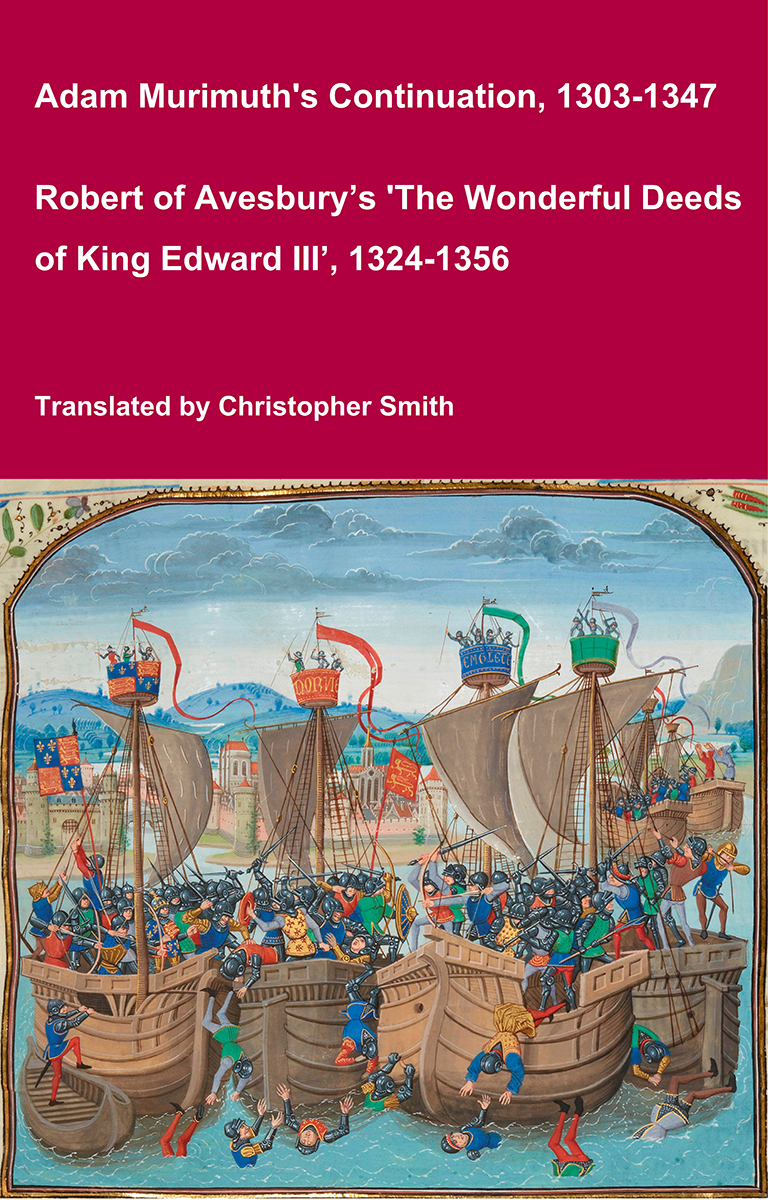
Adam Murimuth's Continuation and Robert of Avesbury’s 'The Wonderful Deeds of King Edward III'
This volume brings together two of the most important contemporary chronicles for the reign of Edward III and the opening phases of the Hundred Years’ War. Written in Latin by English clerical observers, these texts provide a vivid and authoritative window into the political, diplomatic, and military history of fourteenth-century England and its continental ambitions. Adam Murimuth Continuatio's Chronicarum continues an earlier chronicle into the mid-fourteenth century, offering concise but valuable notices on royal policy, foreign relations, and ecclesiastical affairs. Its annalistic structure makes it especially useful for establishing chronology and tracing the development of events year by year. Complementing it, Robert of Avesbury’s De gestis mirabilibus regis Edwardi tertii is a rich documentary chronicle preserving letters, treaties, and official records alongside narrative passages. It is an indispensable source for understanding Edward III’s claim to the French crown, the conduct of war, and the mechanisms of medieval diplomacy. Together, these works offer scholars, students, and enthusiasts a reliable and unembellished account of a transformative period in English and European history. Essential for anyone interested in medieval chronicles, the Hundred Years’ War, or the reign of Edward III.
Available at Amazon in eBook and Paperback format.
Wriothesley's Chronicle [1508-1562]. 1524. This yeare there were three persons, viz. Charles, sometyme master of the Kinges henchmen, and one Pickeringe, sometyme of the King's bakehowse, and one Thomas, a servinge man, latelie come from the Rhodesa which were drawne to Tiburne [Map], and there hanged, their bowells brent afore them, and after quartered, their heades sett on London bridge, and their quarters hanged at divers gates of the Cittie, which persons made an insurrection in Coventree [Map].b
Note a. The Isle of Rhodes, which was this year taken by the Turks.
Note b. The account of this conspiracy is more circumstantially related in Hall's Chronicle, ed. 1809, p. 673.
Froissart Book 4 Chapter 90. News was soon carried to the island of Rhodes, that the sultan had accepted a ransom for the French lords, and that they were now at Mathelin. The intelligence gave much pleasure to the grand-master and to all his knights, who proposed to equip and arm two galleys, and send them to Mathelin to convey the count and his fellow-prisoners to Rhodes. This was executed; and, when ready, sir James de Brasemont1, a Burgundian, who was marshal of Rhodes, embarked on board, and had a favourable voyage to Mathelin, where he was made heartily welcome by the lord de Mathelin, his lady, and their guests. He remained there four days: on the fifth, the galleys having on board the purveyances of the French lords, the count and his companions took leave of the lord and lady de Mathelin, returning them their best thanks for all the kindness and friendship they had received, especially the count de Nevers, who, as the principal personage, said he was bound at all times hereafter to render them every service in his power. After many compliments on both sides, the French lords entered the galleys, and, as long as they were in sight, the lord de Mathelin remained on the shore, and after that went home. The galleys, having a favourable wind, arrived at Rhodes, and anchored in the haven, where vessels from Cyprus, Baruth, and other ports in the Levant, usually do. On their landing, they were received by many of the knights of Rhodes, who wear a white cross, in memory of the cross of our Lord Jesus Christ, who suffered to deliver others from the pains of hell. They are valiant knights, and give daily assaults by sea or land on the infidels, to support and defend the Christian faith.
Note 1. " Sir James de Brasemont." The MSS. have de Bauffremont, which I should prefer.