

The History of William Marshal was commissioned by his son shortly after William’s death in 1219 to celebrate the Marshal’s remarkable life; it is an authentic, contemporary voice. The manuscript was discovered in 1861 by French historian Paul Meyer. Meyer published the manuscript in its original Anglo-French in 1891 in two books. This book is a line by line translation of the first of Meyer’s books; lines 1-10152. Book 1 of the History begins in 1139 and ends in 1194. It describes the events of the Anarchy, the role of William’s father John, John’s marriages, William’s childhood, his role as a hostage at the siege of Newbury, his injury and imprisonment in Poitou where he met Eleanor of Aquitaine and his life as a knight errant. It continues with the accusation against him of an improper relationship with Margaret, wife of Henry the Young King, his exile, and return, the death of Henry the Young King, the rebellion of Richard, the future King Richard I, war with France, the death of King Henry II, and the capture of King Richard, and the rebellion of John, the future King John. It ends with the release of King Richard and the death of John Marshal.
Available at Amazon in eBook and Paperback format.
Algebraic Numbers is in Real Numbers.
Real Numbers can be either Algebraic Numbers or Transcendental Number.
Irrational Number. An Irrational Number is a number that cannot be expressed as a Fraction.
Constructable Numbers are numbers that can be derived using a straight edge and a compass.
The Golden Ratio, also known as the Golden Mean and Golden Section, is 1.618033... It is the solution to the equation x^2 - x - 1 = 0, or ( a + b ) / a = a / b.
The Golden Ratio is usually represented by the Greek Letter phi φ.
The Fibaonacci Series converges on the Golden Ratio.
The formula ( 1 + SQRT(5) ) / 2 is the Golden Ratio.
Square Root of 2, or 2^(1/2) being the length of the diagonal of a square with sides of length 1. It is 1.4142135623...
99/70 = 1.4142857 approximates to the Square Root of 2.
Non-Constructable Numbers are the solution to algebraic equations with a cube root of higher eg 2^(1/3).
Fractions are an Integer divided by an Integer eg 1/2, 5/13, 241/98.
Rational Number. A Rational Number is a number that can be expressed as a Fraction of two Integers. Integers are Fractions with a divisor of 1.
Irrational Number. An Irrational Number is a number that cannot be expressed as a Fraction.
Integers aka whole numbers. Fractions with a divisor of 1.
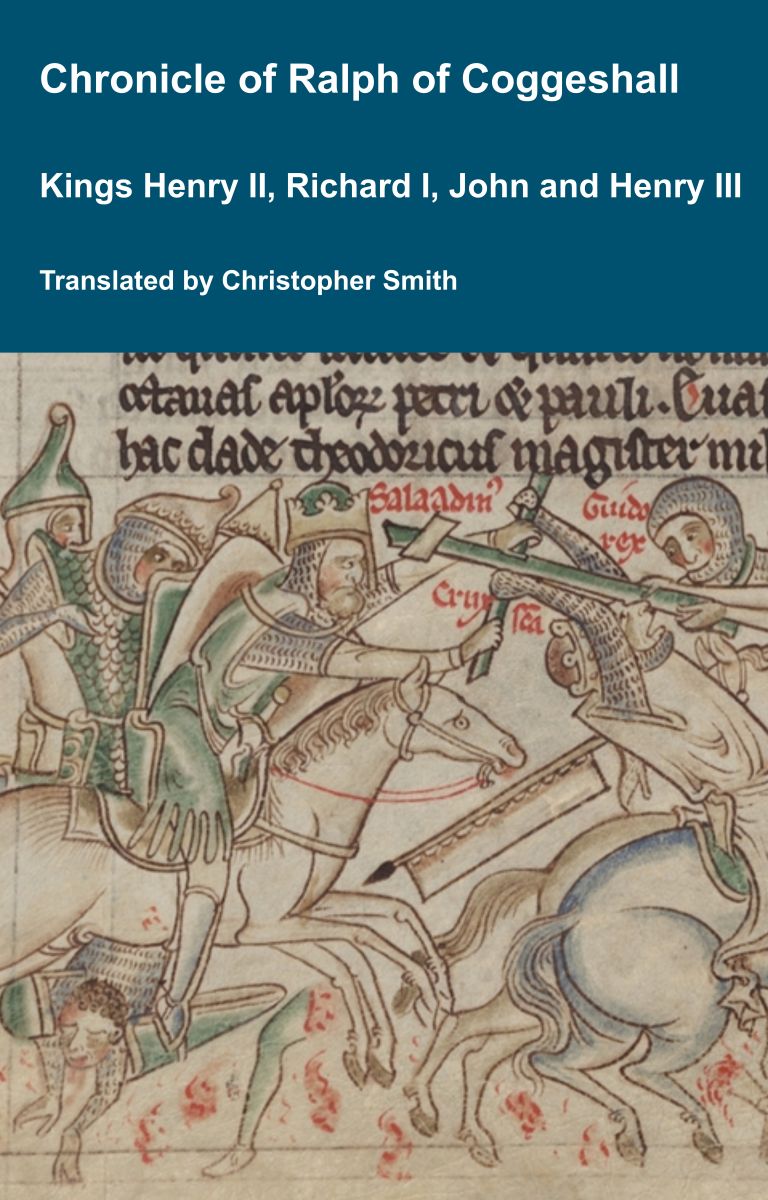
Chronicle of Abbot Ralph of Coggeshall
The Chronicle of Abbot Ralph of Coggeshall (Chronicon Anglicanum) is an indispensable medieval history that brings to life centuries of English and European affairs through the eyes of a learned Cistercian monk. Ralph of Coggeshall, abbot of the Abbey of Coggeshall in Essex in the early 13th century, continued and expanded his community’s chronicle, documenting events from the Norman Conquest of 1066 into the tumultuous reign of King Henry III. Blending eyewitness testimony, careful compilation, and the monastic commitment to record-keeping, this chronicle offers a rare narrative of political intrigue, royal power struggles, and social upheaval in England and beyond. Ralph’s work captures the reigns of pivotal figures such as Richard I and King John, providing invaluable insights into their characters, decisions, and the forces that shaped medieval rule. More than a simple annal, Chronicon Anglicanum conveys the texture of medieval life and governance, making it a rich source for scholars and readers fascinated by English history, monastic authorship, and the shaping of the medieval world.
Available at Amazon in eBook and Paperback format.
Rational Number. A Rational Number is a number that can be expressed as a Fraction of two Integers. Integers are Fractions with a divisor of 1.
Prime Number. A Prime Number is an Integer that is only divisible by 1 and itself with the Remainder ie. 1, 2, 3, 5, 7, 11, 13, 17, 19, ...
Fermat Prime. A Prime Number that is a solution to 2^2^N + 1 eg 3, 5, 17, 65537, 4294967297, 18446744073709551617
2 ^ 2 ^ 0 + 1 = 3
2 ^ 2 ^ 1 + 1 = 5
2 ^ 2 ^ 2 + 1 = 17
With the exeception of the first and second terms Germat Primes always end in 7.
Mersenne Prime. A Mersenne Prime is a prime number that is one less than a power of two. Mersenne Primes do not include all numbers that are one less than a power of two eg 16 - 1 = 15 which is divisible by 1, 3 and 5.