

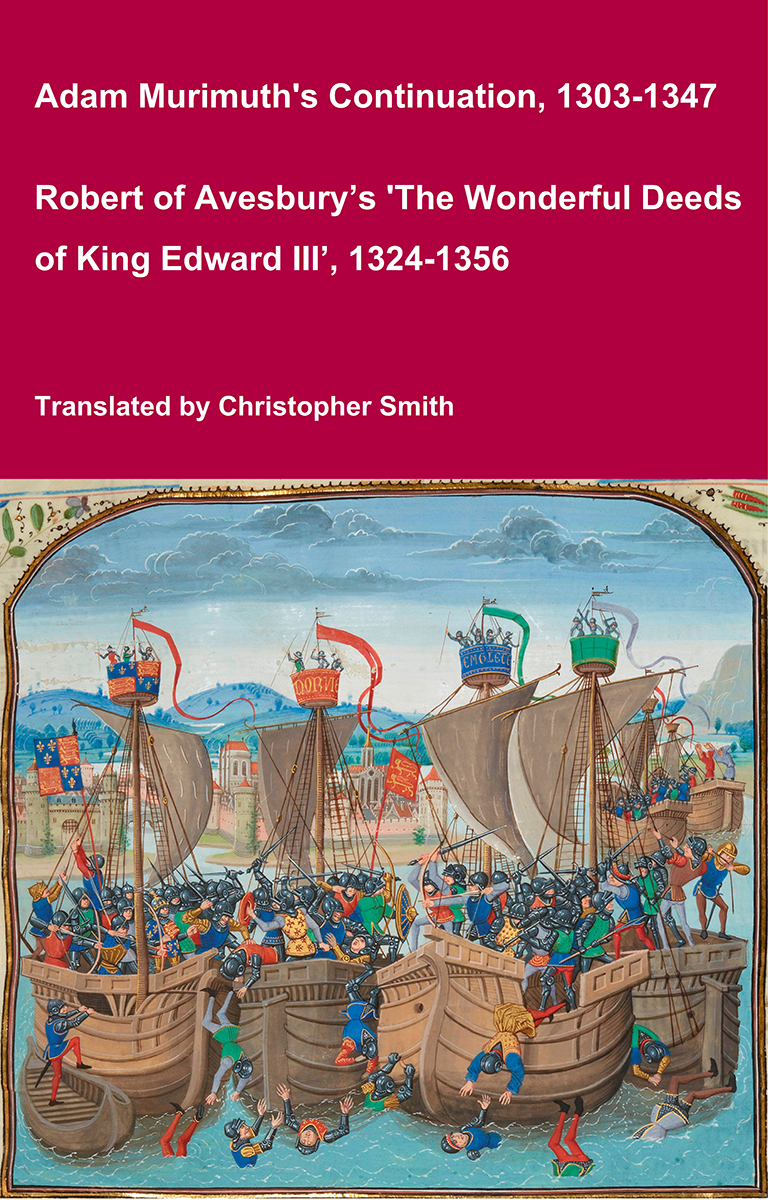
Adam Murimuth's Continuation and Robert of Avesbury’s 'The Wonderful Deeds of King Edward III'
This volume brings together two of the most important contemporary chronicles for the reign of Edward III and the opening phases of the Hundred Years’ War. Written in Latin by English clerical observers, these texts provide a vivid and authoritative window into the political, diplomatic, and military history of fourteenth-century England and its continental ambitions. Adam Murimuth Continuatio's Chronicarum continues an earlier chronicle into the mid-fourteenth century, offering concise but valuable notices on royal policy, foreign relations, and ecclesiastical affairs. Its annalistic structure makes it especially useful for establishing chronology and tracing the development of events year by year. Complementing it, Robert of Avesbury’s De gestis mirabilibus regis Edwardi tertii is a rich documentary chronicle preserving letters, treaties, and official records alongside narrative passages. It is an indispensable source for understanding Edward III’s claim to the French crown, the conduct of war, and the mechanisms of medieval diplomacy. Together, these works offer scholars, students, and enthusiasts a reliable and unembellished account of a transformative period in English and European history. Essential for anyone interested in medieval chronicles, the Hundred Years’ War, or the reign of Edward III.
Available at Amazon in eBook and Paperback format.
Biting the Scabbard is in Feet Resting On.
After 1262. St Mary's Church, Boyton [Map]. Monument to Alexander Giffard. Believed to represent Alexander Giffard; possibly his father Hugh Giffard. Early Medieval Period effigy. Alexander fought on the Seventh Crusade and may possibly have died at the Battle of Mansoura in 1250. The effigy notable for the Otter at his feet, biting his sword, and for the  Giffard Arms on the shield with a label five points indicating the son, possibly grandson, of the current owner of the arms. The Otter may actually be a badly carved lion! Right Leg over Left.
Hugh Giffard: Around 1195 he was born to Walter Giffard at Warminster, Wiltshire [Map]. Before 18th March 1217 Hugh Giffard and Sibyl Cormeilles were married. Around 1246 Hugh Giffard died at Warminster, Wiltshire [Map].


Effigy of King John. The effigy of John, carved in grey marble, which forms the superstructure of his present tomb, was originally the lid of the stone coffin that contained his remains, and in its first position must have been placed on a level with the floor of the building within which he was interred. His head is adorned with a crown of state and supported by two Bishops, undoubtedly intended for Oswald and Wulstan, between whose remains he, as before-mentioned, actually reposed. He is represented as wearing a dalmatic of crimson lined with green, the neck and cuffs edged with a gold and jewelled border; his tunic is yellow, or cloth of gold; he is girt with a belt; on his hands are jewelled gloves, a ring on the middle finger of his right hand, which supports a sceptre, while his left grasps a sword. He wears red hose, golden spurs, his feet have on them black shoes, and rest upon a lion [Note. Which is biting the scabbard]. The greater part of these details will be recognized as the ensigns of royalty.