

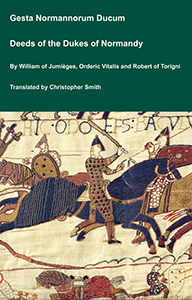
The Deeds of the Dukes of Normandy
The Gesta Normannorum Ducum [The Deeds of the Dukes of Normandy] is a landmark medieval chronicle tracing the rise and fall of the Norman dynasty from its early roots through the pivotal events surrounding the Norman Conquest of England. Originally penned in Latin by the monk William of Jumièges shortly before 1060 and later expanded at the behest of William the Conqueror, the work chronicles the deeds, politics, battles, and leadership of the Norman dukes, especially William’s own claim to the English throne. The narrative combines earlier historical sources with firsthand information and oral testimony to present an authoritative account of Normandy’s transformation from a Viking settlement into one of medieval Europe’s most powerful realms. William’s history emphasizes the legitimacy, military prowess, and governance of the Norman line, framing their expansion, including the conquest of England, as both divinely sanctioned and noble in purpose. Later chroniclers such as Orderic Vitalis and Robert of Torigni continued the history, extending the coverage into the 12th century, providing broader context on ducal rule and its impact. Today this classic work remains a foundational source for understanding Norman identity, medieval statesmanship, and the historical forces that reshaped England and Western Europe between 800AD and 1100AD.
Available at Amazon in eBook and Paperback format.
Chevron is in Charges.
See: Chevron Argent, Chevron Engrailed, Chevron Ermine, Chevron Gules, Chevron Or, Chevron Sable, Chevrons.
Chevron. A v-shape, pointing upwards unless specified inverted.
 Monck Arms. Gules, a chevron between three lion's heads erased argent. Source.
 Berkeley Arms. Gules a chevron between ten crosses pattee six in chief and four in base argent.
 Mordaunt Arms. Argent, a chevron between three estoiles sable. Source.
 Chicheley Arms. Or, a chevron between three cinquefoils gules. Source.
 Mosley Arms. Sable a chevron between three pickaxes argent. Source.
 Finch Arms. Argent, a chevron between three griffins passant sable. Source.
 Ponsonby Arms. Gules, a chevron between three combs argent. Source.
 Rich Arms. Gules, a chevron between three crosses botonée or. Source.
 Lyttleton Arms. Argent, a chevron between three escallops sable. Source.
 Robinson Arms. Vert, a chevron between three bucks at gaze or. Source.
 Braye Arms. Argent, a chevron between three eagle's legs erased sable. Source.
 Tilney Arms. Azure, a chevron between three griffin's heads erased or. Source.
 Mansel Arms. Argent, a chevron between three maunches. Source.
The History of William Marshal was commissioned by his son shortly after William’s death in 1219 to celebrate the Marshal’s remarkable life; it is an authentic, contemporary voice. The manuscript was discovered in 1861 by French historian Paul Meyer. Meyer published the manuscript in its original Anglo-French in 1891 in two books. This book is a line by line translation of the first of Meyer’s books; lines 1-10152. Book 1 of the History begins in 1139 and ends in 1194. It describes the events of the Anarchy, the role of William’s father John, John’s marriages, William’s childhood, his role as a hostage at the siege of Newbury, his injury and imprisonment in Poitou where he met Eleanor of Aquitaine and his life as a knight errant. It continues with the accusation against him of an improper relationship with Margaret, wife of Henry the Young King, his exile, and return, the death of Henry the Young King, the rebellion of Richard, the future King Richard I, war with France, the death of King Henry II, and the capture of King Richard, and the rebellion of John, the future King John. It ends with the release of King Richard and the death of John Marshal.
Available at Amazon in eBook and Paperback format.
 Fanshawe Arms. Or a chevron between three fleur de lys sable. Source.
 Littleton Arms. Argent, a chevron between three escallops sable. Source.
 Trefusis Arms. Argent, a chevron between three spindles sable. Source.
 Wyndham Arms. Azure, a chevron between three lion's heads erased or.
 Fox Arms. Ermine, on a chevron azure three fox's heads and necks erased or on a canton of the second a fleur de lys of the third. The canton is an augmentation of honour to his paternal arms, granted out of the Royal Arms as a mark of esteem to him and his heirs forever, by King Charles II following the Restoration of the Monarchy. Source.


 Brooke Arms. Gules, on a chevron argent a lion rampant sable crowned or. Source.
 Carr Arms. Gules, on a chevron argent, three mullets, of the field.
 Knollys Arms. Gules, on a chevron argent, three roses gules, barbed and seeded proper. Source.
William of Worcester's Chronicle of England
William of Worcester, born around 1415, and died around 1482 was secretary to John Fastolf, the renowned soldier of the Hundred Years War, during which time he collected documents, letters, and wrote a record of events. Following their return to England in 1440 William was witness to major events. Twice in his chronicle he uses the first person: 1. when writing about the murder of Thomas, 7th Baron Scales, in 1460, he writes '… and I saw him lying naked in the cemetery near the porch of the church of St. Mary Overie in Southwark …' and 2. describing King Edward IV's entry into London in 1461 he writes '… proclaimed that all the people themselves were to recognize and acknowledge Edward as king. I was present and heard this, and immediately went down with them into the city'. William’s Chronicle is rich in detail. It is the source of much information about the Wars of the Roses, including the term 'Diabolical Marriage' to describe the marriage of Queen Elizabeth Woodville’s brother John’s marriage to Katherine, Dowager Duchess of Norfolk, he aged twenty, she sixty-five or more, and the story about a paper crown being placed in mockery on the severed head of Richard, 3rd Duke of York.
Available at Amazon in eBook and Paperback format.
 Loftus Arms. Sable, a chevron engrailed ermine, between three trefoils slipped argent. Source.
 Child Villiers Arms. Quarterly 1&4
  Villiers Arms and 2&3 Child Arms gules a chevron engrailed ermine between three eaglets argent gorged or. Source.
 Watson Arms. Argent, on a chevron engrailed azure between three martlets sable as many crescents or. Source.
 Baron Annaly Arms. Argent, on a chevron engrailed gules, between three roses of the last, a cross crosslet or. Source.
 Beaumont Arms. Chequy or and azure a chevron ermine. Source.
 Blennerhassett Arms. Gules, a chevron ermine, between three dolphins naiant embowed argent. Source.
 Clotworthy Arms. Azure, a chevron ermine between three chaplets or. Source.
 Gresham Arms. Argent, a chevron ermine between three mullets pierced sable.
 Townshend Arms. Azure, a chevron ermine between three escallops argent. Source.
 Turner Baronets Arms. Sable, a chevron ermine between three fers de moline or on a chief argent a lion passant gules. Source.
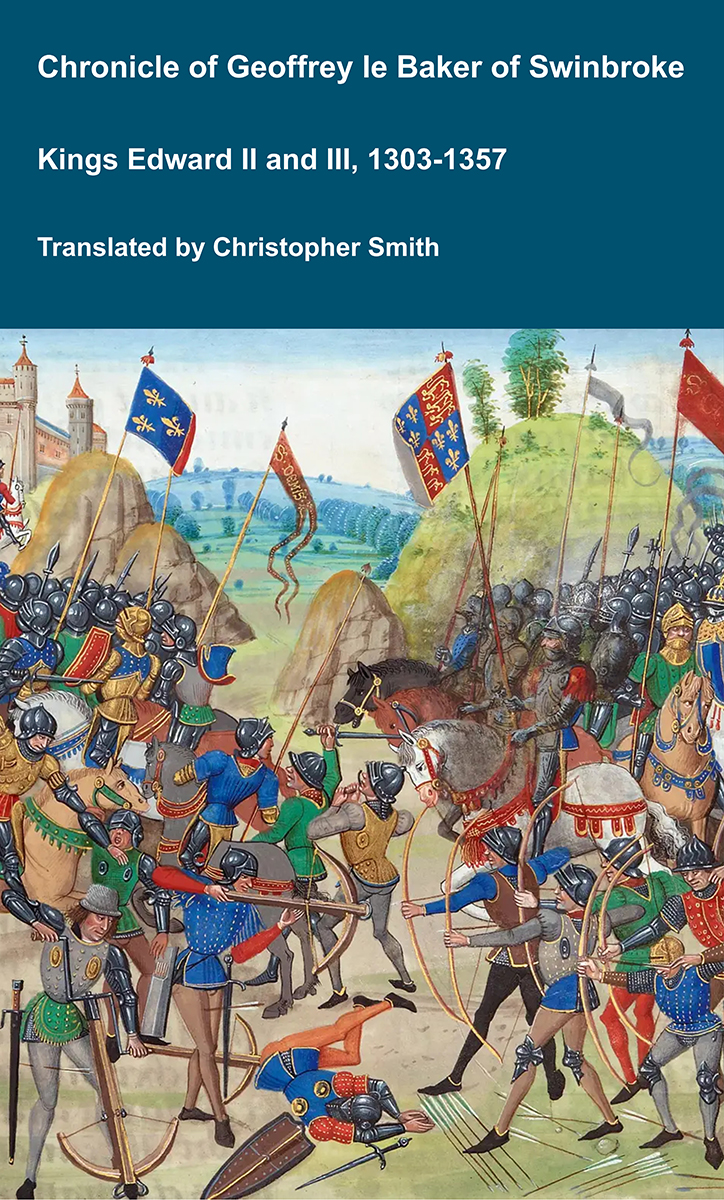
Chronicle of Geoffrey le Baker of Swinbroke
Baker was a secular clerk from Swinbroke, now Swinbrook, an Oxfordshire village two miles east of Burford. His Chronicle describes the events of the period 1303-1356: Gaveston, Bannockburn, Boroughbridge, the murder of King Edward II, the Scottish Wars, Sluys, Crécy, the Black Death, Winchelsea and Poitiers. To quote Herbert Bruce 'it possesses a vigorous and characteristic style, and its value for particular events between 1303 and 1356 has been recognised by its editor and by subsequent writers'. The book provides remarkable detail about the events it describes. Baker's text has been augmented with hundreds of notes, including extracts from other contemporary chronicles, such as the Annales Londonienses, Annales Paulini, Murimuth, Lanercost, Avesbury, Guisborough and Froissart to enrich the reader's understanding. The translation takes as its source the 'Chronicon Galfridi le Baker de Swynebroke' published in 1889, edited by Edward Maunde Thompson.
Available at Amazon in eBook and Paperback format.
 Tuchet Arms. Ermine, a chevron gules. Source.
 Brudenell Arms. Argent, a chevron gules between three morion caps azure pointed to the sinister. Source.
 Boleyn Arms. Argent, a chevron gules between three bull's heads afrontée. Source.
 Gorges Arms. Lozengy or and azure, a chevron gules. Source.
 Newport Arms. Argent, a chevron gules between three leopard's faces sable. Source.
 Stafford Arms. Or, a chevron gules.
 Belasyse Arms. Argent a chevron gules between three fleur de lys azure. Source.
 Barkham Arms. Paly argent and gules a chevron or.
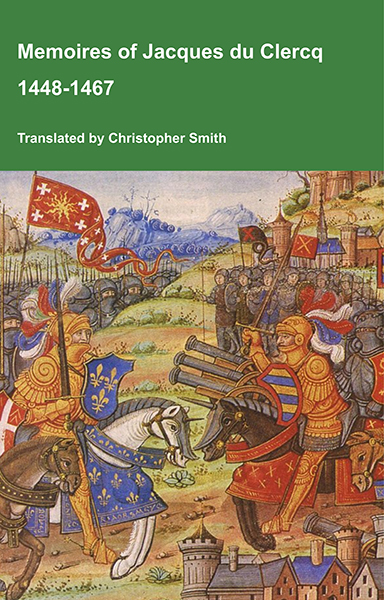
This is a translation of the 'Memoires of Jacques du Clercq', published in 1823 in two volumes, edited by Frederic, Baron de Reissenberg. In his introduction Reissenberg writes: 'Jacques du Clercq tells us that he was born in 1424, and that he was a licentiate in law and a counsellor to Philip the Good, Duke of Burgundy, in the castellany of Douai, Lille, and Orchies. It appears that he established his residence at Arras. In 1446, he married the daughter of Baldwin de la Lacherie, a gentleman who lived in Lille. We read in the fifth book of his Memoirs that his father, also named Jacques du Clercq, had married a lady of the Le Camelin family, from Compiègne. His ancestors, always attached to the counts of Flanders, had constantly served them, whether in their councils or in their armies.' The Memoires cover a period of nineteen years beginning in in 1448, ending in in 1467. It appears that the author had intended to extend the Memoirs beyond that date; no doubt illness or death prevented him from carrying out this plan. As Reissenberg writes the 'merit of this work lies in the simplicity of its narrative, in its tone of good faith, and in a certain air of frankness which naturally wins the reader’s confidence.' Du Clercq ranges from events of national and international importance, including events of the Wars of the Roses in England, to simple, everyday local events such as marriages, robberies, murders, trials and deaths, including that of his own father in Book 5; one of his last entries.
Available at Amazon in eBook and Paperback format.
 Cobham Arms. Gules a chevron or three lions rampant sable. Source.
 Danvers Arms. Gules a chevron or three estoiles. Source.
 Wentworth Arms. Sable, a chevron or three leopard's faces or. Source.
 Wodehouse Arms. Sable a chevron or between three cinquefoils. Source.
 Wodehouse Augmented Arms. Wodehouse Arms augmented with a chevron or guttée de sang. The Wodehouse arms were augmented after the Battle of Agincourt. Source.
 Clare Arms. Or three chevrons gules. Source.
 Fitzhugh Arms. Azure, three chevrons interlaced in base or a chief of the last. Source.
 Hainault Arms. Or, three chevrons sable. Source.

Around 1577 George Gower (age 37). Portrait of Richard Drake (age 42). The heraldic escutcheon shows seven quarters as follows:
1:  Drake of Ash Arms. Drake of Ash in the parish of Musbury, Devon.
2: Argent, on a chief gules three cinquefoils of the first; Billet of Ash.
3: Gules, on a fess argent two mullets sable; Hamton of Rockbere and Ash.
4: Ermine, on a chief indented sable three crosslets fitchee or; Orwey of Orwey and Ash.
5: Barry of seven argent and sable.
6: Azure, six lions rampant argent crowned Gules, 3, 2, 1; Forde of Forde.
7: Argent, two chevrons sable (Esse/Ash of Ash); Esse or Ash of Ash.
 Daubeney Arms. Or, two chevrons gules three griffin's heads. Source.
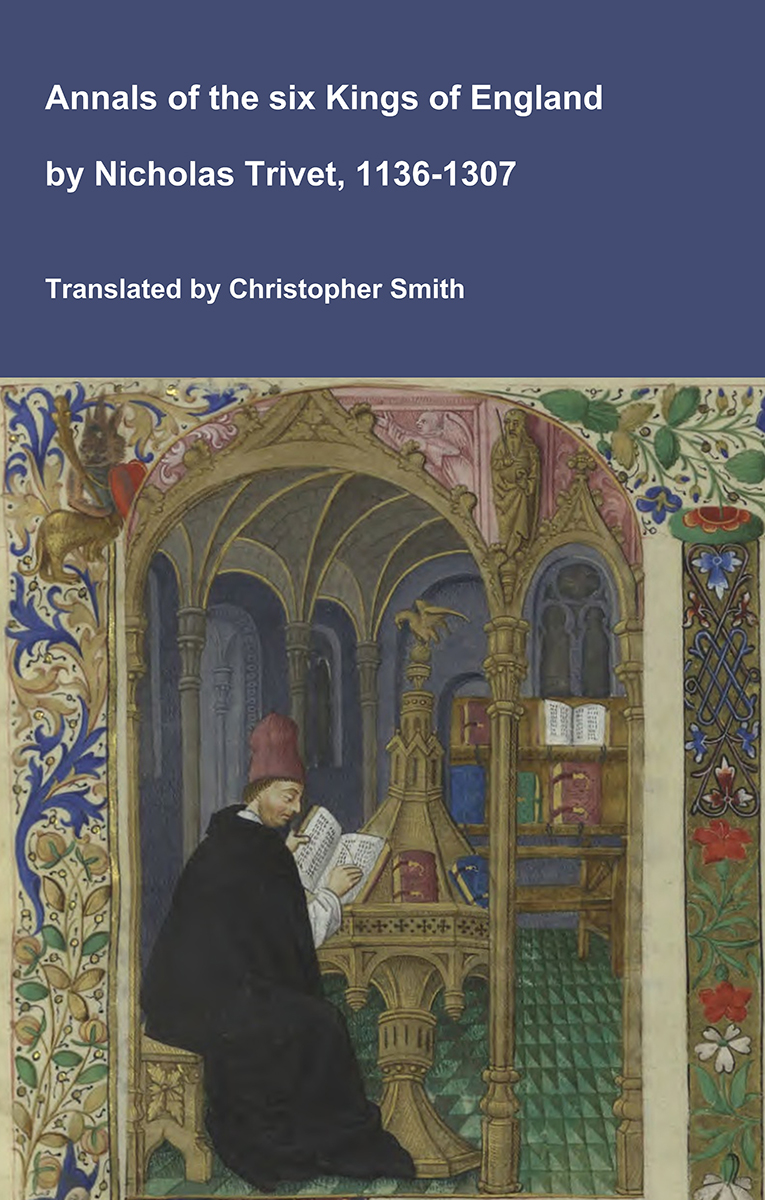
Annals of the six Kings of England by Nicholas Trivet
Translation of the Annals of the Six Kings of England by that traces the rise and rule of the Angevin aka Plantagenet dynasty from the mid-12th to early 14th century. Written by the Dominican scholar Nicholas Trivet, the work offers a vivid account of English history from the reign of King Stephen through to the death of King Edward I, blending political narrative with moral reflection. Covering the reigns of six monarchs—from Stephen to Edward I—the chronicle explores royal authority, rebellion, war, and the shifting balance between crown, church, and nobility. Trivet provides detailed insight into defining moments such as baronial conflicts, Anglo-French rivalry, and the consolidation of royal power under Edward I, whose reign he describes with particular immediacy. The Annals combines careful year-by-year reporting with thoughtful interpretation, presenting history not merely as a sequence of events but as a moral and political lesson. Ideal for readers interested in medieval history, kingship, and the origins of the English state, this chronicle remains a valuable and accessible window into the turbulent world of the Plantagenet kings.
Available at Amazon in eBook and Paperback format.
 Fitzwalter Arms. Or, a fess gules between two chevrons of the last. Source.
 Lisle Arms. Or a fess between two chevrons sable. Source.
 Walpole Arms. Or a fess between two chevrons sable three cross crosslets of the field. Source.


_Arms.png)


.svg)


.png)


#/media/File:Blason_Louise_d'Abos.svg)


.svg)

.svg)
