

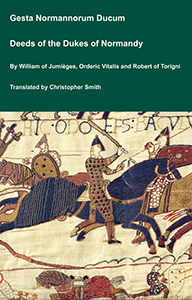
The Deeds of the Dukes of Normandy
The Gesta Normannorum Ducum [The Deeds of the Dukes of Normandy] is a landmark medieval chronicle tracing the rise and fall of the Norman dynasty from its early roots through the pivotal events surrounding the Norman Conquest of England. Originally penned in Latin by the monk William of Jumièges shortly before 1060 and later expanded at the behest of William the Conqueror, the work chronicles the deeds, politics, battles, and leadership of the Norman dukes, especially William’s own claim to the English throne. The narrative combines earlier historical sources with firsthand information and oral testimony to present an authoritative account of Normandy’s transformation from a Viking settlement into one of medieval Europe’s most powerful realms. William’s history emphasizes the legitimacy, military prowess, and governance of the Norman line, framing their expansion, including the conquest of England, as both divinely sanctioned and noble in purpose. Later chroniclers such as Orderic Vitalis and Robert of Torigni continued the history, extending the coverage into the 12th century, providing broader context on ducal rule and its impact. Today this classic work remains a foundational source for understanding Norman identity, medieval statesmanship, and the historical forces that reshaped England and Western Europe between 800AD and 1100AD.
Available at Amazon in eBook and Paperback format.
Crescent is in Charges.
See: Crescents Argent, Crescents Or.
On 12th March 1560. [Some sources say 25th February 1560] Catherine Blount (deceased) died. On 11th August 1580 Maurice Berkeley (age 54) died. Church of St Mary, Bruton [Map]. Elizabethan Period recumbent effigies of himself and his two wives Catherine Blount and Elizabeth Sands (age 27) in an Easter sepulchre-type recess with double round arched front, Corinthian pilasters and strapwork panels. Ruff. Panel with quartered arms 1  Berkeley Arms 2 probably
  Tiptoft Arms, possibly Wotton Arms 3 Unknown Arms 4 probably
  Babington Arms, possibly
  Zouche Arms differenced with a label three points, overall a Crescent.
Catherine Blount: John Champernowne and she were married. Around 1518 she was born to William Blount 4th Baron Mountjoy and Alice Keble Baroness Mountjoy. After 1541 Maurice Berkeley and she were married. They were sixth cousins. Henry Machyn's Diary. 12th March 1560. The xij day of Marche was bered at Dyttun [Map] my lade Barkeley, the wyff of ser Mores Barthelay knyght, with a penon of armes and a iiij dosen of skochyons, and a harold of armes, master Rychemond.
Elizabeth Sands: In 1533 she was born to Anthony Sands of Throwley in Kent. In 1562 Maurice Berkeley and she were married. The difference in their ages was 27 years. On 16th June 1585 she died at Berkeley House. She was buried at the St James' Church, Clerkenwell where a monument was constructed. Before 16th June 1685 she was appointed Lady of the Bedchamber to Queen Elizabeth I of England and Ireland.


On 10th July 1759 Catherine Blount Freeman (age 22) died of a malignant fever. She was buried at St Andrew's Church, Wimpole [Map]. Armorial  Yorke Arms differenced with a crescent to indicate son of the current holder; her husband Charles Yorke (age 36) with an inescutcheon of Freeman Arms quartered with unknown arms two lions passant guardant with a bordure engrailed.
Stylised sarcophagus in white veined marble, bearing a white inscription panel; above is an urn in brown marble against a grey background standing on a base of three steps around which are grouped three putti: two garlanding the urn while the third stands by in dejection with reversed torch; in front of the steps is a portrait medallion and at the base of the sarcophagus is an achievement of arms; signed 'JAMES STUART (age 46), INVT. PR. SCHEEMAKERS (age 68), SCULP. MDCCLXI'.
Catherine Blount Freeman: Around 1737 she was born to William Freeman of Hamels in Hertfordshire and Catherine Blount. On 19th May 1755 Charles Yorke and she were married. He the son of Philip Yorke 1st Earl of Hardwicke and Margaret Cocks Countess Hardwicke.


 Scott Arms. Or, on a bend azure a mullet of six points between two crescents of the field. Source.
 Salusbury Arms. Gules a lion rampant argent three crescents argent.
 Jermyn Arms. Sable, a crescent between two mullets in pale argent. Source.
 Tennant Arms. Argent, two crescents in fess sable on a chief gules a boar's head couped of the first. Source.
 Hovell Arms. Sable, a crescent or.
NO IMAGE. Or, a chief indented azure, a crescent for difference. Source.
 Coventry Arms. Sable a fess between three crescents or. Source.
The History of William Marshal was commissioned by his son shortly after William’s death in 1219 to celebrate the Marshal’s remarkable life; it is an authentic, contemporary voice. The manuscript was discovered in 1861 by French historian Paul Meyer. Meyer published the manuscript in its original Anglo-French in 1891 in two books. This book is a line by line translation of the first of Meyer’s books; lines 1-10152. Book 1 of the History begins in 1139 and ends in 1194. It describes the events of the Anarchy, the role of William’s father John, John’s marriages, William’s childhood, his role as a hostage at the siege of Newbury, his injury and imprisonment in Poitou where he met Eleanor of Aquitaine and his life as a knight errant. It continues with the accusation against him of an improper relationship with Margaret, wife of Henry the Young King, his exile, and return, the death of Henry the Young King, the rebellion of Richard, the future King Richard I, war with France, the death of King Henry II, and the capture of King Richard, and the rebellion of John, the future King John. It ends with the release of King Richard and the death of John Marshal.
Available at Amazon in eBook and Paperback format.
 Dorward Arms. Ermine on a chevron sable, three crescents or.
 Preston Arms. Or, a chief sable three crescents or.
 Watson Arms. Argent, on a chevron engrailed azure between three martlets sable as many crescents or. Source.


.svg)

#/media/File:Strode_OfParnham_Arms.svg)

#/media/File:Butler_arms_(Earl_of_Carrick).svg)


