

Abbot John Whethamstede’s Chronicle of the Abbey of St Albans
Abbot John Whethamstede's Register aka Chronicle of his second term at the Abbey of St Albans, 1451-1461, is a remarkable text that describes his first-hand experience of the beginning of the Wars of the Roses including the First and Second Battles of St Albans, 1455 and 1461, respectively, their cause, and their consequences, not least on the Abbey itself. His text also includes Loveday, Blore Heath, Northampton, the Act of Accord, Wakefield, and Towton, and ends with the Coronation of King Edward IV. In addition to the events of the Wars of the Roses, Abbot John, or his scribes who wrote the Chronicle, include details in the life of the Abbey such as charters, letters, land exchanges, visits by legates, and disputes, which provide a rich insight into the day-to-day life of the Abbey, and the challenges faced by its Abbot.
Available at Amazon in eBook and Paperback format.
Died of plague is in Disease.
In 664 Bishop Tuda died of plague.
On 14th July 664 Archbishop Deusdedit died of plague.
On 21st May 1259 Bishop Fulk Basset [aged 70] died of plague. On 25th May 1259 he was buried at St Paul's Cathedral [Map].
In September 1343 Gaston Foix II Count Foix [aged 35] died of plague at Seville. His son Gaston [aged 12] succeeded III Count Foix.
In June 1348 the The Black Death arrived in England. The first of many occurrences. It is estimated to have killed between 25 to 60 percent of the population of around six million. The outbreak lasted through 1349 recurring in 1362, 1369 and regularly thereafter until its last significant outbreak in The Great Plague of 1666.
On 11th September 1349 Bonne Luxemburg Queen Consort France [aged 34] died of plague in Maubisson, Pontoise.
In 1348 John Savoy [aged 10] died of plague during the The Black Death.
In 1348 John Barcelona [aged 31] died of plague.
On 6th June 1349 William Harcourt [aged 49] died of plague at Stanton Harcourt, Oxfordshire [Map].
On 29th September 1349 Margaret Wake Countess Kent [aged 52] died of plague. Her son John [aged 19] succeeded 4th Baron Wake of Liddell and inherited her dower lands and the estates she had inherited from her brother Thomas Wake 2nd Baron Wake of Liddell.
On 26th March 1350 Alfonso "Avenger" XI King Castile [aged 38] died of plague. His son Peter [aged 15] succeeded I King Castile.
On 20th August 1348 Robert Bourchier 1st Baron Bourchier died of plague whilst escorting King Edward III's daughter Joan [aged 14] [who died a fortnight later] to Spain to marry Peter, the future King Peter of Castile. His son John [aged 19] succeeded 2nd Baron Bourchier.
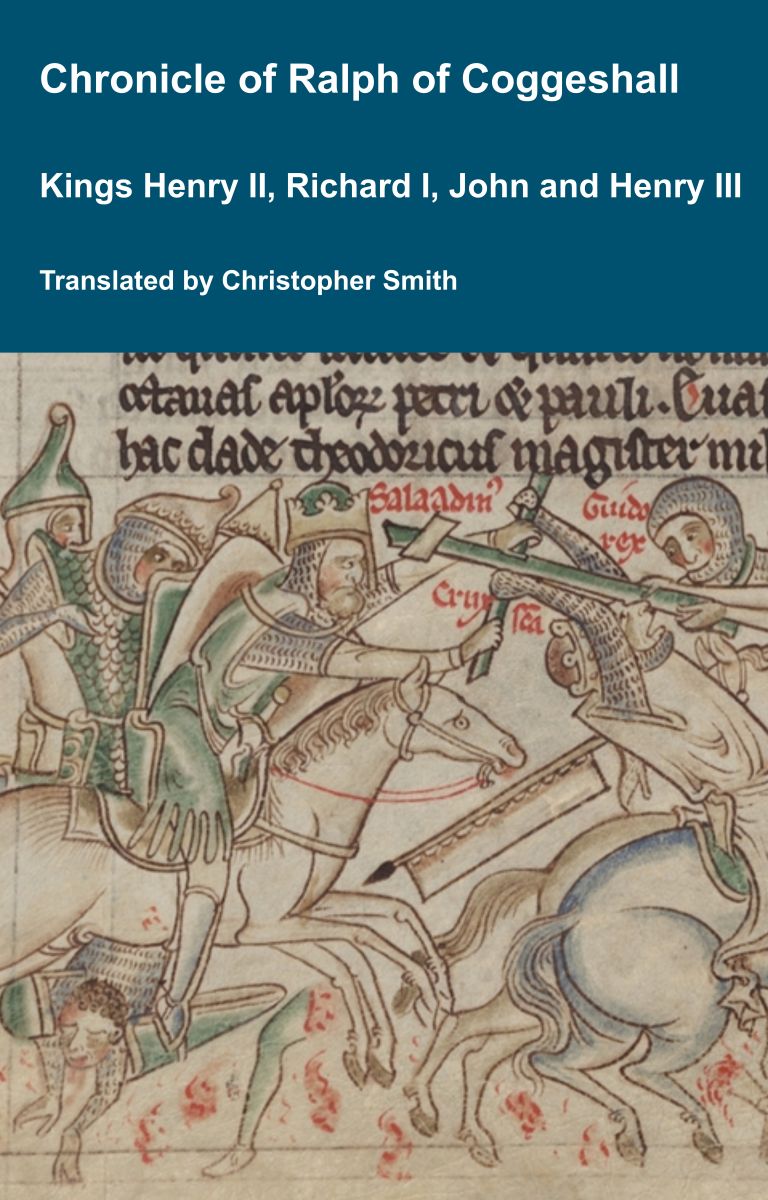
Chronicle of Abbot Ralph of Coggeshall
The Chronicle of Abbot Ralph of Coggeshall (Chronicon Anglicanum) is an indispensable medieval history that brings to life centuries of English and European affairs through the eyes of a learned Cistercian monk. Ralph of Coggeshall, abbot of the Abbey of Coggeshall in Essex in the early 13th century, continued and expanded his community’s chronicle, documenting events from the Norman Conquest of 1066 into the tumultuous reign of King Henry III. Blending eyewitness testimony, careful compilation, and the monastic commitment to record-keeping, this chronicle offers a rare narrative of political intrigue, royal power struggles, and social upheaval in England and beyond. Ralph’s work captures the reigns of pivotal figures such as Richard I and King John, providing invaluable insights into their characters, decisions, and the forces that shaped medieval rule. More than a simple annal, Chronicon Anglicanum conveys the texture of medieval life and governance, making it a rich source for scholars and readers fascinated by English history, monastic authorship, and the shaping of the medieval world.
Available at Amazon in eBook and Paperback format.
On 30th October 1348 Eleanor Burgundy Queen Consort Aragon [aged 20] died of plague. See Masearo, Condes de Barcelona, Volume 2, p. 274.
On 20th May 1349 Archbishop John de Ufford died of plague.
On 26th August 1349 Archbishop Thomas Bradwardine [aged 49] died of plague.
On 4th October 1361 John Mowbray 3rd Baron Mowbray [aged 50] died of plague. His son John [aged 21] succeeded 4th Baron Mowbray.
On 5th October 1361 Reginald Cobham 1st Baron Cobham [aged 66] died of plague at Lingfield, Surrey. He was buried at Lingfield, Surrey. His son Reginald [aged 13] succeeded 2nd Baron Cobham.
On 7th September 1362 Joan of the Tower Queen Consort Scotland [aged 41] died of plague at Hertford Castle [Map]. She was buried at either Christ Church, Greyfriars [Map] or Greyfriars Church Farringdon Within [Map].
On 13th November 1369 Thomas Beauchamp 11th Earl Warwick [aged 56] died of plague. His son Thomas [aged 31] succeeded 12th Earl Warwick. Margaret Ferrers Countess Warwick [aged 22] by marriage Countess Warwick.
On 20th September 1370 Edward Plantagenet [aged 6] died of plague at Bordeaux [Map].
On 7th June 1394 Anne of Bohemia Queen Consort England [aged 28] died of plague (probably) at Sheen Palace [Map]. King Richard II of England [aged 27] was so distraught at her death he ordered the destruction of Sheen Palalce [Map].


In October 1397 Henry of Bar [aged 33] died of plague at Treviso [Map].
On 22nd September 1399 Thomas Mowbray 1st Duke of Norfolk [aged 31] died of plague in Venice [Map] whilst in exile. He was buried at St Mark's Cathedral, Venice [Map]. Duke Norfolk forfeit. His son Thomas [aged 14] succeeded 4th Earl Norfolk, 2nd Earl Nottingham, 7th Baron Mowbray, 8th Baron Segrave and Earl Marshal.
In 1403 George Douglas 1st Earl Angus [aged 23] died of plague. His son William [aged 5] succeeded 2nd Earl Angus.
Henrici Quinti, Angliæ Regis, Gesta, is a first-hand account of the Agincourt Campaign, and subsequent events to his death in 1422. The author of the first part was a Chaplain in King Henry's retinue who was present from King Henry's departure at Southampton in 1415, at the siege of Harfleur, the battle of Agincourt, and the celebrations on King Henry's return to London. The second part, by another writer, relates the events that took place including the negotiations at Troye, Henry's marriage and his death in 1422.
Available at Amazon in eBook and Paperback format.
On 22nd September 1405 Barnim Griffins 6th Duke Pomerania [aged 40] died of plague. His son Barnim succeeded 7th Duke Pomerania.
On 14th August 1414 Guy Montfort Baron Laval [aged 29] died of plague following his return from the Holy Land.
On 31st August 1433 Peter Luxemburg I Count Saint Pol [aged 43] died of plague at Rambures, Somme. His son Louis [aged 15] succeeded I Count Saint Pol.
On 3rd November 1456 Edmund Tudor 1st Earl Richmond [aged 26] died of plague at Carmarthen Castle [Map] leaving his thirteen year old wife Margaret Beaufort Countess Richmond [aged 13] pregnant with their child Henry Tudor, the future King Henry VII. His son Henry Tudor succeeded 2nd Earl Richmond posthumously.

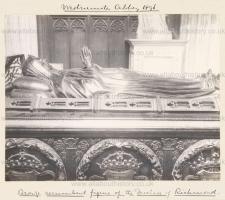


In 1462 or 1467 Christopher Plunkett 2nd Baron Killeen [aged 14] died of plague. His brother Edmund [aged 13] succeeded 3rd Baron Killeen.
On 18th November 1463 John Wittelsbach IV Duke Bavaria [aged 26] died of plague. His brother Sigismund [aged 24] succeeded Duke Bavaria.
On or after 20th May 1474 John VI Duke of Mecklenburg [deceased] died of plague.
In March 1479 George York 1st Duke Bedford [aged 2] died of plague at Windsor Castle [Map]. Duke Bedford extinct.
On 29th May 1500 Archbishop Thomas Rotherham [aged 76] died of plague at Cawood, North Yorkshire [Map].
On 27th January 1501 Bishop Thomas Langton died of plague. He was buried in a marble tomb within 'a very fair chapel' which he had built south of the lady-chapel in Winchester Cathedral [Map].
On 15th March 1530 Katherine Howard Countess Derby [aged 15] died of plague.
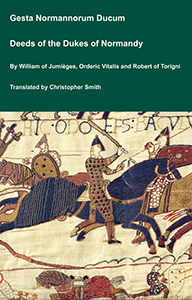
The Deeds of the Dukes of Normandy
The Gesta Normannorum Ducum [The Deeds of the Dukes of Normandy] is a landmark medieval chronicle tracing the rise and fall of the Norman dynasty from its early roots through the pivotal events surrounding the Norman Conquest of England. Originally penned in Latin by the monk William of Jumièges shortly before 1060 and later expanded at the behest of William the Conqueror, the work chronicles the deeds, politics, battles, and leadership of the Norman dukes, especially William’s own claim to the English throne. The narrative combines earlier historical sources with firsthand information and oral testimony to present an authoritative account of Normandy’s transformation from a Viking settlement into one of medieval Europe’s most powerful realms. William’s history emphasizes the legitimacy, military prowess, and governance of the Norman line, framing their expansion, including the conquest of England, as both divinely sanctioned and noble in purpose. Later chroniclers such as Orderic Vitalis and Robert of Torigni continued the history, extending the coverage into the 12th century, providing broader context on ducal rule and its impact. Today this classic work remains a foundational source for understanding Norman identity, medieval statesmanship, and the historical forces that reshaped England and Western Europe between 800AD and 1100AD.
Available at Amazon in eBook and Paperback format.
Before 1541 Thomas Fiennes [aged 4] died of plague.
In 1583 Walter Corbet died of plague.
In 1613 John Leveson of Haling Kent [aged 26] died of plague.

On 4th August 1624 Emanuel Filibert of Savoy [aged 36] died of plague.

In August 1625 John Fletcher [aged 45] died of plague.
On 13th September 1631 Elizabeth Southwell [aged 48] died of plague in Florence, Tuscany.
On 1st July 1641 George Hastings [aged 51] died of plague.

On 26th November 1651 Henry Ireton [aged 40] died of plague.
On 25th August 1665 Alexander Burnett died of plague.
On 1st March 1666 Talbot Pepys [aged 83] died of plague.
On 29th September 1665 Martin Noell [aged 65] died of plague.
Chronicle of Walter of Guisborough
A canon regular of the Augustinian Guisborough Priory, Yorkshire, formerly known as The Chronicle of Walter of Hemingburgh, describes the period from 1066 to 1346. Before 1274 the Chronicle is based on other works. Thereafter, the Chronicle is original, and a remarkable source for the events of the time. This book provides a translation of the Chronicle from that date. The Latin source for our translation is the 1849 work edited by Hans Claude Hamilton. Hamilton, in his preface, says: 'In the present work we behold perhaps one of the finest samples of our early chronicles, both as regards the value of the events recorded, and the correctness with which they are detailed; Nor will the pleasing style of composition be lightly passed over by those capable of seeing reflected from it the tokens of a vigorous and cultivated mind, and a favourable specimen of the learning and taste of the age in which it was framed.'
Available at Amazon in eBook and Paperback format.
John Sutherland died of plague.