

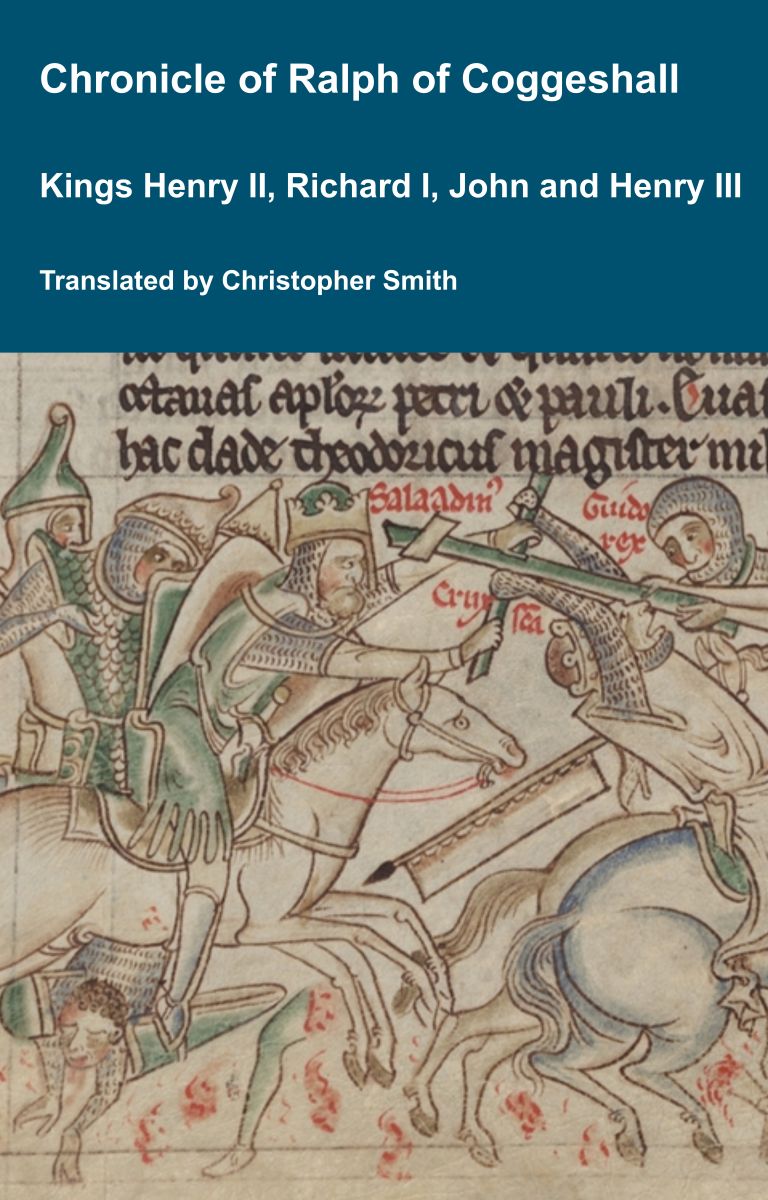
Chronicle of Abbot Ralph of Coggeshall
The Chronicle of Abbot Ralph of Coggeshall (Chronicon Anglicanum) is an indispensable medieval history that brings to life centuries of English and European affairs through the eyes of a learned Cistercian monk. Ralph of Coggeshall, abbot of the Abbey of Coggeshall in Essex in the early 13th century, continued and expanded his community’s chronicle, documenting events from the Norman Conquest of 1066 into the tumultuous reign of King Henry III. Blending eyewitness testimony, careful compilation, and the monastic commitment to record-keeping, this chronicle offers a rare narrative of political intrigue, royal power struggles, and social upheaval in England and beyond. Ralph’s work captures the reigns of pivotal figures such as Richard I and King John, providing invaluable insights into their characters, decisions, and the forces that shaped medieval rule. More than a simple annal, Chronicon Anglicanum conveys the texture of medieval life and governance, making it a rich source for scholars and readers fascinated by English history, monastic authorship, and the shaping of the medieval world.
Available at Amazon in eBook and Paperback format.
Garter Collar is in Garter Knights.

In 1546 Unknown Painter. Italian. Portrait of Henry Howard Earl of Surrey [aged 30] wearing his Garter Collar and Leg Garter. His right  Thomas of Brotherton 1st Earl Norfolk 1300 1338 Arms, his left
  Thomas of Woodstock 1st Duke of Gloucester Arms.

In 1559 Hans Eworth [aged 39]. Portrait of Anthony Browne 1st Viscount Montagu [aged 30] wearing a Garter Collar and St George Pendant.

In 1573 Unknown Painter. Portrait of Henry Sidney [aged 44] wearing his Garter Collar.

Around 1575 Unknown Painter. Portrait of Robert Dudley 1st Earl of Leicester [aged 42] wearing his Garter Collar.

Around 1576 Unknown Painter. Portrait of William Paulet 1st Marquess Winchester wearing his Garter Collar and Lord Treasurer Staff of Office.

Around 1580 based on a work of 1565.Unknown Painter. Portrait of Robert Radclyffe 5th Earl of Sussex [aged 6] wearing his Garter Collar and holding the Lord Treasurer Staff of Office.

In 1583 Unknown Painter. Portrait of Edward Clinton 1st Earl Lincoln [aged 71] wearing his Garter Collar.

Around 1605 John Critz [aged 54]. Portrait of King James I of England and Ireland and VI of Scotland [aged 38] with Garter Collar and Leg Garter.

Around 1615 Unknown Painter. Posthumous portrait of Philip Herbert 4th Earl Pembroke 1st Earl Montgomery [aged 30] wearing his Garter Robes and Garter Collar.

In 1619 Daniel Mijtens [aged 29]. Portrait of William Knollys 1st Earl Banbury [aged 75] wearing his Garter Collar and Leg Garter.
Chronicle of Abbot Ralph of Coggeshall
The Chronicle of Abbot Ralph of Coggeshall (Chronicon Anglicanum) is an indispensable medieval history that brings to life centuries of English and European affairs through the eyes of a learned Cistercian monk. Ralph of Coggeshall, abbot of the Abbey of Coggeshall in Essex in the early 13th century, continued and expanded his community’s chronicle, documenting events from the Norman Conquest of 1066 into the tumultuous reign of King Henry III. Blending eyewitness testimony, careful compilation, and the monastic commitment to record-keeping, this chronicle offers a rare narrative of political intrigue, royal power struggles, and social upheaval in England and beyond. Ralph’s work captures the reigns of pivotal figures such as Richard I and King John, providing invaluable insights into their characters, decisions, and the forces that shaped medieval rule. More than a simple annal, Chronicon Anglicanum conveys the texture of medieval life and governance, making it a rich source for scholars and readers fascinated by English history, monastic authorship, and the shaping of the medieval world.
Available at Amazon in eBook and Paperback format.

In 1621 Daniel Mijtens [aged 31]. Portrait of King James I of England and Ireland and VI of Scotland [aged 54] wearing his Garter Collar and Leg Garter.

In 1630 Daniel Mijtens [aged 40]. Portrait of Thomas Howard 14th or 21st Earl of Arundel 4th Earl of Surrey 1st Earl Norfolk [aged 44] and wearing his Garter Collar.

In 1634 Daniel Mijtens [aged 44]. Portrait of Philip Herbert 4th Earl Pembroke 1st Earl Montgomery [aged 49] wearing his Leg Garter and Garter Collar.

Around 1634 Anthony Van Dyck [aged 34]. Portrait of James Stewart 4th Duke Lennox wearing his Leg Garter and Garter Collar.

Samuel Pepys' Diary. 9th October 1660. This morning Sir W. Batten [aged 59] with Colonel Birch [aged 45] to Deptford, to pay off two ships. Sir W. Pen [aged 39] and I staid to do business, and afterwards together to White Hall, where I went to my Lord, and found him in bed not well, and saw in his chamber his picture1, very well done; and am with child2 till I get it copied out, which I hope to do when he is gone to sea.
Note 1. Peter Lely [aged 42]. Portrait of Edward Montagu 1st Earl Sandwich [aged 35] in his Garter Robes and Garter Collar.
Note 2. A figurative expression for an eager longing desire, used by Udall and by Spenser. The latest authority given by Dr. Murray in the "New English Dictionary", is Bailey in 1725.

Around 1661 Peter Lely [aged 42]. Portrait of Charles Stewart 6th Duke Lennox in his Garter Robes and Garter Collar.

Around 1673 Peter Lely [aged 54]. Portrait of Charles II King Scotland in his Garter Robes and Garter Collar.

Around 1675 Peter Lely [aged 56]. Portrait of George Villiers 2nd Duke of Buckingham [aged 46] wearing his Garter Collar.

Around 1678 Peter Lely [aged 59]. Portrait of Charles II King Scotland in his Garter Robes and Garter Collar and Leg Garter.

Around 1680 Willem Wissing [aged 24]. Portrait of King William III of England, Scotland and Ireland [aged 29] wearing his Garter Collar.
The Deeds of the Dukes of Normandy
The Gesta Normannorum Ducum [The Deeds of the Dukes of Normandy] is a landmark medieval chronicle tracing the rise and fall of the Norman dynasty from its early roots through the pivotal events surrounding the Norman Conquest of England. Originally penned in Latin by the monk William of Jumièges shortly before 1060 and later expanded at the behest of William the Conqueror, the work chronicles the deeds, politics, battles, and leadership of the Norman dukes, especially William’s own claim to the English throne. The narrative combines earlier historical sources with firsthand information and oral testimony to present an authoritative account of Normandy’s transformation from a Viking settlement into one of medieval Europe’s most powerful realms. William’s history emphasizes the legitimacy, military prowess, and governance of the Norman line, framing their expansion, including the conquest of England, as both divinely sanctioned and noble in purpose. Later chroniclers such as Orderic Vitalis and Robert of Torigni continued the history, extending the coverage into the 12th century, providing broader context on ducal rule and its impact. Today this classic work remains a foundational source for understanding Norman identity, medieval statesmanship, and the historical forces that reshaped England and Western Europe between 800AD and 1100AD.
Available at Amazon in eBook and Paperback format.

Around 1686 Willem Wissing [aged 30]. Portrait of Lawrence Hyde 1st Earl Rochester [aged 43] wearing his Garter Robes including the Garter Collar and holding his white Lord Treasurer Staff of Office.