The History of William Marshal was commissioned by his son shortly after William’s death in 1219 to celebrate the Marshal’s remarkable life; it is an authentic, contemporary voice. The manuscript was discovered in 1861 by French historian Paul Meyer. Meyer published the manuscript in its original Anglo-French in 1891 in two books. This book is a line by line translation of the first of Meyer’s books; lines 1-10152. Book 1 of the History begins in 1139 and ends in 1194. It describes the events of the Anarchy, the role of William’s father John, John’s marriages, William’s childhood, his role as a hostage at the siege of Newbury, his injury and imprisonment in Poitou where he met Eleanor of Aquitaine and his life as a knight errant. It continues with the accusation against him of an improper relationship with Margaret, wife of Henry the Young King, his exile, and return, the death of Henry the Young King, the rebellion of Richard, the future King Richard I, war with France, the death of King Henry II, and the capture of King Richard, and the rebellion of John, the future King John. It ends with the release of King Richard and the death of John Marshal.
Available at Amazon in eBook and Paperback format.
Leg Garter is in Garter Knights.
On 26th July 1375 Richard Pembridge [aged 55] died. Hereford Cathedral [Map]. Alabaster altar-tomb and effigy, altar-tomb with moulded base and capping, sides and ends panelled with alternate quatrefoils enclosing shields of his arms and trefoil-headed panels; effigy in bascinet, Camail and Jupon Period. His jupon with same arms as his shield. Hip Belt, Leg Garter, right leg modern, head on helm crested with a Feathered Crest, feet on hound.


On 6th June 1441 William Phelip [aged 58] died. He was buried at St Mary's Church, Dennington [Map]. Monument to William Phelip and Joan Bardolf [aged 50]. Early Plate Bascinet and Gorget Period. Feathered Crest. Detail of the Wyvern on which her feet rest. Detail of Eagle, possibly hawk, on which his feet rest. Crespine Headress covering her hair. He wearing a bascinet with IHC NASARE Lettering. Both wearing a Lancastrian Esses Collar. Leg Garter below the left knee.
Joan Bardolf: On 11th November 1390 she was born to Thomas Bardolf 5th Baron Bardolf and Avice Cromwell Baroness Bardolf. She a great x 4 granddaughter of King Edward I of England. Before 1407 William Phelip and she were married. On 12th March 1447 Joan Bardolf died.


After 29th March 1461. Monument in Church of St Oswald, Methley [Map] to Lionel Welles 6th Baron Welles [deceased] and Joan or Cecily Waterton. He with short hair typical of the period, his head resting on great helm. Livery collar of linked chain, standard (the chain mail around the neck), wearing a coat of arms (or (gold) a lion sable (black)), leg garter at the knee, fluted period with tassets that protect the thighs, his feet on a lion. She wearing a horned headdress, her head resting on a cushion supported by angels, small linked collar. Both with hands clasped in prayer with lots of rings. Little dog chewing at her dress. Chest with Angels with Rounded Wings holding Shields. Dogs chewing at her dress with Studded Collar. Angels Supporting Pillow.
Joan or Cecily Waterton: she was born to Robert Waterton and Cecily Fleming. Before 14th April 1447 Lionel Welles 6th Baron Welles and she were married.


On 30th May 1499 John Cheney 1st Baron Cheyne [aged 57] died. Baron Cheyne extinct. Fluted Period. Alabaster Monument at Salisbury Cathedral [Map].
Fluted armour typified by having no headwear, being clean shaven, a breastplate in two pieces and the neck protected by a Standard. Damaged angel, its head removed, holding the cushion on which his head rests. He wearing a Lancastrian Esses Collar with large Esses. Ringed fingers.


Detail of the heavily graffitied Shoulder Garter.

Detail of the heavily graffitied Leg Garter and Poleyn.

Mutilated Lion at his feet with its head missing. The figure beneath his right foot appears to be a Bedesman. That beneath his left foot may be the remains of the means by which a bedesman was originally fixed to the foot. What appears to be a birds foot lying across the lions body is the tail of the lion.
After 1503. Monument to John de la Pole 2nd Duke of Suffolk and Elizabeth York Duchess Suffolk [aged 58] in St Andrew's Church, Wingfield [Map]. Finely made Fluted Period alabaster monument. Both wearing their ducal coronets. He wearing a Leg Garter. His head resting on a great helm with Saracen's Head Crest, feet resting on a Lion. Chunky Lions Mane.


After 20th September 1543. Alabaster Monument to Thomas Manners 1st Earl of Rutland [deceased] and Eleanor Paston Countess Rutland [aged 48] in the Chancel of St Mary the Virgin Church, Bottesford, Leicestershire [Map].
Chest with Weepers. Monument sculpted by Richard Parker of Burton on Trent.


Detail of his head with a short haircut and beard. He wearing a circlet, possibly coronet. His head resting on a Great Helm with Peacock in Pride ie with its feathers displayed.

His Mitten Gauntlets with the cloven-hooved foot of the Unicorn visible.

Detail of his Great Helm with Cap of Maintenance and the Manners Peacock in Pride ie with its feathers displayed.


Detail of the panels of the chest.

Detail of her dress with fastenings, heart locket, hands crasped in prayer.

In 1546 Unknown Painter. Italian. Portrait of Henry Howard Earl of Surrey [aged 30] wearing his Garter Collar and Leg Garter. His right  Thomas of Brotherton 1st Earl Norfolk 1300 1338 Arms, his left
  Thomas of Woodstock 1st Duke of Gloucester Arms.
After 20th June 1560. Hasting's Chapel, St Helen's Church, Ashby-de-la-Zouch [Map]. Monument to Francis Hastings 2nd Earl Huntingdon [deceased] and Catherine Pole Countess Huntingdon [aged 49] by Richard Parker of Burton on Trent. Chest tomb with five sons on one side, five daughters on the other side, and eldest son on the end. Elizabethan Period. Leg Garter. Garter Robes. Widow's Barbe. Lancastrian Esses and Inter-twined Knots Collar. Feet resting on the Manticore badge of the Hasting's family.
Inscription: "Here lyeth ye corps of Francys late Erle of Hutyngdun, Lord Hastyngs, Hungerford, Botreaux, Molyns, and Moyles, Knight of ye honorable order of ye Garter, which deceased ye XXth daye of June ao Dni 1561: and ye ladie Katheryn, Countisse of Hutyngdon his wife, which deceased ye XXIIId daye of Sepbr anno dni 1576". Moved at least twice. Some restoration.


After 17th September 1563. Alabaster Monument to Henry Manners 2nd Earl of Rutland [deceased] and Margaret Neville Countess Rutland at St Mary the Virgin Church, Bottesford, Leicestershire [Map].
Monument an unusual Table Tomb with their effigies beneath surmounted by effigies of their children. The table may once have been raised in the same way as the one at St Lawrence's Church, Snarford [Map] to Thomas St Paul which may be by the same carver.


His arms showing quarterly: 1&4:  Manners Augmented Arms. 2nd: Top Row:
  Ros Arms,
  Roet Arms, Trusbutt [or Belvoir], Bottom Row: Todeni [Albini ancient],
  Daubeney Arms,
  Badlesmere Arms. 3rd Quarterly: 1
  Thomas Holland 2nd Earl Kent 1350 1397 Arms, 2
  Tiptoft Arms, 3
  Vaux Arms 4.
  Powys Arms aka Charlton.

Her arms. Quartered 1&4  Neville Arms, 2 Thomas Holland 2nd Earl Kent 1350 1397 Arms, 4 Neville Ancient Arms.


Detail of his Leg Garter.

Peacock in Pride ie with its feathers displayed.


Detail of their children.


Detail of the corner of the pediment on which the arms are displayed decorated with fruit and detail of one of the legs of the table.


Detail of his armour, in his right hand a prayer-book, his left hand clutching his sword.

Detail of the Unicorn on which his feet rest and Lion on which her feet rest.

The Manners Peacock Crest.
The History of William Marshal was commissioned by his son shortly after William’s death in 1219 to celebrate the Marshal’s remarkable life; it is an authentic, contemporary voice. The manuscript was discovered in 1861 by French historian Paul Meyer. Meyer published the manuscript in its original Anglo-French in 1891 in two books. This book is a line by line translation of the first of Meyer’s books; lines 1-10152. Book 1 of the History begins in 1139 and ends in 1194. It describes the events of the Anarchy, the role of William’s father John, John’s marriages, William’s childhood, his role as a hostage at the siege of Newbury, his injury and imprisonment in Poitou where he met Eleanor of Aquitaine and his life as a knight errant. It continues with the accusation against him of an improper relationship with Margaret, wife of Henry the Young King, his exile, and return, the death of Henry the Young King, the rebellion of Richard, the future King Richard I, war with France, the death of King Henry II, and the capture of King Richard, and the rebellion of John, the future King John. It ends with the release of King Richard and the death of John Marshal.
Available at Amazon in eBook and Paperback format.
After 14th April 1587. Elizabethan Period monument to Edward Manners 3rd Earl of Rutland [deceased] and Isabel Holcroft Countess Rutland [aged 37] sculpted by Gerard Johnson The Elder [aged 37] in the Chancel of St Mary the Virgin Church, Bottesford, Leicestershire [Map].
Isabel Holcroft Countess Rutland: In 1550 she was born to Thomas Holcroft. On 6th June 1573 Edward Manners 3rd Earl of Rutland and she were married. She by marriage Countess of Rutland, Baroness Ros Helmsley. He the son of Henry Manners 2nd Earl of Rutland and Margaret Neville Countess Rutland. Around 16th January 1606 she died.


Detail of the sculpture of their only child Elizabeth Manners 15th Baroness Ros of Helmsley [aged 12].

His feet resting on a Bulls Head with a chained coronet around its neck - a change from the Unicorn seen on earlier Manners effigies.


Detail of her Ermine lined mantle and hands clasped in prayer.

Her arms quarterd 1&4 Holcroft 2 Unknown? A squirrel, possibly fox, eating what may be a nut. 3 A black bird and an infant wrapped in swaddling clothes.

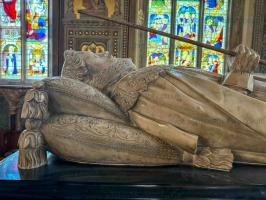
On 4th August 1598 William Cecil 1st Baron Burghley [aged 77] died. His son Thomas [aged 56] succeeded 2nd Baron Burghley. He was buried at St Martin's Church, Stamford [Map] with a large free-standing Elizabethan Period monument under the north chapel arch, in coloured marbles with a figure on tomb chest under an arched canopy supported on paired columns. Attributed to Cornelius Cure. The emblem of the Knights of the Garter on William's left shoulder. Leg Garter. In his right-hand he is holding the Lord Treasurer Staff of Office; originally white.
The inscription on the monument is on contained within three panels: two on the south (Chancel) side, and one on the north (Chapel) side.
Sacred to God most good and great, and to memory. The most honourable and far renowned Lord William Cecil, Baron of Burghley, Lord High Treasurer of England, President of the Court of Wards, knight of the most noble order of the Garter, Privy Counsellor to the most serene Elizabeth, Queen of England, &c., and Chancellor of the University of Cambridge, under this tomb awaits the second coming of Christ: Who for the excellent endowments of the mind, was first made Privy Counsellor to Edward the sixth, King of England; afterwards to Queen Elizabeth: under whom being intrusted with the greatest and most weighty affairs of this kingdom, and above all others approved, in promoting the true religion, and providing for the safety and honour of the commonwealth; by his prudence, honesty, integrity, and great services to the nation, he obtained the highest honours: and when he had long enough to nature, long enough for glory, but not long enough to his country, quietly fell asleep in Christ. He had two wives: Mary, sister of Sir John Cheeke, knight, of whom ie begat one son, Thomas, now Baron of Burghley; and Mildred, daughter of Sir Anthony Cooke, knight, who bore to him Sir Robert Cecil [aged 35], knight, Privy Counsellor to Queen Elizabeth and President of the Court of Wards; Anne, married to Edward, Earl of Oxford [aged 48]; and Elizabeth [aged 34] to William Wentworth, eldest son of Baron Wentworth.
Mary Cheke: she was born to Peter Cheke. In 1541 William Cecil 1st Baron Burghley and she were married. In February 1543 Mary Cheke died.
Elizabeth Cecil: On 1st July 1564 she was born to William Cecil 1st Baron Burghley and Mildred Cooke Baroness Burghley. On 26th February 1582 William Wentworth and she were married.


Around 1605 John Critz [aged 54]. Portrait of King James I of England and Ireland and VI of Scotland [aged 38] with Garter Collar and Leg Garter.

In 1611 Robert "The Elder" Peake [aged 60]. Portrait of King Charles I of England, Scotland and Ireland [aged 10] in his Garter Robes and Leg Garter.
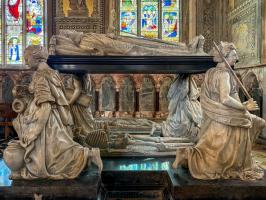
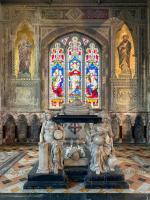
St Etheldreda's Church, Hatfield [Map]. After 24th May 1612. Monument to Robert Cecil 1st Earl Salisbury [deceased].
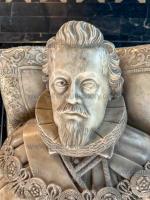
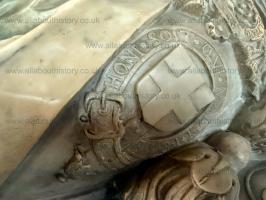
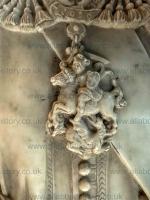
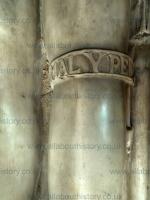
The insignia of the Order of the Garter being the shoulder emblem, the small St George pendant hanging from his chain, and the leg garter.
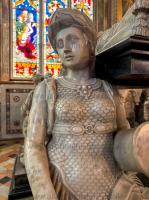
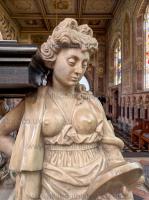
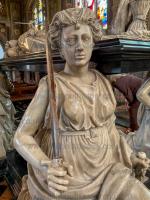
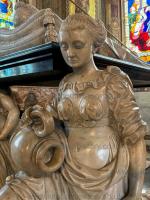
The four ladies at each corner.
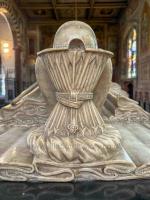
His feet resting on a sheaf of arrows.

In 1616 William Larkin [aged 34]. Portrait of George Villiers 1st Duke of Buckingham [aged 23] wearing his Garter Robes and Leg Garter.

Before 1619 Robert "The Elder" Peake [aged 67]. Portrait of Henry Frederick Stewart Prince of Wales in his Garter Robes and Leg Garter.

In 1619 Daniel Mijtens [aged 29]. Portrait of William Knollys 1st Earl Banbury [aged 75] wearing his Garter Collar and Leg Garter.

In 1621 Daniel Mijtens [aged 31]. Portrait of King James I of England and Ireland and VI of Scotland [aged 54] wearing his Garter Collar and Leg Garter.

Around 1634 Anthony Van Dyck [aged 34]. Portrait of James Stewart 4th Duke Lennox wearing his Leg Garter and Garter Collar.

In 1634 Daniel Mijtens [aged 44]. Portrait of Philip Herbert 4th Earl Pembroke 1st Earl Montgomery [aged 49] wearing his Leg Garter and Garter Collar.
After 17th December 1642 Monument to Francis Manners 6th Earl of Rutland, Frances Knyvet Lady Bevill and Cecily Tufton Countess Rutland at St Mary the Virgin Church, Bottesford, Leicestershire [Map].


Detail of his Leg Garter.

Detail of the Manner's family Peacock in Pride.

Around 1678 Peter Lely [aged 59]. Portrait of Charles II King Scotland in his Garter Robes and Garter Collar and Leg Garter.
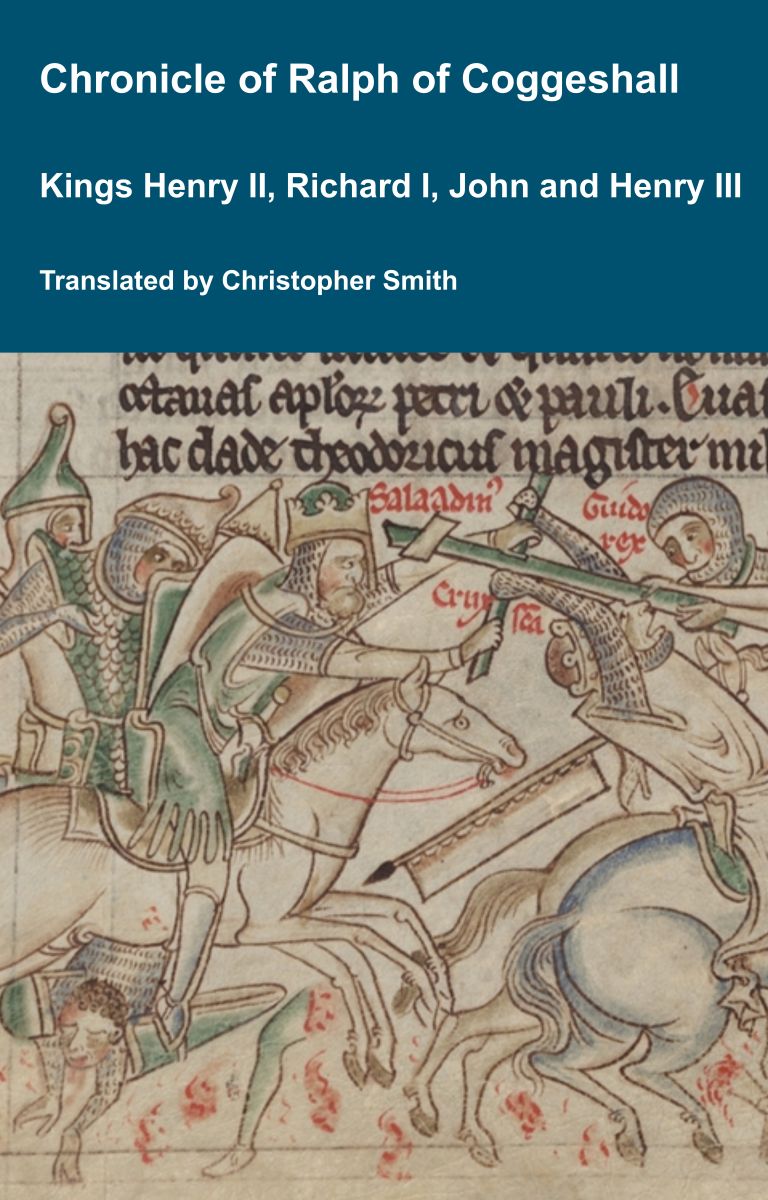
Chronicle of Abbot Ralph of Coggeshall
The Chronicle of Abbot Ralph of Coggeshall (Chronicon Anglicanum) is an indispensable medieval history that brings to life centuries of English and European affairs through the eyes of a learned Cistercian monk. Ralph of Coggeshall, abbot of the Abbey of Coggeshall in Essex in the early 13th century, continued and expanded his community’s chronicle, documenting events from the Norman Conquest of 1066 into the tumultuous reign of King Henry III. Blending eyewitness testimony, careful compilation, and the monastic commitment to record-keeping, this chronicle offers a rare narrative of political intrigue, royal power struggles, and social upheaval in England and beyond. Ralph’s work captures the reigns of pivotal figures such as Richard I and King John, providing invaluable insights into their characters, decisions, and the forces that shaped medieval rule. More than a simple annal, Chronicon Anglicanum conveys the texture of medieval life and governance, making it a rich source for scholars and readers fascinated by English history, monastic authorship, and the shaping of the medieval world.
Available at Amazon in eBook and Paperback format.

Around 1691 John Closterman [aged 31]. Portrait of Charles Seymour 6th Duke of Somerset [aged 28] wearing his Leg Garter.

In 1767 Daniel Gardner [aged 17]. Portrait of George Montagu Dunk 2nd Earl Halifax [aged 50] in conversation with his secretaries. He wearing his Leg Garter.

In 1807 John Hoppner [aged 48]. Portrait of King George IV of Great Britain and Ireland [aged 44] in his Garter Robes and Leg Garter.
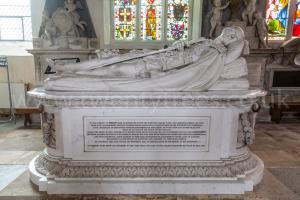
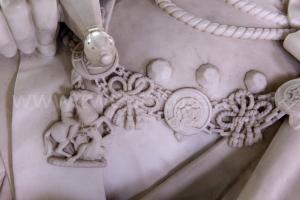
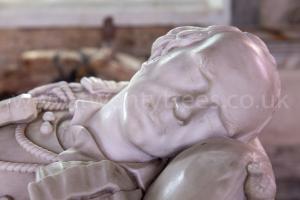
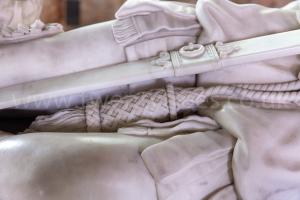
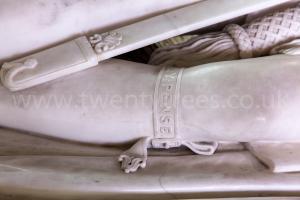
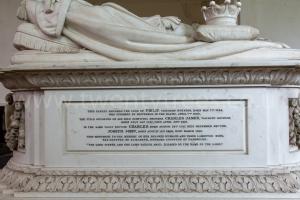
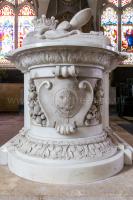
After 18th November 1834. St Andrew's Church, Wimpole [Map]. Monument to Philip Yorke 3rd Earl of Hardwicke [deceased].
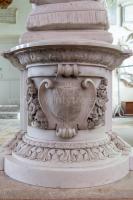
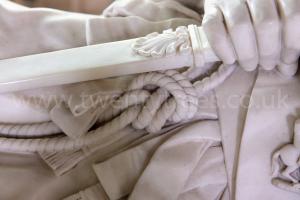
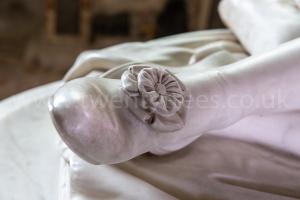
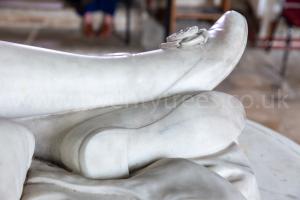
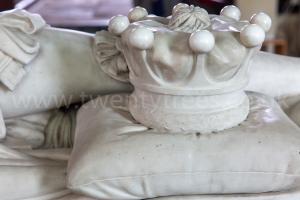
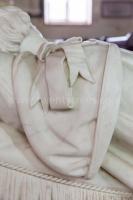
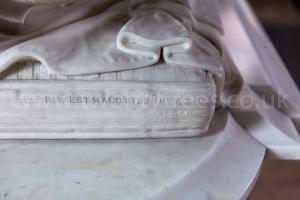
Altar tomb with shaped ends and recumbent effigy in Garter robes with Leg Garter, all in white marble; the ends of the tomb chest are carved with arms and heraldic emblems; signed 'R. WESTMACOTT, JUNR, A.R.A. [aged 35] 1844'.