

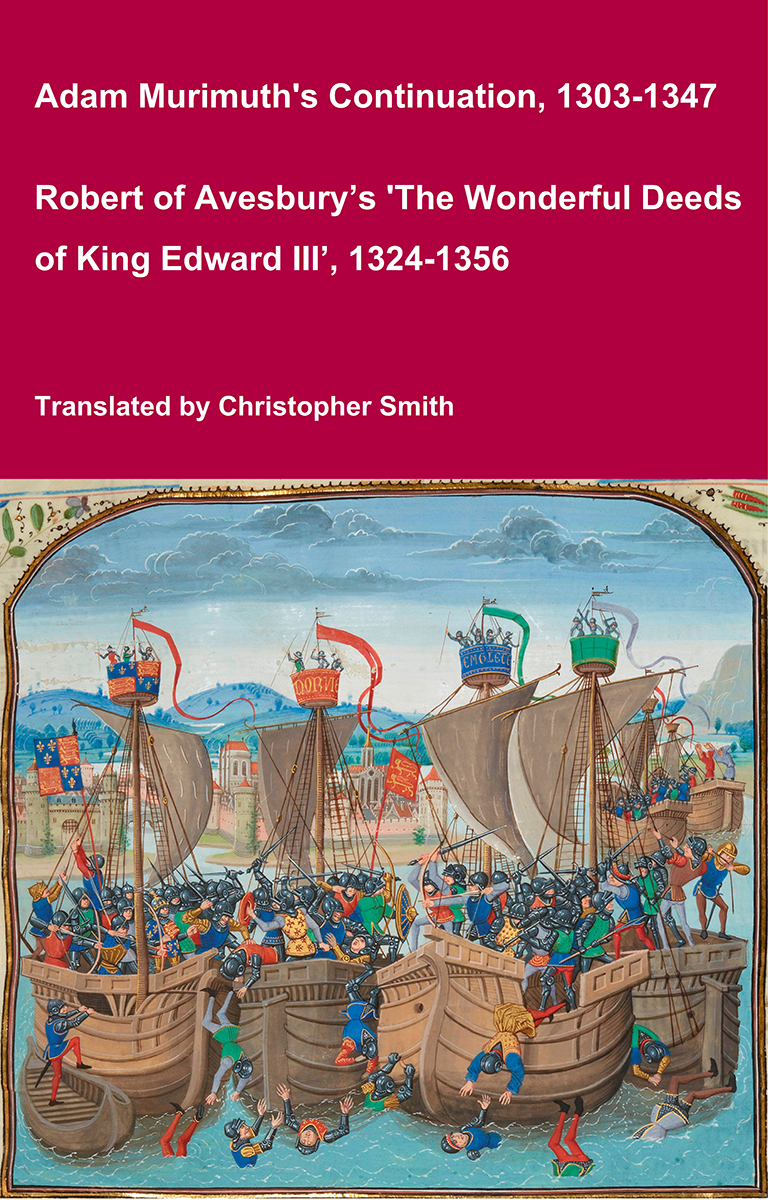
Adam Murimuth's Continuation and Robert of Avesbury’s 'The Wonderful Deeds of King Edward III'
This volume brings together two of the most important contemporary chronicles for the reign of Edward III and the opening phases of the Hundred Years’ War. Written in Latin by English clerical observers, these texts provide a vivid and authoritative window into the political, diplomatic, and military history of fourteenth-century England and its continental ambitions. Adam Murimuth Continuatio's Chronicarum continues an earlier chronicle into the mid-fourteenth century, offering concise but valuable notices on royal policy, foreign relations, and ecclesiastical affairs. Its annalistic structure makes it especially useful for establishing chronology and tracing the development of events year by year. Complementing it, Robert of Avesbury’s De gestis mirabilibus regis Edwardi tertii is a rich documentary chronicle preserving letters, treaties, and official records alongside narrative passages. It is an indispensable source for understanding Edward III’s claim to the French crown, the conduct of war, and the mechanisms of medieval diplomacy. Together, these works offer scholars, students, and enthusiasts a reliable and unembellished account of a transformative period in English and European history. Essential for anyone interested in medieval chronicles, the Hundred Years’ War, or the reign of Edward III.
Available at Amazon in eBook and Paperback format.
Misericorde is in Armour.
Misericorde. A pointed dagger literally 'act of mercy' used to kill an injured opponent.
After 17th January 1425. Monument in Church of St Oswald, Methley [Map] to Robert Waterton (deceased) and Cecily Fleming.
York School of Carving. Crocketed arch. He in Early Plate Bascinet Period armour. Large Orle highly decorated with head resting on great helm with feathered crest. Beard with spiral twists. Collar Esses and Crowns Alternating. Misericorde. Hip Belt with decorated buckle. She wearing a squared crespine headress and small Esses Collar. Chest with Angels with Rounded Wings holding Shields. Chunky Lions Mane.
Cecily Fleming: she was born to Robert Fleming of Woodhall. Before 1398 Robert Waterton and she were married. Around 1424 she died.


St Andrew's Church, Radbourne [Map]. Alabaster Fluted Period monument in the north aisle. The identification somewhat difficult. Either Ralph Pole (age 62) and his wife Elizabeth Moton, or their son John Pole, who predeceased his father, and his wife Jane Fitzherbert (age 12). He wears a Lancastrian Esses Collar. Hawk Crest. Misericorde. The dogs on which their feet rest unusuall for chewing at her dress - usually these chewing dogs are separate - and for there being two at her feet.
Ralph Pole: Around 1430 he was born to Ralph Pole and Joan Grosvenor.
John Pole: Around 1450 he was born to Ralph Pole. Before 1482 John Pole and Jane Fitzherbert were married. The difference in their ages was 30 years. Around 1491 John Pole died.
Jane Fitzherbert: In 1480 she was born to John Fitzherbert and Margaret Babington at Codsall Wood, Staffordshire. In 1519 Jane Fitzherbert died at Codsall Wood, Staffordshire.
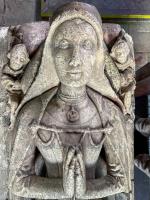
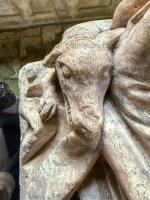
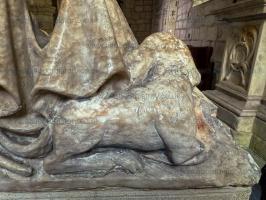
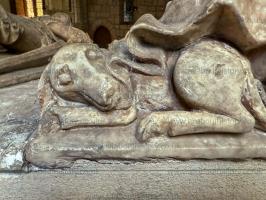
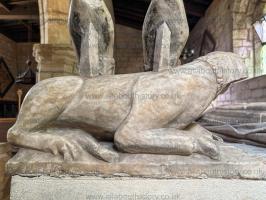
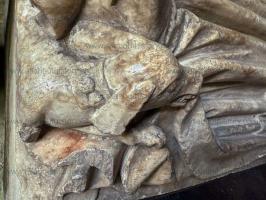
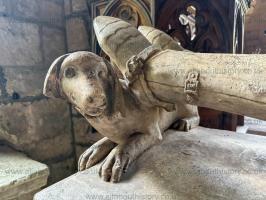
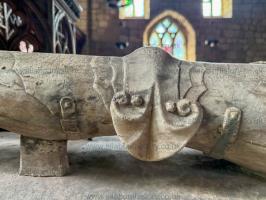
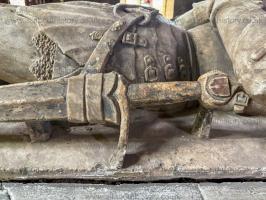
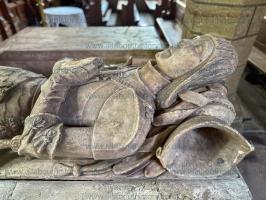
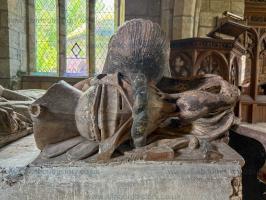
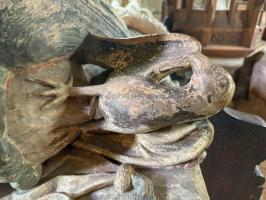
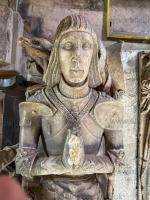
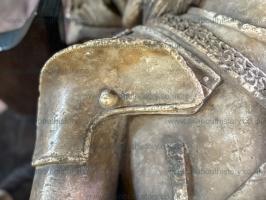
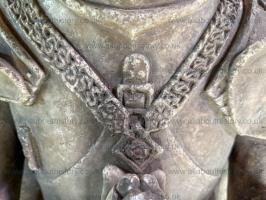
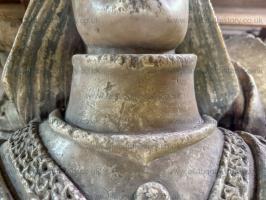
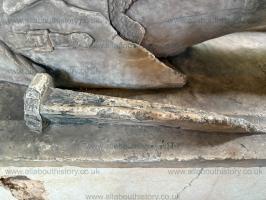
After 11th September 1504. All Saints Church, Turvey [Map]. Monument to John Mordaunt (deceased) and Edith Latimer (deceased).
Fluted Period. Angels Supporting Pillow. Dress Folds at Feet. Misericorde. Tassets. Crespine Headress. Lancastrian Esses Collar with Big Esses. Screaming Man crest, possibly Saracen's Head Crest. Harpur and Moorecock of Burton on Trent. Dogs chewing at her dress. Some uncertainty about the attribution. Dogs chewing at her dress with Studded Collar. Swirling Tail. Chunky Lions Mane.
Edith Latimer: Before 1479 John Greene and she were married. Around 1450 she was born to Nicholas Latimer and Joan Hody at Duntish, Dorset. Before 1475 John Mordaunt and she were married. The date somewhat unreliable. Her first husband John Greene is supposed to have died in 1483 which makes the date of her marriage to John Mordaunt and the birth of her sons by him unreliable? On 1st September 1504 Edith Latimer died at Turvey, Bedfordshire. She was buried at All Saints Church, Turvey [Map].


