

Chronicle of Walter of Guisborough
A canon regular of the Augustinian Guisborough Priory, Yorkshire, formerly known as The Chronicle of Walter of Hemingburgh, describes the period from 1066 to 1346. Before 1274 the Chronicle is based on other works. Thereafter, the Chronicle is original, and a remarkable source for the events of the time. This book provides a translation of the Chronicle from that date. The Latin source for our translation is the 1849 work edited by Hans Claude Hamilton. Hamilton, in his preface, says: 'In the present work we behold perhaps one of the finest samples of our early chronicles, both as regards the value of the events recorded, and the correctness with which they are detailed; Nor will the pleasing style of composition be lightly passed over by those capable of seeing reflected from it the tokens of a vigorous and cultivated mind, and a favourable specimen of the learning and taste of the age in which it was framed.'
Available at Amazon in eBook and Paperback format.
Ordinaries is in Terms.
 Joicey Arms. Argent three lozenges Sable within two bendlets invected gules between two miners' picks in bend proper. Source.
 Nelson Arms. Or, a cross flory sable a bendlet gules. Source.
Bendy is a pattern of diagonal stripes (bendlet), running from top-left to bottom-right.
Crusilly. Sprinkled. Similar, if not the same as Semée.
 Beresford Arms. Argent, crusilly fitchée sable, three fleurs-de-lis within a bordure engrailed of the second. Source.
Orle. A border around the edge of the shield composed of charges.
 Brownlow Arms. Or an escutcheon within an orle of martlets sable. Source
William of Worcester's Chronicle of England
William of Worcester, born around 1415, and died around 1482 was secretary to John Fastolf, the renowned soldier of the Hundred Years War, during which time he collected documents, letters, and wrote a record of events. Following their return to England in 1440 William was witness to major events. Twice in his chronicle he uses the first person: 1. when writing about the murder of Thomas, 7th Baron Scales, in 1460, he writes '… and I saw him lying naked in the cemetery near the porch of the church of St. Mary Overie in Southwark …' and 2. describing King Edward IV's entry into London in 1461 he writes '… proclaimed that all the people themselves were to recognize and acknowledge Edward as king. I was present and heard this, and immediately went down with them into the city'. William’s Chronicle is rich in detail. It is the source of much information about the Wars of the Roses, including the term 'Diabolical Marriage' to describe the marriage of Queen Elizabeth Woodville’s brother John’s marriage to Katherine, Dowager Duchess of Norfolk, he aged twenty, she sixty-five or more, and the story about a paper crown being placed in mockery on the severed head of Richard, 3rd Duke of York.
Available at Amazon in eBook and Paperback format.
Pale. Vertically. Usually a vertical stripe, sometimes an animal.
 Brandon Arms. Barry of ten argent and gules, a lion rampant or ducally crowned per pale of the first and second. Source.
 Plantagenet Arms. Gules, three lions passant guardant in pale or armed and langued azure. Source.
 Giffard Arms. Gules Three lions passant guardant or in pale or.
 Normandy Arms. Gules, two lions passant guardant in pale or armed and langued azure. Source.
 Strange Arms. Argent, two lions passant in pale gules. Source.
Semée. Seeded like the field being sown.
 Brunswick Luneburg Arms. Per pale, I gules two lions passant guardant or (for Brunswick), II or a semy of hearts gules a lion rampant azure (for Lunenburg).
 Clifton Arms. Sable semée of cinquefoils and a lion rampant argent. Source.
 Darcy Arms. Azure semée of cross crosslets argent, three cinquefoils of the last. Source.
 France Ancient Arms. Azure semy-de-lis or. Source.
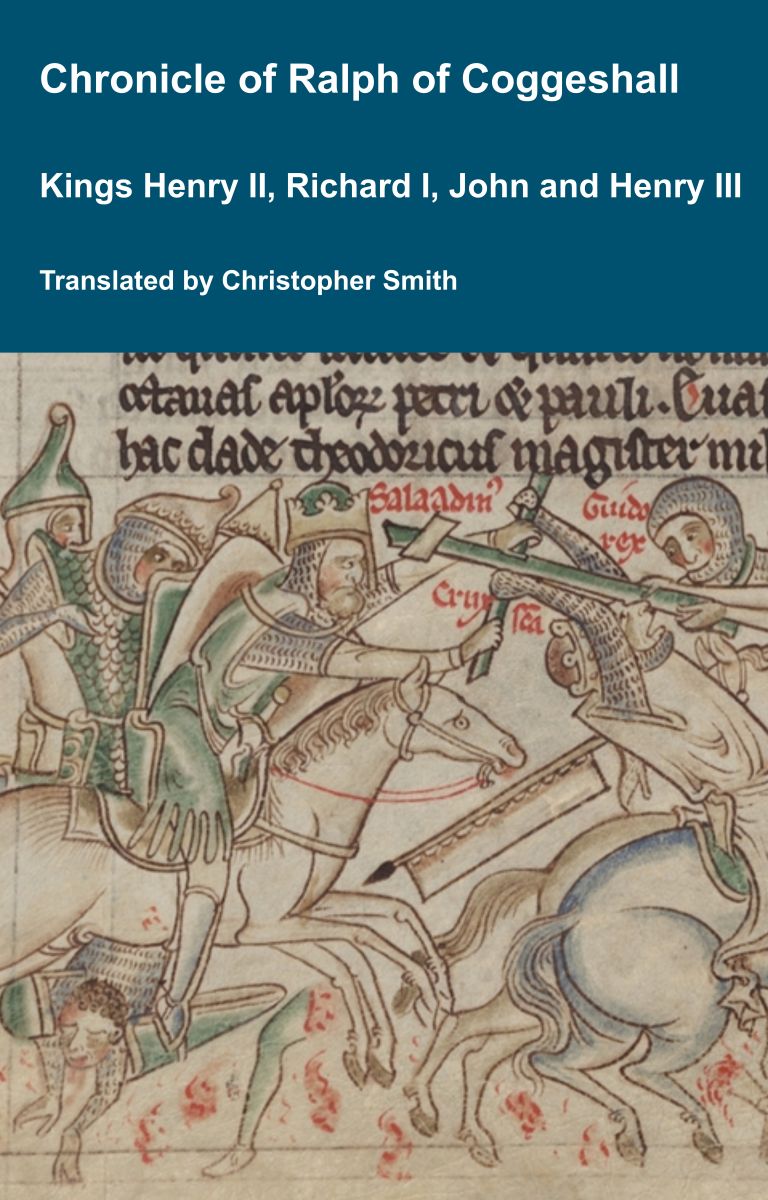
Chronicle of Abbot Ralph of Coggeshall
The Chronicle of Abbot Ralph of Coggeshall (Chronicon Anglicanum) is an indispensable medieval history that brings to life centuries of English and European affairs through the eyes of a learned Cistercian monk. Ralph of Coggeshall, abbot of the Abbey of Coggeshall in Essex in the early 13th century, continued and expanded his community’s chronicle, documenting events from the Norman Conquest of 1066 into the tumultuous reign of King Henry III. Blending eyewitness testimony, careful compilation, and the monastic commitment to record-keeping, this chronicle offers a rare narrative of political intrigue, royal power struggles, and social upheaval in England and beyond. Ralph’s work captures the reigns of pivotal figures such as Richard I and King John, providing invaluable insights into their characters, decisions, and the forces that shaped medieval rule. More than a simple annal, Chronicon Anglicanum conveys the texture of medieval life and governance, making it a rich source for scholars and readers fascinated by English history, monastic authorship, and the shaping of the medieval world.
Available at Amazon in eBook and Paperback format.
 Holand Arms. Azure, semée-de-lys argent, a lion rampant. Source.
 Pierrepoint Arms. Argent, semée of cinquefoils gules, a lion rampant sable. Source.
Tressure. A subordinary. A line or two lines forming a border. Possibly a diminutive of the orle.
 Duke Atholl Arms.
  Earl Atholl Arms overall, an inescutcheon en surtout azure three mullets argent within a double tressure flory or ensigned of a Marquess's coronet. Source.
 Bowes Lyon Arms. Quarterly 1&4 Argent a lion rampant azure, armed and langued gules within a double tressure flory counter-flory of the second (for Lyon); 2&3 ermine three bows stringed palewise in fess proper (for Bowes).
 Marquess Zetland Arms.
  Dundas Arms within a double tressure flory counterflory gules, all within a bordure azure. Source.
 Dunkeld Arms. Or a lion rampant gules armed and langued azure a double tressure flory counter-flory gules.
 Murray Arms. Azure, three mullets argent, within a double tressure flory counter-flory or. Source.
 Earl Roseberry Arms. Quarterly, 1&4 vert, three primroses within a double tressure flory counter-flory or (for Primrose); 2&3 argent, a lion rampant double queued sable (for Cressy). Source.
 Stewart Royal Arms. Or a lion rampant gules armed and langued azure within a double tressure flory counter-flory of the second.


#/media/File:Arms_Nelson_(of_Mawdesley,_Lancs).svg)


.svg)
#/media/File:BrandonArms.png)

.svg)


#/media/File:PoleOfShuteArms.png)


.svg)

