

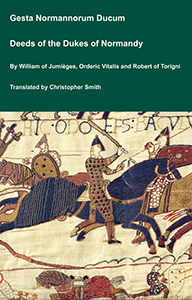
The Deeds of the Dukes of Normandy
The Gesta Normannorum Ducum [The Deeds of the Dukes of Normandy] is a landmark medieval chronicle tracing the rise and fall of the Norman dynasty from its early roots through the pivotal events surrounding the Norman Conquest of England. Originally penned in Latin by the monk William of Jumièges shortly before 1060 and later expanded at the behest of William the Conqueror, the work chronicles the deeds, politics, battles, and leadership of the Norman dukes, especially William’s own claim to the English throne. The narrative combines earlier historical sources with firsthand information and oral testimony to present an authoritative account of Normandy’s transformation from a Viking settlement into one of medieval Europe’s most powerful realms. William’s history emphasizes the legitimacy, military prowess, and governance of the Norman line, framing their expansion, including the conquest of England, as both divinely sanctioned and noble in purpose. Later chroniclers such as Orderic Vitalis and Robert of Torigni continued the history, extending the coverage into the 12th century, providing broader context on ducal rule and its impact. Today this classic work remains a foundational source for understanding Norman identity, medieval statesmanship, and the historical forces that reshaped England and Western Europe between 800AD and 1100AD.
Available at Amazon in eBook and Paperback format.
Sable is in Field.
 Wodehouse Arms. Sable a chevron or between three cinquefoils. Source.
 Lewis Arms. Sable a chevron or three fleur de lys or. Source.
 Arundell Arms. Sable, six martlets argent. Source.
 Loftus Arms. Sable, a chevron engrailed ermine, between three trefoils slipped argent. Source.
 Bonville Arms. Sable, six mullets argent pierced gules. Source.
 Mosley Arms. Sable a chevron between three pickaxes argent. Source.
 Browne Arms. Sable a bend sable cotised three lions rampant argent. Source.
 Newton Arms. Sable, a skull and crossbones argent. Source
 Cavendish Arms. Sable, three buck's heads caboshed argent. Source.
 Oldham Arms. Sable, a chevron or between three owls argent on a chief of the second three roses gules. Possibly an example of canting arms where owl represents owl-dam. Source.
Jean de Waurin's Chronicle of England Volume 6 Books 3-6: The Wars of the Roses
Jean de Waurin was a French Chronicler, from the Artois region, who was born around 1400, and died around 1474. Waurin’s Chronicle of England, Volume 6, covering the period 1450 to 1471, from which we have selected and translated Chapters relating to the Wars of the Roses, provides a vivid, original, contemporary description of key events some of which he witnessed first-hand, some of which he was told by the key people involved with whom Waurin had a personal relationship.
Available at Amazon in eBook and Paperback format.
 Clifton Arms. Sable semée of cinquefoils and a lion rampant argent. Source.
 Paget Arms. Sable, on a cross engrailed between four eagles displayed argent, five lions passant guardant of the field. Source.
 Conway Arms. Sable, on a bend cotised argent a rose gules between two annulets of the first. Source.
 Palmer Carlton Arms. Sable a chevron or three crecents argent. Source.
 Dymoke Arms. Sable, two lions passant in pale argent ducally crowned or. Source.
 Parker Arms. Sable, a stag's head cabossed between two flaunches argent. Source.
 Hohenstaufen Arms. Sable a lion rampant or.
 Paulet Arms. Sable three swords pilewise points in base proper pomels and hilts or. Source.
 Peyton Arms. Sable, a cross engrailed or a mullet in the first quarter argent.
 Ridgeway Arms. Sable, a pair of wings conjoined and elevated argent. Source.
 Jermyn Arms. Sable, a crescent between two mullets in pale argent. Source.
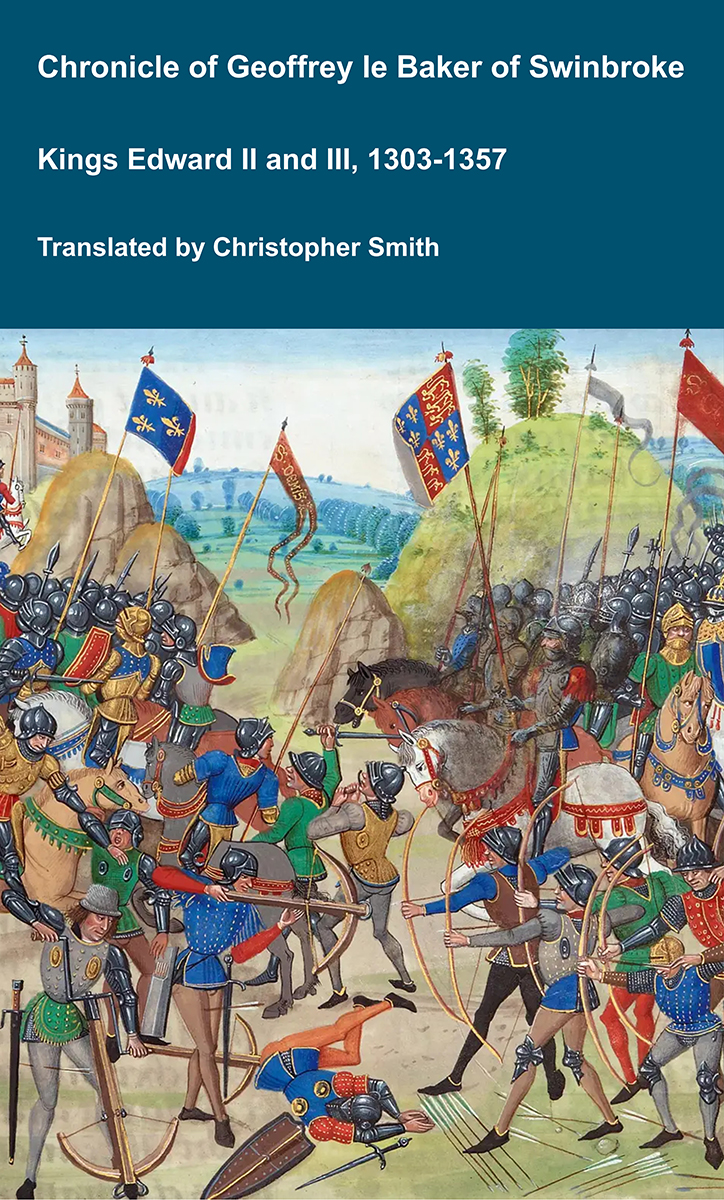
Chronicle of Geoffrey le Baker of Swinbroke
Baker was a secular clerk from Swinbroke, now Swinbrook, an Oxfordshire village two miles east of Burford. His Chronicle describes the events of the period 1303-1356: Gaveston, Bannockburn, Boroughbridge, the murder of King Edward II, the Scottish Wars, Sluys, Crécy, the Black Death, Winchelsea and Poitiers. To quote Herbert Bruce 'it possesses a vigorous and characteristic style, and its value for particular events between 1303 and 1356 has been recognised by its editor and by subsequent writers'. The book provides remarkable detail about the events it describes. Baker's text has been augmented with hundreds of notes, including extracts from other contemporary chronicles, such as the Annales Londonienses, Annales Paulini, Murimuth, Lanercost, Avesbury, Guisborough and Froissart to enrich the reader's understanding. The translation takes as its source the 'Chronicon Galfridi le Baker de Swynebroke' published in 1889, edited by Edward Maunde Thompson.
Available at Amazon in eBook and Paperback format.
 Riley Arms. Sable, on a pile or three crosses formy fitchy at the foot sable. Source.
 Lake Arms. Sable, a bend argent six crosslets fitchy.
 Rous Arms. Sable, a fess dancetté or between three crescents argent. Source.
 Ayscough Arms. Sable, a fess or, between three asses passant argent, maned and unguled of the second. Source.
 Segrave Arms. Sable, a lion rampant argent, crowned or.
 Buller Arms. Sable, on a cross argent quarter pierced of the field four eagles displayed of the first. Source.
 Compton Arms. Sable a lion passant guardant or between three Esquire's Helmets argent. Source.
 Spelman Arms. Sable, ten plates between two flaunches argent.
 Foljambe Arms. Sable a bend between six escallops or.
The Deeds of the Dukes of Normandy
The Gesta Normannorum Ducum [The Deeds of the Dukes of Normandy] is a landmark medieval chronicle tracing the rise and fall of the Norman dynasty from its early roots through the pivotal events surrounding the Norman Conquest of England. Originally penned in Latin by the monk William of Jumièges shortly before 1060 and later expanded at the behest of William the Conqueror, the work chronicles the deeds, politics, battles, and leadership of the Norman dukes, especially William’s own claim to the English throne. The narrative combines earlier historical sources with firsthand information and oral testimony to present an authoritative account of Normandy’s transformation from a Viking settlement into one of medieval Europe’s most powerful realms. William’s history emphasizes the legitimacy, military prowess, and governance of the Norman line, framing their expansion, including the conquest of England, as both divinely sanctioned and noble in purpose. Later chroniclers such as Orderic Vitalis and Robert of Torigni continued the history, extending the coverage into the 12th century, providing broader context on ducal rule and its impact. Today this classic work remains a foundational source for understanding Norman identity, medieval statesmanship, and the historical forces that reshaped England and Western Europe between 800AD and 1100AD.
Available at Amazon in eBook and Paperback format.
 Stourton Arms. Sable, a bend or between six fountains. Source.
 Hobart Arms. Sable, an estoile of six points or between two flaunches ermine.
 Strangeways Arms. Sable two lions passant paly of six argent and gules. Source.
 Kitson Arms. Sable three fishes hauriant in fess argent a chief or. Source.
 Strickland Arms. Sable three escallops argent. SSource.
 Bridgeman Arms. Sable, ten plates, four, three, two, and one, on a chief argent a lion passant ermines. Source
 Turner Baronets Arms. Sable, a chevron ermine between three fers de moline or on a chief argent a lion passant gules. Source.
 Hovell Arms. Sable, a crescent or.
 Lascelles Arms. Sable a cross patoncé within a Bordure or. Source.
 Churchill Arms. Sable a lion rampant argent a canton of the last a cross gules. Source.
Abbot John Whethamstede’s Chronicle of the Abbey of St Albans
Abbot John Whethamstede's Register aka Chronicle of his second term at the Abbey of St Albans, 1451-1461, is a remarkable text that describes his first-hand experience of the beginning of the Wars of the Roses including the First and Second Battles of St Albans, 1455 and 1461, respectively, their cause, and their consequences, not least on the Abbey itself. His text also includes Loveday, Blore Heath, Northampton, the Act of Accord, Wakefield, and Towton, and ends with the Coronation of King Edward IV. In addition to the events of the Wars of the Roses, Abbot John, or his scribes who wrote the Chronicle, include details in the life of the Abbey such as charters, letters, land exchanges, visits by legates, and disputes, which provide a rich insight into the day-to-day life of the Abbey, and the challenges faced by its Abbot.
Available at Amazon in eBook and Paperback format.
 Greville Arms. Sable a cross in a border Engrailed or with five roundels sable on the cross. Source.
 Ufford Arms. Sable, a cross engrailed or. Source.
 Vaughan Arms. Sable a chevron between three fleurs-de-lys argent. Source.
 Wentworth Arms. Sable, a chevron or three leopard's faces or. Source.
 Coventry Arms. Sable a fess between three crescents or. Source.


#/media/File:Blason_Louise_d'Abos.svg)
.svg)


#/media/File:Blazon_of_Palmer_Baronets_of_Carlton_(1660).svg)


_Arms.png)
#/media/File:Marquess_of_Downshire_COA.svg)


#/media/File:BullerArms.PNG)
#/media/File:Smith_OfExeter_Arms.png)


#/media/File:Strickland_of_Westmorland_arms.svg)


