

William of Worcester's Chronicle of England
William of Worcester, born around 1415, and died around 1482 was secretary to John Fastolf, the renowned soldier of the Hundred Years War, during which time he collected documents, letters, and wrote a record of events. Following their return to England in 1440 William was witness to major events. Twice in his chronicle he uses the first person: 1. when writing about the murder of Thomas, 7th Baron Scales, in 1460, he writes '… and I saw him lying naked in the cemetery near the porch of the church of St. Mary Overie in Southwark …' and 2. describing King Edward IV's entry into London in 1461 he writes '… proclaimed that all the people themselves were to recognize and acknowledge Edward as king. I was present and heard this, and immediately went down with them into the city'. William’s Chronicle is rich in detail. It is the source of much information about the Wars of the Roses, including the term 'Diabolical Marriage' to describe the marriage of Queen Elizabeth Woodville’s brother John’s marriage to Katherine, Dowager Duchess of Norfolk, he aged twenty, she sixty-five or more, and the story about a paper crown being placed in mockery on the severed head of Richard, 3rd Duke of York.
Available at Amazon in eBook and Paperback format.
Tympanum is in Architectural Detail.
Tympanum. A semi-circular, or triangular, decorative wall surface over an entrance, door or window, which is bounded by a lintel and an arch.
St Leonard's Church, Ribbesford [Map]. Herefordshire School of Carving tympanum. Archer aiming at what appears to be a bird with dog beneath. The description 'bird' somewhat difficult. Others call it a 'fishlike monster'. The capitals are carved with large bird pecking small bird, intertwined knots, and snakes.
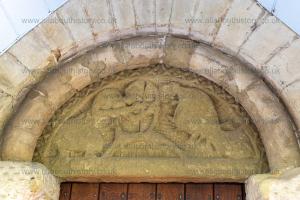
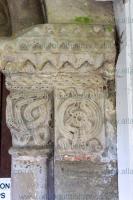
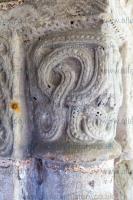
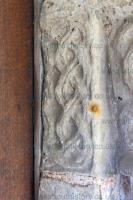
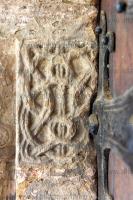
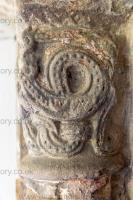
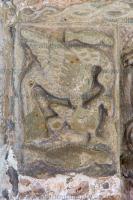
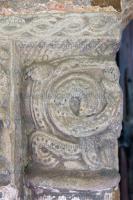
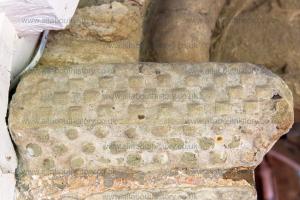
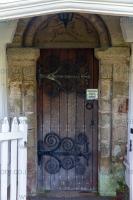
Tympanum above the south door at Holy Trinity Church, Ashford-in-the-Water [Map]:
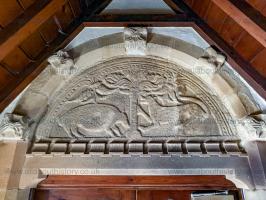
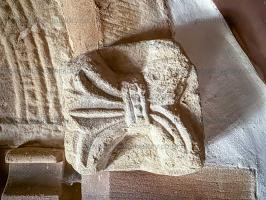
All Saints Church, Billesley [Map]. In the transept are two pieces of carved stone. One is a tympanum dating from about 1140 that depicts a man being attacked by a snake and a dragon, and being defended by a dove. The man is similarly dressed to those on the font at the Church of St Mary Magdalene, Eardisley [Map]. Herefordshire School of Carving.
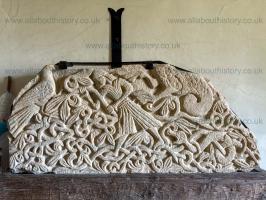
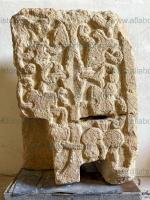
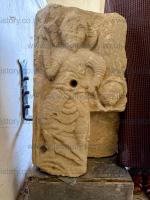
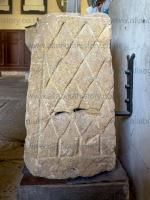
Around 1150. Norman Tympanum at St Mary's Church, Tissington [Map].


1150. St Mary's Church, Halford [Map]. Norman tympanum of the Herefordshire School of Carving over the north door.
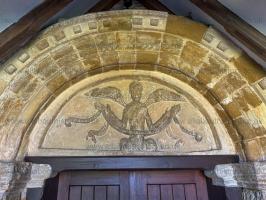
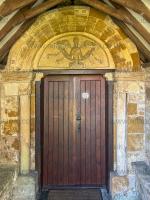
1200. St Andrew's Church, Bredwardine [Map]. Carving of lintel above north door. Possibly missing a Tympanum. From the Herefordshire School of Carving.
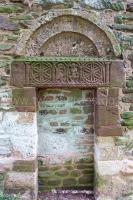
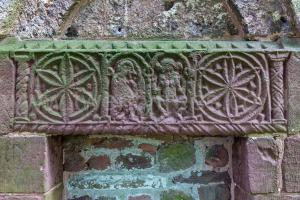
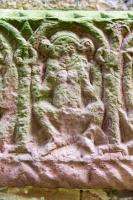
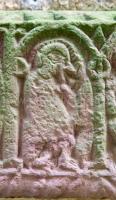
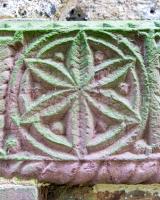
The Herefordshire School of Carving at St Giles' Church, Pipe Aston [Map]. Tympanum over the North doorway. An "agnus dei" - Lamb of God - flanked by a winged eagle and a winged bull surrounded byan archivolt of animals and foliage enclosed within a chevroned arch. The church guide describes the eagle as the emblem of St John complementing the winged bull emblem of St Luke which has at the end of one of its forelegs a block that is assumed to be St Luke's Gospel. Malcolm Thurlby, in this excellent book "The Herefordshire School of Romanesque Sculpture" suggest the carving is of a griffin. The imposts at the end of the arches have, on the left, dragons entwined, and, on the right, foliage. See Herefordshire School of Carving.


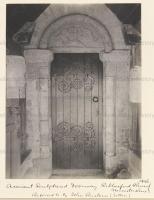
1896. John Benjamin Stone [aged 57]. Photograph of the tympanum at St Leonard's Church, Ribbesford [Map].
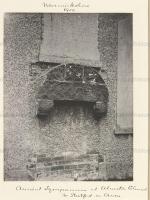
1900. John Benjamin Stone [aged 61]. Photograph of the tympanums at St James' Church, Alveston [Map].
St John's Church, Shobdon [Map].When the 18th-century church was built, the original Romanesque chancel arch was carefully removed and reassembled on the hill overlooking the church. This was linked to two carved doorways with their tympana to create an unusual folly, or eyecatcher. Though somewhat eroded by wind and weather, the arches feature exquisitely detailed Norman carving.
Annals of the six Kings of England by Nicholas Trivet
Translation of the Annals of the Six Kings of England by that traces the rise and rule of the Angevin aka Plantagenet dynasty from the mid-12th to early 14th century. Written by the Dominican scholar Nicholas Trivet, the work offers a vivid account of English history from the reign of King Stephen through to the death of King Edward I, blending political narrative with moral reflection. Covering the reigns of six monarchs—from Stephen to Edward I—the chronicle explores royal authority, rebellion, war, and the shifting balance between crown, church, and nobility. Trivet provides detailed insight into defining moments such as baronial conflicts, Anglo-French rivalry, and the consolidation of royal power under Edward I, whose reign he describes with particular immediacy. The Annals combines careful year-by-year reporting with thoughtful interpretation, presenting history not merely as a sequence of events but as a moral and political lesson. Ideal for readers interested in medieval history, kingship, and the origins of the English state, this chronicle remains a valuable and accessible window into the turbulent world of the Plantagenet kings.
Available at Amazon in eBook and Paperback format.
St John the Baptist Church, Beckford [Map]. Fine Tympanum showing Harrowing of Hell. Possibly Herefordshire School of Carving.
St Mary's Church, Fownhope [Map]. Fine tympanum of the Herefordshire School of Carving.
St Mary's Church, Stottesdon [Map]. Fine tympanum and font of the Herefordshire School of Carving.
St Nicholas' Church, Little Langford [Map]. Fine tympanum from the Herefordshire School of Carving.
The Church of St Mary Magdalene and St Andrew, Ridlington [Map] has a Jacobean memorial to James Harington and his wife facing each other, praying in a kneeling position. Over the vestry door in the south aisle, is a Norman tympanum.
St Michael's Church, Houghton le Spring [Map]. The church dates from the 12C but during recent renovations the foundations of an earlier Anglo-Saxon church were discovered. Many Saxon post holders were found. Below the Saxon church were found some Roman foundations, possibly from a temple and boulders from an early prehistoric burial cairn or ritual site. A carved tympanum (which probably predates the church) features intertwined beasts. It is known as 'The Houghton Beasts or Dragons'. See Herefordshire School of Carving.
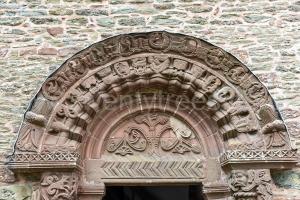
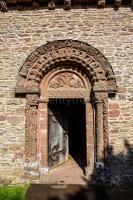
Church of St Mary and St David, Kilpeck [Map]. South door with tympanum. Fine example of the Herefordshire School of Carving.
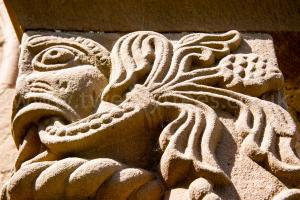
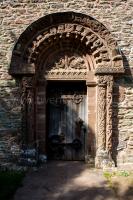
St Botolph's Church, Stow Longa [Map]. Above the priest door, outside the east side of the church, is the nationally important tympanum known as the Mermaid Stone (or the Beckoning Mermaid Stone), since the engraving displays a mermaid between two creatures.
St Peter's Church, Rowlestone [Map]. Tympanum of the Herefordshire School of Carving.


St Gregory's Church, Castlemorton [Map]. The C12 doorway has a round arch with zig-zag ornament, and angle shafts with scalloped capitals. The tympanum is carved with the Agnus Dei..
