

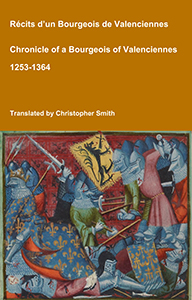
Chronicle of a Bourgeois of Valenciennes
Récits d’un bourgeois de Valenciennes aka The Chronicle of a Bourgeois of Valenciennes is a vivid 14th-century vernacular chronicle written by an anonymous urban chronicler from Valenciennes in the County of Hainaut. It survives in a manuscript that describes local and regional history from about 1253 to 1366, blending chronology, narrative episodes, and eyewitness-style accounts of political, military, and social events in medieval France, Flanders, and the Low Countries. The work begins with a chronological framework of events affecting Valenciennes and its region under rulers such as King Philip VI of France and the shifting allegiances of local nobility. It includes accounts of conflicts, sieges, diplomatic manoeuvres, and the impact of broader struggles like the Hundred Years’ War on urban life in Hainaut. Written from the perspective of a burgher (bourgeois) rather than a monastery or royal court, the chronicle offers a rare lay viewpoint on high politics and warfare, reflecting how merchants, townspeople, and civic institutions experienced the turbulence of the 13th and 14th centuries. Its narrative style combines straightforward reporting of events with moral and civic observations, making it a valuable source for readers interested in medieval urban society, regional politics, and the lived experience of war and governance in pre-modern Europe.
Available at Amazon in eBook and Paperback format.
Was Declared Bankrupt is in General Things.
In 1803 Richard "The Elder" Westmacott (age 56) was declared bankrupt.
In 1832 George Duckett 2nd Baronet (age 54) was declared bankrupt.
On 27th October 1837 Robert Slack (age 30) was declared bankrupt after which he became a farmer in Whitfield.
In 1847 Thomas Denman (age 57) was declared bankrupt.

In 1847 Richard Temple-Nugent-Brydges-Chandos-Grenville 2nd Duke of Buckingham and Chandos (age 49) was declared bankrupt with debts of over a million pounds. He was required to sell his estate in Keynsham, Somerset, Avington Park Itchen Valley, Winchester and the contents of Stowe House, Buckinghamshire in 1848.
In 1878 James Anderson Rose (age 58) represented James Abbott McNeill Whistler (age 43) in his libel trial against John Ruskin (age 58) for having described his painting Nocturne in Black and Gold: The Falling Rocket as "flinging a pot of paint in the public's face". Whistler won the case and was awarded one farthing, the smallest coin, to Whistler. The court costs were divided between the two. Ruskin's were paid for by a public subscription organised by the Fine Art Society. Whistler was declared bankrupt.




On 22nd November 1900 James McGarel-Hogg 2nd Baron Magheramorne (age 39) was declared bankrupt in Dublin.
In 1922 Rowland Allanson-Winn 5th Baron Headley (age 66) was declared bankrupt.
In 1937 Victor Hervey 6th Marquess of Bristol (age 21) was declared bankrupt with debts of £123,955.