

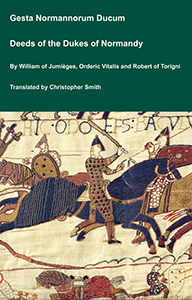
The Deeds of the Dukes of Normandy
The Gesta Normannorum Ducum [The Deeds of the Dukes of Normandy] is a landmark medieval chronicle tracing the rise and fall of the Norman dynasty from its early roots through the pivotal events surrounding the Norman Conquest of England. Originally penned in Latin by the monk William of Jumièges shortly before 1060 and later expanded at the behest of William the Conqueror, the work chronicles the deeds, politics, battles, and leadership of the Norman dukes, especially William’s own claim to the English throne. The narrative combines earlier historical sources with firsthand information and oral testimony to present an authoritative account of Normandy’s transformation from a Viking settlement into one of medieval Europe’s most powerful realms. William’s history emphasizes the legitimacy, military prowess, and governance of the Norman line, framing their expansion, including the conquest of England, as both divinely sanctioned and noble in purpose. Later chroniclers such as Orderic Vitalis and Robert of Torigni continued the history, extending the coverage into the 12th century, providing broader context on ducal rule and its impact. Today this classic work remains a foundational source for understanding Norman identity, medieval statesmanship, and the historical forces that reshaped England and Western Europe between 800AD and 1100AD.
Available at Amazon in eBook and Paperback format.
William and Mary is in Church Monument Periods.
On 4th February 1698 Thomas Strode of Parnham (age 70) died. Monument in Church of St Mary, Beaminster [Map]. William and Mary. Marble with standing figure in wig, gown, side pilasters support cornice. Possibly by John Nost.
To God, the Best and Greatest. Here lie the mortal remains of THOMAS STRODE, Serjeant-at-Law, who peacefully fell asleep in Christ on February 4th, 1698, in the 70th year of his age. A man consecrated to immortal memory, renowned for jurisprudence, piety, and wisdom; of integrity no less than gentleness of character; always faithful to God, to his sovereign, and to his friends. He was the son of Sir John Strode, Knight, of Parnham in the county of Dorset. He chose for himself a most beloved wife, Mary Adams, widow of Parkinson Odber, Esquire, by whom he had one daughter, still surviving. She, most sorrowfully and with tears, set up this monument of final devotion.
D.O.M.P.Q. Mortalitatis Exuvias hic deposuit THOMAS STRODE Serviens ad Legem; Qui in Christo placidè obdormivit Feb: 4o. 1698. Ætat.: suae 70. Vir Immortali Memoriæ sacratus; Jurisprudentiâ, pietate, & Consilio, Insignis; Moribus Integris Juxta ac Suavissimis: Deo, Principi & amicis semper fidus: Patre JOHANE STRODE Equite Aurato de Parnham in Comitatu Dorset oriundus; Charissmam sibi adscîvit Conjugem MARIAM ADAMS relic: de PARKINSON ODBER Armigero; Ex quâ filiam suscepit unicam adhue superstitem. Quæ hoc supræmu: pietatis Monument:, Mœsstissima & cum lacrymis gemens, L.M.D.P.Q. To God the Greatest and Best and to Posterity
Thomas Strode of Parnham: In 1628 he was born to John Strode of Parnham and Anne Wyndham. On 1st July 1642 he matriculated Oxford University. On 1st February 1665 Thomas Strode of Parnham and Mary Adams were married. In 1677 he was appointed Serjeant at Law.


Sherborne Abbey [Map]. On 12th September 1698 John Digby 3rd Earl Bristol (age 64) died without issue. Earl Bristol extinct. In May 1658 Alice Bourne died. On 16th February 1709 Rachel Wyndham Countess of Bristol (age 53) died. William and Mary. Monument sculpted by John Nost.
Alice Bourne: she was born to Robert Bourne of Blake Hall in Essex. On 26th May 1656 John Digby 3rd Earl Bristol and she were married. He the son of George Digby 2nd Earl Bristol and Anne Russell Countess Bristol.
Rachel Wyndham Countess of Bristol: Around 1645 she was born to Hugh Wyndham Baron of the Exchequer and Jane Wodehouse. On or after 13th July 1663, the date of the licence, John Digby 3rd Earl Bristol and she were married. He the son of George Digby 2nd Earl Bristol and Anne Russell Countess Bristol. They were fifth cousin once removed. On 20th March 1677 George Digby 2nd Earl Bristol died. His son John succeeded 3rd Earl Bristol. She by marriage Countess Bristol.


