

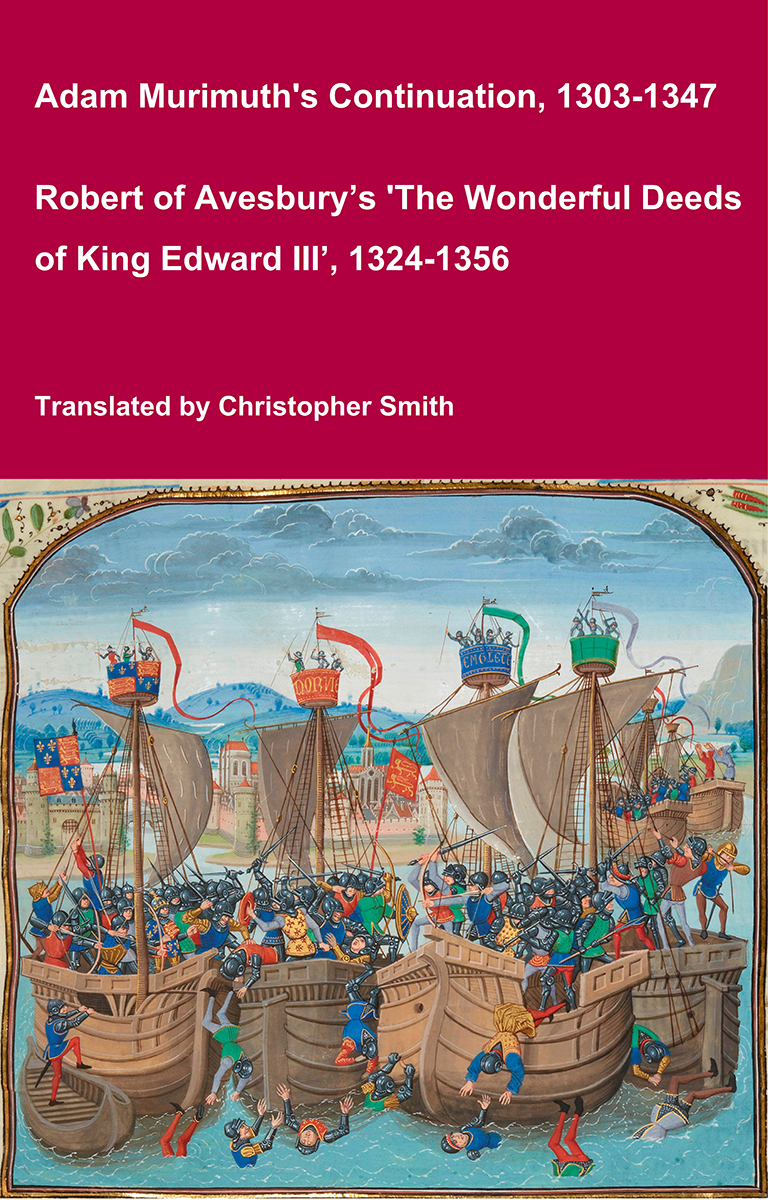
Adam Murimuth's Continuation and Robert of Avesbury’s 'The Wonderful Deeds of King Edward III'
This volume brings together two of the most important contemporary chronicles for the reign of Edward III and the opening phases of the Hundred Years’ War. Written in Latin by English clerical observers, these texts provide a vivid and authoritative window into the political, diplomatic, and military history of fourteenth-century England and its continental ambitions. Adam Murimuth Continuatio's Chronicarum continues an earlier chronicle into the mid-fourteenth century, offering concise but valuable notices on royal policy, foreign relations, and ecclesiastical affairs. Its annalistic structure makes it especially useful for establishing chronology and tracing the development of events year by year. Complementing it, Robert of Avesbury’s De gestis mirabilibus regis Edwardi tertii is a rich documentary chronicle preserving letters, treaties, and official records alongside narrative passages. It is an indispensable source for understanding Edward III’s claim to the French crown, the conduct of war, and the mechanisms of medieval diplomacy. Together, these works offer scholars, students, and enthusiasts a reliable and unembellished account of a transformative period in English and European history. Essential for anyone interested in medieval chronicles, the Hundred Years’ War, or the reign of Edward III.
Available at Amazon in eBook and Paperback format.
Augustus Saint-Gaudens is in Sculptors.
On 1st March 1848 Augustus Saint-Gaudens was born.
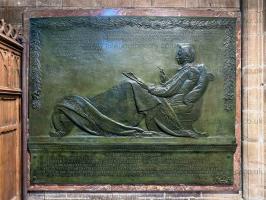
Moray Aisle, Edinburgh Cathedral [Map]. 1904. Bronze memorial to Robert Louis Stevenson sculpted by Augustus Saint-Gaudens (age 55).
Upon Stevenson's move to Manasquan, New Jersey, he once again met with Saint-Gaudens to sit for his portrait. It was this sitting which gave Saint-Gaudens a lasting impression of Stevenson. Because it was decided that the author looked too stiff simply sitting in no useful occupation, Saint-Gaudens suggested he should pose in his natural state: writing. To this Stevenson not only agreed, but took the suggestion to heart by writing a letter to Homer Saint-Gaudens, Augustus' son. Once the plaque was completed, the author and the sculptor never met in person again, but did maintain a friendship as evidenced by the exchange of several letters. Stevenson referred to Saint-Gaudens as his "God-like sculptor," and Saint-Gaudens was pleased to consider the author who captivated his literary attention a friend.
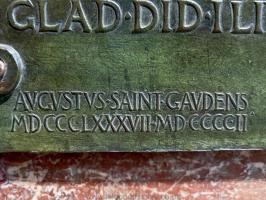
On 3rd August 1907 Augustus Saint-Gaudens (age 59) died.