

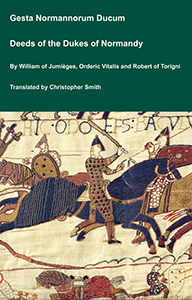
The Deeds of the Dukes of Normandy
The Gesta Normannorum Ducum [The Deeds of the Dukes of Normandy] is a landmark medieval chronicle tracing the rise and fall of the Norman dynasty from its early roots through the pivotal events surrounding the Norman Conquest of England. Originally penned in Latin by the monk William of Jumièges shortly before 1060 and later expanded at the behest of William the Conqueror, the work chronicles the deeds, politics, battles, and leadership of the Norman dukes, especially William’s own claim to the English throne. The narrative combines earlier historical sources with firsthand information and oral testimony to present an authoritative account of Normandy’s transformation from a Viking settlement into one of medieval Europe’s most powerful realms. William’s history emphasizes the legitimacy, military prowess, and governance of the Norman line, framing their expansion, including the conquest of England, as both divinely sanctioned and noble in purpose. Later chroniclers such as Orderic Vitalis and Robert of Torigni continued the history, extending the coverage into the 12th century, providing broader context on ducal rule and its impact. Today this classic work remains a foundational source for understanding Norman identity, medieval statesmanship, and the historical forces that reshaped England and Western Europe between 800AD and 1100AD.
Available at Amazon in eBook and Paperback format.
On 20th April 1176 Richard "Strongbow" Clare 2nd Earl Pembroke [aged 46] died at Dublin [Map]. He was buried at Christ Church Cathedral, Dublin [Map]. His son Gilbert succeeded 3rd Earl Pembroke although being a minor he was never invested with the title.
On 25th October 1212 Bishop John Comyn [aged 62] died. He was buried at Christ Church Cathedral, Dublin [Map], where a marble monument was erected to his memory.
In 1468 Thomas Fitzgerald 7th Earl Desmond and Thomas Fitzgerald 7th Earl of Kildare [aged 47] attended Parliament in Drogheda [Map] to answer charges of treason. Both were found guilty and attainted. Thomas Fitzgerald 7th Earl Desmond sought sanctuary in Drogheda Priory [Map] where he was captured by John "Butcher of England" Tiptoft 1st Earl of Worcester [aged 40]. On 14th February 1468 Thomas Fitzgerald 7th Earl Desmond was summarily beheaded. He was buried initially in St Peter's Church Drogheda [Map] then Christ Church Cathedral, Dublin [Map]. Some accounts claim John "Butcher of England" Tiptoft 1st Earl of Worcester also murdered two of his young sons. Thomas Fitzgerald 7th Earl of Kildare escaped and was subsequently pardoned and attainder reversed when King Edward IV found Ireland was ungovernable without him. In 1470 Thomas Fitzgerald 7th Earl of Kildare was appointed Lord Deputy of Ireland under George York 1st Duke of Clarence [aged 18] which position he held until the Duke's death in 1478.
On 3rd July 1579 Edward Fitton [aged 52] died at Dublin [Map]. He was buried at Christ Church Cathedral, Dublin [Map] on 21st September 1579.
Around 2nd January 1597 Thomas Molyneux [aged 66] died. He was buried in Christ Church Cathedral, Dublin [Map].
On 8th March 1600 Constance Clifford [aged 78] died at Christ Church Cathedral, Dublin [Map].
Before 31st October 1606 Arthur Chichester died. He was buried in Christ Church Cathedral, Dublin [Map].
On 17th August 1627 Toby Caulfeild 1st Baron Caulfeild [aged 61] died. He was buried at Christ Church Cathedral, Dublin [Map]. His nephew William [aged 40] succeeded 2nd Baron Caulfield.
On 2nd January 1659 Richard Pepys [aged 69] died. He was buried in Christ Church Cathedral, Dublin [Map].
On 17th December 1661 Charles Coote 1st Earl Mountrath [aged 51] died of smallpox. He was buried in Christ Church Cathedral, Dublin [Map]. Charles Coote 2nd Earl of Mountrath [aged 31] succeeded 2nd Earl Mountrath, 3rd Baronet Coote of Castle Cuffe.
On 20th March 1664 Bishop William Fuller [aged 56] was consecrated Bishop of Limerick at Christ Church Cathedral, Dublin [Map].
On 30th August 1678 Archbishop James Margetson [deceased] was buried at Christ Church Cathedral, Dublin [Map].
The Deeds of the Dukes of Normandy
The Gesta Normannorum Ducum [The Deeds of the Dukes of Normandy] is a landmark medieval chronicle tracing the rise and fall of the Norman dynasty from its early roots through the pivotal events surrounding the Norman Conquest of England. Originally penned in Latin by the monk William of Jumièges shortly before 1060 and later expanded at the behest of William the Conqueror, the work chronicles the deeds, politics, battles, and leadership of the Norman dukes, especially William’s own claim to the English throne. The narrative combines earlier historical sources with firsthand information and oral testimony to present an authoritative account of Normandy’s transformation from a Viking settlement into one of medieval Europe’s most powerful realms. William’s history emphasizes the legitimacy, military prowess, and governance of the Norman line, framing their expansion, including the conquest of England, as both divinely sanctioned and noble in purpose. Later chroniclers such as Orderic Vitalis and Robert of Torigni continued the history, extending the coverage into the 12th century, providing broader context on ducal rule and its impact. Today this classic work remains a foundational source for understanding Norman identity, medieval statesmanship, and the historical forces that reshaped England and Western Europe between 800AD and 1100AD.
Available at Amazon in eBook and Paperback format.
In 1685 Anne Bonnett died. She was buried at Christ Church Cathedral, Dublin [Map].

In 1689 Bishop Thomas Cartwright [aged 55] died of dysentery in Dublin [Map]. He was buried in Christ Church Cathedral, Dublin [Map].
On 24th November 1715 Bishop William Moreton [deceased] was buried at Christ Church Cathedral, Dublin [Map].
On 6th August 1716 Paul Davys 1st Viscount Mount Cashell [aged 46] died. He was buried at Christ Church Cathedral, Dublin [Map]. His son James [aged 6] succeeded 2nd Viscount Mount Cashell of the City of Cashell.
On 1st January 1734 Bishop Welbore Ellis [aged 83] died. He was buried at Christ Church Cathedral, Dublin [Map].
In 1752 General William Loftus was born to Captain Henry Loftus [aged 25] and Diana Bullock at Raynham Hall, Norfolk. He was baptised at Christ Church Cathedral, Dublin [Map]. He married (1) 18th February 1778 Margaret King and had issue (2) 7th May 1790 Elizabeth Townshend, daughter of George Townshend 1st Marquess Townshend and Charlotte Compton 16th Baroness Ferrers Chartley 7th Baroness Compton, and had issue.