


Chronicle of Abbot Ralph of Coggeshall
The Chronicle of Abbot Ralph of Coggeshall (Chronicon Anglicanum) is an indispensable medieval history that brings to life centuries of English and European affairs through the eyes of a learned Cistercian monk. Ralph of Coggeshall, abbot of the Abbey of Coggeshall in Essex in the early 13th century, continued and expanded his community’s chronicle, documenting events from the Norman Conquest of 1066 into the tumultuous reign of King Henry III. Blending eyewitness testimony, careful compilation, and the monastic commitment to record-keeping, this chronicle offers a rare narrative of political intrigue, royal power struggles, and social upheaval in England and beyond. Ralph’s work captures the reigns of pivotal figures such as Richard I and King John, providing invaluable insights into their characters, decisions, and the forces that shaped medieval rule. More than a simple annal, Chronicon Anglicanum conveys the texture of medieval life and governance, making it a rich source for scholars and readers fascinated by English history, monastic authorship, and the shaping of the medieval world.
Available at Amazon in eBook and Paperback format.
Province of Connaught is in Ireland.
In 464 Conall Gulban King was murdered by the Masraige at Magh Slécht. He was buried by Saint Caillín at Fenagh. His descendants are known as the Cenél Conaill; geographically the western half of Donegal aka Tir Conaill. The Cenél Conaill is part of the Northern Uí Néill.
Keel East Count Tomb is also in Prehistoric Ireland.
Keel East Count Tomb [Map] sits on the lower slopes of Slievemore Mountain on Achill Island in County Mayo. The tomb is aligned North-South with the court opening facing towards the mountain.
Dolmen of the Four Maols is also in Prehistoric Ireland.
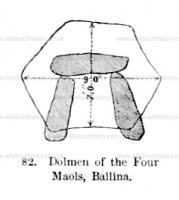
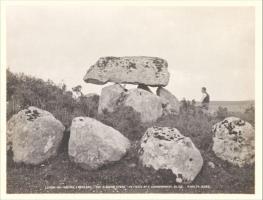
Rude Stone Monuments in all Countries Chapter V. The dolmen [Dolmen of the Four Maols [Map]] in question has nothing very remarkable about it. The cap-stone, which measures 9 feet by 7 feet, is hexagonal in form, and is supported on three uprights, arranged similarly to those of Kit's Cotty House. It is perfectly level, and stands about 4 feet above the level of the soil. The cap-stone may have been fashioned into its present form by art; but there is no sign of chiselling, and, altogether there is nothing that would attract especial attention.1 The interest rests with its date. If it can be established that it belongs to the beginning of the sixth century, which I see no more reason for doubting than Dr. O'Donovan does, it is a point gained in our investigation, in so far at least as dates are concerned.
Note 1. My attention was first directed to this monument by Mr. Samuel Ferguson, Keeper of the Kecords, Dublin. He considered it then as the only cromlech in Ireland with an authenticated date; but, as he has not published this, I must not be considered as committing him to anything except beyond the desire of putting me on the scent of an interesting investigation.
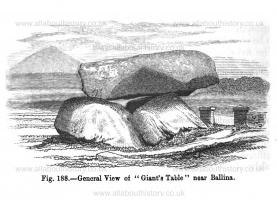
Rude Stone Monuments in Ireland County Sligo and the Island of Achill Chapter 7. Before concluding the description of the Rude Stone Monuments of Sligo we shall make an excursion into the neighbouring county Mayo—for a distance of about two hundred yards—to where there is a remarkable cromleac1 [Dolmen of the Four Maols [Map]] supported by three stones, of which fig. 188 gives a perfect representation, taken from a photograph as well as a sketch. It is now popularly called "The Giant's Table," but by the Irish-speaking natives Clock- an-Togbhail. The cap-stone, which is nearly hexagonal in form, and now practically horizontal in position—one of the supports having slightly given way—measures about 9 feet by 7.2 This monument interests chiefly as being, according to the late John O'Donovan, the only megalith in Ireland which can be satisfactorily connected with history. The story is as follows:—
"In the life of St. Ceallach, it is related that Eoghan Bel, King of Connaught, when dying from the effects of wounds received at the Battle of Sligo (fought in the year A.D. 537), counselled the Hy Fiachrach to elect his son Ceallach to be King in his stead. This Ceallach was the great-grandson of King Daithí, whose red pillar stone at Rath Croghan, erected A.D. 428, is still pointed out. According to the King's dying injunction messengers were sent to Ceallach at Clonmacnoise, and he accepted the proffered dignity, despite the remonstrance and threats of St. Kieran, under whose tuition he was there residing. The saint thereupon solemnly cursed his pupil, and although a reconciliation afterwards took place, and Ceallach, entering the priesthood, attained Episcopal dignity, the curse was still efficacious, and could not be revoked. King Guaire Aidhne conceived a mortal hatred of the Bishop, on account of his having been elected to the sovereignty, and Ceallach in consequence resigned his See and retired to the seclusion of an island on Lough Conn, where, at the King's instigation, he was murdered by four of his pupils, or foster-brothers; and thus St. Kieran's curse was fulfilled. Cucoingilt (brother of Bishop Ceallach) succeeded in capturing the murderers, and carried them in chains to a place in the County Sligo, since called Ardnaree, where he slew them on the banks of the Moy. The hill, on the Sligo side, overlooking the river, was hence called Ard-na-riadh, i.e. "The Hill of the Executions," and this, in turn, gave name to a village (situated on the east side of the stream), which may be considered a suburb of the town of Ballina. The bodies of the four murderers were carried across the river, and interred on the summit of an eminence, (Supposedly beneath the Dolmen) on the Mayo bank, subsequently called Ard-na-Maol (the Height of the Maols), or Leac-na-Maol (The tomb of the Maols), from the four murderers of St. Ceallach having had the prefix Maol attached to their names. A more circumstantial account of the execution and interment is given in the Dinnsenchus, fol. 246."
Note 1. Close to it there is a fragment of rock, but it probably, at no period, had any connexion with the monument. It bears distinct traces of having been blasted with gunpowder, and the holes, in which it was inserted, are still visible.
Note 2. A ground plan of this cromleac is given by Fergusson in Rude Stone Monuments, p. 233.
 Become a Member via our Buy Me a Coffee page to read more.
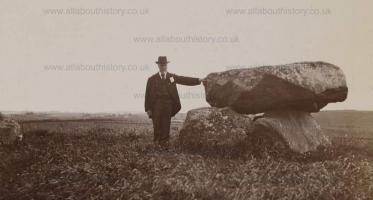
Mr. Thomas Johnson Westropp at Dolmen of the Four Maols [Map] aka "The Giants Table," aka Cloch-an-Togbhail in September 1898.
On 10th August 1897 Bishop William Walsham How (age 73) died at Leenane whilst on holiday. he weas buried at Whittington, Shropshire.
Bede. In the meantime, Colman, the Scottish bishop, departing from Britain, took along with him all the Scots he had assembled in the isle of Lindisfarne, and also about thirty of the English nation, who had been all instructed in the monastic life; and leaving some brothers in his church, he repaired first to the isle of Hii, whence he had been sent to preach the word of God to the English nation. Afterwards he retired to a small island, which is to the west of Ireland, and at some distance from its coast, called, in the language of the Scots, Inisbofinde, the Island of the White Heifer. Arriving there, he built a monastery, and placed in it the monks he had brought of both nations; who not agreeing among themselves, by reason that the Scots, in the summer season, when the harvest was to be brought in, leaving the monastery, wandered about through places with which they were acquainted; but returned again the next winter, and would have what the English had provided to be in common; Colman sought to put an end to this dissension, and travelling about far and near, he found a place in the island of Ireland fit to build a monastery, which, in the language of the Scots, is called Mageo [Note. Probably Mayo Abbey], and bought a small part of it of the earl to whom it belonged, to build his monastery thereon; upon condition, that the monks residing there should pray to our Lord for him who let them have the place. Then building a monastery, with the assistance of the earl and all the neighbours, he placed the English there, leaving the Scots in the aforesaid island. This monastery is to this day possessed by English inhabitants; being the same that, grown up from a small beginning to be very large, is generally called Mageo; and as all things have long since been brought under a better method, it contains an exemplary society of monks, who are gathered there from the province of the English, and live by the labour of their hands, after the example of the venerable fathers, under a rule and a canonical abbot, in much continency and singleness of life.
Become a Member via our Buy Me a Coffee page to read more.
In 1624 William Caulfeild 1st Viscount Charlemont was born to William Caulfeild 2nd Baron Caulfeild (age 37) and Mary King at Dunamon Castle. He married 1653 Sarah Moore Viscountess Charlemont, daughter of Charles Moore 2nd Viscount Moore of Drogheda and Alice Loftus Viscountess Moore, and had issue.
Scregg aka The Cloghogle Passage Tomb is also in Prehistoric Ireland.
Scregg aka The Cloghogle Passage Tomb [Map]. "Another name for this Cromlech is 'Lopa-Erma.' It is said that this name was got from the giant that put it up. Under the cross stones of the cromlech there is said to be stone steps for a long way down in the ground and it is said to be closed up by the chieftain O'Kelly some years ago." From Charles Fuery, a 60 year old local farmer, recorded for the Schools' Collection of Irish folklore in the 1930s.
Carrowmore Burial Mounds is also in Prehistoric Ireland.
1898. Robert Welch (age 38). Carrowmore Burial Mounds [Map].
On 5th September 1691 Colonel Albert Conyngham was killed by an Irish Catholic soldier whilst being held as prisoner of war at Collooney, Sligo.
Chronicle of a Bourgeois of Valenciennes
Récits d’un bourgeois de Valenciennes aka The Chronicle of a Bourgeois of Valenciennes is a vivid 14th-century vernacular chronicle written by an anonymous urban chronicler from Valenciennes in the County of Hainaut. It survives in a manuscript that describes local and regional history from about 1253 to 1366, blending chronology, narrative episodes, and eyewitness-style accounts of political, military, and social events in medieval France, Flanders, and the Low Countries. The work begins with a chronological framework of events affecting Valenciennes and its region under rulers such as King Philip VI of France and the shifting allegiances of local nobility. It includes accounts of conflicts, sieges, diplomatic manoeuvres, and the impact of broader struggles like the Hundred Years’ War on urban life in Hainaut. Written from the perspective of a burgher (bourgeois) rather than a monastery or royal court, the chronicle offers a rare lay viewpoint on high politics and warfare, reflecting how merchants, townspeople, and civic institutions experienced the turbulence of the 13th and 14th centuries. Its narrative style combines straightforward reporting of events with moral and civic observations, making it a valuable source for readers interested in medieval urban society, regional politics, and the lived experience of war and governance in pre-modern Europe.
Available at Amazon in eBook and Paperback format.
In 1685 Robert Morgan (age 61) died at Cottlestown.