

Text this colour links to Pages. Text this colour links to Family Trees. Text this colour are links that disabled for Guests.
Place the mouse over images to see a larger image. Click on paintings to see the painter's Biography Page.
Mouse over links for a preview. Move the mouse off the painting or link to close the popup.
Chronicle of a Bourgeois of Valenciennes
Récits d’un bourgeois de Valenciennes aka The Chronicle of a Bourgeois of Valenciennes is a vivid 14th-century vernacular chronicle written by an anonymous urban chronicler from Valenciennes in the County of Hainaut. It survives in a manuscript that describes local and regional history from about 1253 to 1366, blending chronology, narrative episodes, and eyewitness-style accounts of political, military, and social events in medieval France, Flanders, and the Low Countries. The work begins with a chronological framework of events affecting Valenciennes and its region under rulers such as King Philip VI of France and the shifting allegiances of local nobility. It includes accounts of conflicts, sieges, diplomatic manoeuvres, and the impact of broader struggles like the Hundred Years’ War on urban life in Hainaut. Written from the perspective of a burgher (bourgeois) rather than a monastery or royal court, the chronicle offers a rare lay viewpoint on high politics and warfare, reflecting how merchants, townspeople, and civic institutions experienced the turbulence of the 13th and 14th centuries. Its narrative style combines straightforward reporting of events with moral and civic observations, making it a valuable source for readers interested in medieval urban society, regional politics, and the lived experience of war and governance in pre-modern Europe.
Available at Amazon in eBook and Paperback format.
Canaletto is in Painters.
On 18th October 1697 Canaletto was born. His given name was Giovanni Antonio Canal. He came to be known as Canaletto meaning Little Canal or Canal Junior.

Around 1735. Canaletto (age 37). The Interior of the King Henry VII Chapel, Westminster Abbey [Map].
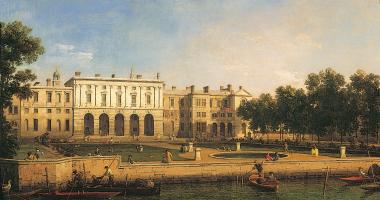
Around 1745. Canaletto (age 47). Old Somerset House [Map].
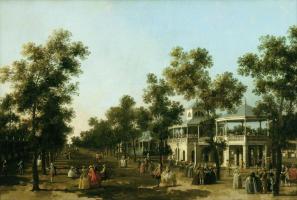
Around 1746. Canaletto (age 48). The Grand Walk at Vauxhall Gardens.

Around 1746. Canaletto (age 48). The City of Westminster from River Thames near the York Water Gate, York House [Map] with Westminster Bridge [Map] under construction.

Around 1747. Canaletto (age 49). View across the River Thames to Westminster Abbey [Map] and Westminster Hall [Map].

Around 1747. Canaletto (age 49). Westminster Bridge [Map], with the Lord Mayor's Procession on the Thames.
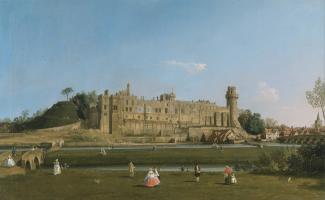
Around 1748. Canaletto (age 50). Warwick Castle [Map].
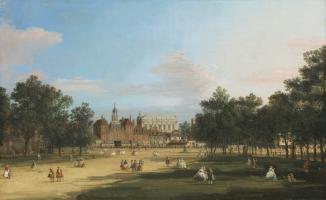
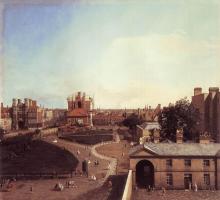
Around 1749. Canaletto (age 51). View of Whitehall, Old Horse Guards and Banqueting House, Whitehall Palace [Map].
The Deeds of the Dukes of Normandy
The Gesta Normannorum Ducum [The Deeds of the Dukes of Normandy] is a landmark medieval chronicle tracing the rise and fall of the Norman dynasty from its early roots through the pivotal events surrounding the Norman Conquest of England. Originally penned in Latin by the monk William of Jumièges shortly before 1060 and later expanded at the behest of William the Conqueror, the work chronicles the deeds, politics, battles, and leadership of the Norman dukes, especially William’s own claim to the English throne. The narrative combines earlier historical sources with firsthand information and oral testimony to present an authoritative account of Normandy’s transformation from a Viking settlement into one of medieval Europe’s most powerful realms. William’s history emphasizes the legitimacy, military prowess, and governance of the Norman line, framing their expansion, including the conquest of England, as both divinely sanctioned and noble in purpose. Later chroniclers such as Orderic Vitalis and Robert of Torigni continued the history, extending the coverage into the 12th century, providing broader context on ducal rule and its impact. Today this classic work remains a foundational source for understanding Norman identity, medieval statesmanship, and the historical forces that reshaped England and Western Europe between 800AD and 1100AD.
Available at Amazon in eBook and Paperback format.
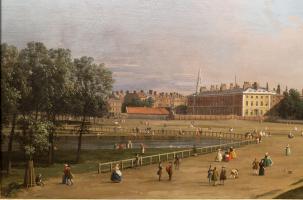
Around 1749. Canaletto (age 51). View of St James' Park [Map].

1749. Canaletto (age 51). Westminster Abbey [Map] with a procession of Knights of the Bath. St Margaret's Church, Westminster [Map] adjacent with the flag.
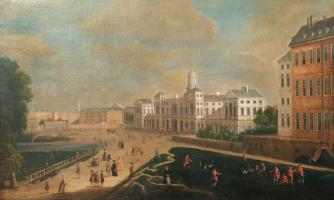
Around 1749. Canaletto (age 51). View of Whitehall, New Horse Guards.

Around 1750. Canaletto (age 52). Alnwick Castle, Northumberland [Map].

Around 1750. Canaletto (age 52). Westminster from near the Terrace of Somerset House [Map] In the distance the Banqueting House, Whitehall Palace [Map], Westminster Abbey [Map] and Westminster Bridge [Map].

Around 1750. Canaletto (age 52). The City from near the Terrace of Somerset House [Map] with St Paul's Cathedral [Map].
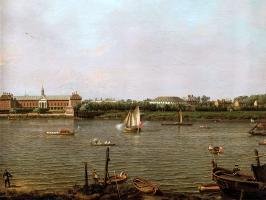
Around 1751. Canaletto (age 53). Royal Hospital Chelsea, Rotunda Ranelagh Gardens Chelsea and Ranelagh House.
Anne Boleyn. Her Life as told by Lancelot de Carle's 1536 Letter.
In 1536, two weeks after the execution of Anne Boleyn, her brother George and four others, Lancelot du Carle, wrote an extraordinary letter that described Anne's life, and her trial and execution, to which he was a witness. This book presents a new translation of that letter, with additional material from other contemporary sources such as Letters, Hall's and Wriothesley's Chronicles, the pamphlets of Wynkyn the Worde, the Memorial of George Constantyne, the Portuguese Letter and the Baga de Secrets, all of which are provided in Appendices.
Available at Amazon in eBook and Paperback format.
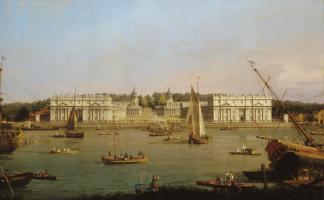
Around 1752. Canaletto (age 54). Greenwich Hospital [Map] from the North Bank of the Thames.
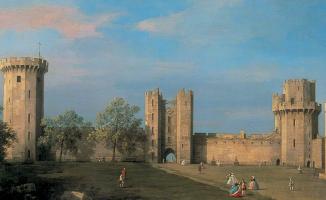
Around 1752. Canaletto (age 54). Warwick Castle [Map] East Front from the Courtyard.
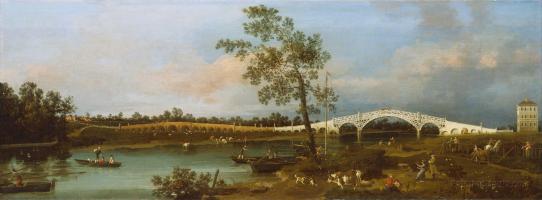
1754. Canaletto (age 56). Walton on Thames Bridge [Map]. Commissioned by Thomas Hollis (age 33).
Thomas Hollis: On 14th April 1720 he was born. In 1757 Thomas Hollis was elected Fellow of the Royal Society. On 1st January 1774 he died.
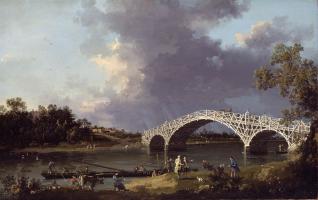
1754. Canaletto (age 56). Walton on Thames Bridge [Map].
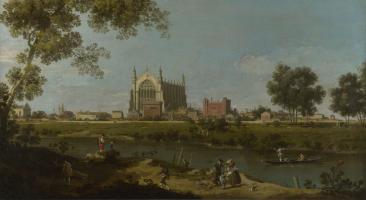
Around 1754. Canaletto (age 56). View across the River Thames to Eton College [Map] with the new Eton College Chapel [Map] visible in white stone and the original Tudor buildings in red brick.
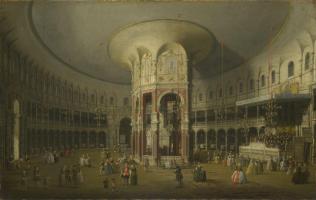
Around 1754. Canaletto (age 56). View of the interior of the Rotunda Ranelagh Gardens Chelsea.

Around 1754. Canaletto (age 56). St Paul's Cathedral [Map].
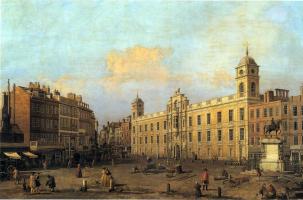
Around 1763. Canaletto (age 65). Northumberland House looking towards Strand [Map]. Note the Percy Lion; crest of the Duke Northumberland. And the statue of King Charles I of England, Scotland and Ireland which remains in situ on the corner of what is now the south-east corner of .
On 19th April 1768 Canaletto (age 70) died.