

Henrici Quinti, Angliæ Regis, Gesta, is a first-hand account of the Agincourt Campaign, and subsequent events to his death in 1422. The author of the first part was a Chaplain in King Henry's retinue who was present from King Henry's departure at Southampton in 1415, at the siege of Harfleur, the battle of Agincourt, and the celebrations on King Henry's return to London. The second part, by another writer, relates the events that took place including the negotiations at Troye, Henry's marriage and his death in 1422.
Available at Amazon in eBook and Paperback format.
On 14th August 1642 Cosimo III de Medici Prince Tuscany was born.
On 17th April 1661 Cosimo III de Medici Prince Tuscany [aged 18] and Marguerite Louise d'Orléans [aged 15] were married by proxy.
Samuel Pepys' Diary. 5th April 1669. At noon by appointment comes Mr. Sheres, and he and I to Unthanke's, where my wife stays for us in our coach, and Betty Turner [aged 16] with her; and we to the Mulberry Garden, where Sheres is to treat us with a Spanish Olio1, by a cook of his acquaintance that is there, that was with my Lord in Spain: and without any other company, he did do it, and mighty nobly; and the Olio was indeed a very noble dish, such as I never saw better, or any more of. This, and the discourse he did give us of Spain, and description of the Escuriall, was a fine treat. So we left other good things, that would keep till night, for a collation; and, with much content, took coach again, and went five or six miles towards Branford, the Prince of Tuscany [aged 26], who comes into England only to spend money and see our country, comes into the town to-day, and is much expected; and we met him, but the coach passing by apace, we could not see much of him but he seems a very jolly and good comely man. By the way, we overtook Captain Ferrers upon his fine Spanish horse, and he is a fine horse indeed; but not so good, I think, as I have seen some. He did ride by us most of the way, and with us to the Park, and there left us, where we passed the evening, and meeting The. Turner [aged 17], Talbot, W. Batelier, and his sister, in a coach, we anon took them with us to the Mulberry Garden; and there, after a walk, to supper upon what was left at noon; and very good; only Mr. Sheres being taken suddenly ill for a while, did spoil our mirth; but by and by was well again, and we mighty merry: and so broke up, and left him at Charing Cross [Map], and so calling only at my cozen Turner's, away home, mightily pleased with the day's work, and this day come another new mayd, for a middle mayd, but her name I know not yet; and, for a cookmaid, we have, ever since Bridget went, used a blackmoore of Mr. Batelier's, Doll, who dresses our meat mighty well, and we mightily pleased with her. So by and by to bed.
Note 1. An olio is a mixed dish of meat and vegetables, and, secondarily, mixture or medley.

Samuel Pepys' Diary. 11th April 1669. Thence, leaving Balty [aged 29] there, I took my wife to St. James's, and there carried her to the Queen's [aged 30] Chapel, the first time I ever did it; and heard excellent musick, but not so good as by accident I did hear there yesterday, as I went through the Park from White Hall to see Sir W. Coventry [aged 41], which I have forgot to set down in my journal yesterday. And going out of the Chapel, I did see the Prince of Tuscany [aged 26] come out, a comely, black, fat man, in a mourning suit; and my wife and I did see him this afternoon through a window in this Chapel. All that Sir W. Coventry yesterday did tell me new was, that the King [aged 38] would not yet give him leave to come to kiss his hand; and he do believe that he will not in a great while do it, till those about him shall see fit, which I am sorry for.
Samuel Pepys' Diary. 18th April 1669. Lord's Day. Up, and all the morning till 2 o'clock at my Office, with Gibson and Tom, about drawing up fair my discourse of the Administration of the Navy, and then, Mr. Spong being come to dine with me, I in to dinner, and then out to my Office again, to examine the fair draught; and so borrowing Sir J. Minnes's [aged 70] coach, he going with Colonel Middleton, I to White Hall, where we all met and did sign it and then to my Lord Arlington's [aged 51], where the King [aged 38], and the Duke of York [aged 35], and Prince Rupert [aged 49], as also Ormond and the two Secretaries, with my Lord Ashly [aged 47] and Sir T. Clifton [aged 38] was. And there, by and by, being called in, Mr. Williamson [aged 35] did read over our paper, which was in a letter to the Duke of York, bound up in a book with the Duke of York's Book of Instructions. He read it well; and, after read, we were bid to withdraw, nothing being at all said to it. And by and by we were called in again, and nothing said to that business; but another begun, about the state of this year's action, and our wants of money, as I had stated the same lately to our Treasurers; which I was bid, and did largely, and with great content, open. And having so done, we all withdrew, and left them to debate our supply of money; to which, being called in, and referred to attend on the Lords of the Treasury, we all departed. And I only staid in the House till the Council rose; and then to the Duke of York, who in the Duchess's chamber come to me, and told me that the book was there left with my Lord Arlington, for any of the Lords to view that had a mind, and to prepare and present to the King what they had to say in writing, to any part of it, which is all we can desire, and so that rested. The Duke of York then went to other talk; and by and by comes the Prince of Tuscany [aged 26] to visit him, and the Duchess [aged 32]; and I find that he do still remain incognito, and so intends to do all the time he stays here, for avoiding trouble to the King and himself, and expence also to both.
Samuel Pepys' Diary. 25th April 1669. So to church, where a stranger made a dull sermon, but I mightily pleased to looks upon Mr. Buckworth's [aged 47] little pretty daughters, and so home to, dinner, where W. Howe come and dined with us; and then I to my Office, he being gone, to write down my journal for the last twelve days: and did it with the help of my vizard and tube fixed to it, and do find it mighty manageable, but how helpfull to my eyes this trial will shew me. So abroad with my wife, in the afternoon, to the Park, where very much company, and the weather very pleasant. I carried my wife to the Lodge, the first time this year, and there in our coach eat a cheese-cake and drank a tankard of milk. I showed her this day also first the Prince of Tuscany [aged 26], who was in the Park, and many very fine ladies, and so home, and after supper to bed.
Samuel Pepys' Diary. 29th May 1669. Home to dinner, and then with my wife to Hyde Park, where all the evening; great store of company, and great preparations by the Prince of Tuscany [aged 26] to celebrate the night with fire-works, for the King's birth-day. And so home.
Samuel Pepys' Diary. 29th May 1669. The King's birth-day. To White Hall, where all very gay; and particularly the Prince of Tuscany [aged 26] very fine, and is the first day of his appearing out of mourning, since he come. I heard the Bishop of Peterborough [aged 61] preach but dully; but a good anthem of Pelham's [aged 22].
On 17th September 1721 [his wife] Marguerite Louise d'Orléans [aged 76] died.
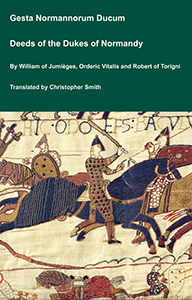
The Deeds of the Dukes of Normandy
The Gesta Normannorum Ducum [The Deeds of the Dukes of Normandy] is a landmark medieval chronicle tracing the rise and fall of the Norman dynasty from its early roots through the pivotal events surrounding the Norman Conquest of England. Originally penned in Latin by the monk William of Jumièges shortly before 1060 and later expanded at the behest of William the Conqueror, the work chronicles the deeds, politics, battles, and leadership of the Norman dukes, especially William’s own claim to the English throne. The narrative combines earlier historical sources with firsthand information and oral testimony to present an authoritative account of Normandy’s transformation from a Viking settlement into one of medieval Europe’s most powerful realms. William’s history emphasizes the legitimacy, military prowess, and governance of the Norman line, framing their expansion, including the conquest of England, as both divinely sanctioned and noble in purpose. Later chroniclers such as Orderic Vitalis and Robert of Torigni continued the history, extending the coverage into the 12th century, providing broader context on ducal rule and its impact. Today this classic work remains a foundational source for understanding Norman identity, medieval statesmanship, and the historical forces that reshaped England and Western Europe between 800AD and 1100AD.
Available at Amazon in eBook and Paperback format.
On 31st October 1723 Cosimo III de Medici Prince Tuscany [aged 81] died.