

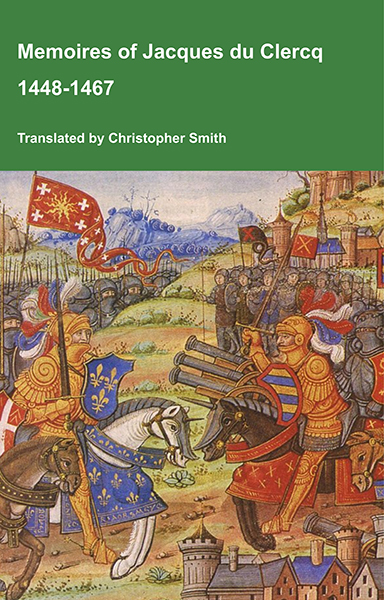
This is a translation of the 'Memoires of Jacques du Clercq', published in 1823 in two volumes, edited by Frederic, Baron de Reissenberg. In his introduction Reissenberg writes: 'Jacques du Clercq tells us that he was born in 1424, and that he was a licentiate in law and a counsellor to Philip the Good, Duke of Burgundy, in the castellany of Douai, Lille, and Orchies. It appears that he established his residence at Arras. In 1446, he married the daughter of Baldwin de la Lacherie, a gentleman who lived in Lille. We read in the fifth book of his Memoirs that his father, also named Jacques du Clercq, had married a lady of the Le Camelin family, from Compiègne. His ancestors, always attached to the counts of Flanders, had constantly served them, whether in their councils or in their armies.' The Memoires cover a period of nineteen years beginning in in 1448, ending in in 1467. It appears that the author had intended to extend the Memoirs beyond that date; no doubt illness or death prevented him from carrying out this plan. As Reissenberg writes the 'merit of this work lies in the simplicity of its narrative, in its tone of good faith, and in a certain air of frankness which naturally wins the reader’s confidence.' Du Clercq ranges from events of national and international importance, including events of the Wars of the Roses in England, to simple, everyday local events such as marriages, robberies, murders, trials and deaths, including that of his own father in Book 5; one of his last entries.
Available at Amazon in eBook and Paperback format.
Brussels is in Belgium.
On 18th July 1501 Isabella of Austria Queen Consort Denmark and Norway was born to Philip "Handsome Fair" King Castile [aged 22] and Joanna "The Mad" Trastámara Queen Castile [aged 22] at Brussels [Map]. She a great x 4 granddaughter of King Edward III of England. Coefficient of inbreeding 2.88%. She married 1515 her third cousin Christian II King of Denmark II King Norway, son of John King of Denmark Norway and Sweden and Christina Queen Consort Denmark Norway and Sweden, and had issue.


On 10th March 1538 Philip Hoby [aged 33] arrived in Brussels [Map] with Hans Holbein The Younger [aged 41] having been sent by Thomas Cromwell 1st Earl Essex [aged 53] to procure a portrait of Christina Oldenburg Duchess Lorraine [aged 16]. King Henry VIII of England and Ireland [aged 46] received the portrait on 18th March 1538 and was reported to have been pleased.


In 1549 William Brooke 10th Baron Cobham [aged 21] accompanied Paget's embassy at Brussels [Map].
On 1st May 1549 Nicholas of Lorraine Duke of Mercœur [aged 24] and Marguerite Egmont [aged 32] were married in Brussels [Map]. He the son of Antoine Lorraine II Duke Lorraine. They were third cousin once removed.
On 24th February 1555 Nicholas of Lorraine Duke of Mercœur [aged 30] and Princess Joanna of Savoy Nemours [aged 23] were married in Brussels [Map]. He the son of Antoine Lorraine II Duke Lorraine. They were fourth cousin once removed.

In November 1555 Edward Courtenay 1st Earl Devon [aged 28] wrote a letter from Brussels [Map] pleading for permission to return to England to pay his respects to Queen Mary and to his mother.
John Evelyn's Diary. 22nd September 1641. I went again to Rotterdam to receive a pass which I expected from Brussels [Map], securing me through Brabant and Flanders, designing to go into England through those countries. The Cardinal Infante [aged 32], brother to the king of Spain [aged 36], was then governor. By this pass, having obtained another from the Prince of Orange, upon the 24th of September I departed through Dort; but met with very bad tempestuous weather, being several times driven back, and obliged to lie at anchor off Keele, other vessels lying there waiting better weather. The 25th and 26th we made other essays; but were again repulsed to the harbour, where lay sixty vessels waiting to sail. But, on the 27th we, impatient of the time and inhospitableness of the place, sailed again with a contrary and impetuous wind and a terrible sea, in great jeopardy; for we had much ado to keep ourselves above water, the billows breaking desperately on our vessel: we were driven into Willemstad, North Brabant, a place garrisoned by the English, where the Governor of had a fair house. The works, and especially the counterscarp, are curiously hedged with quick, and planted with a stately row of limes on the rampart. The church is of a round structure, with a cupola, and the town belongs entirely to the Prince of Orange, as does that of Breda [Map], and some other places.


John Evelyn's Diary. 5th October 1641. But there was nothing about this city which more ravished me than those delicious shades and walks of stately trees, which render the fortified works of the town one of the sweetest places in Europe; nor did I ever observe a more quiet, clean, elegantly built, and civil place, than this magnificent and famous city of Antwerp [Map]. In the evening, I was invited to Signor Duerte's, a Portuguese by nation, an exceeding rich merchant, whose palace I found to be furnished hke a prince's. His three daughters entertained us with rare music, vocal and instrumental, which was finished with a handsome collation. I took leave of the ladies and of sweet Antwerp [Map], as late as it was, embarking for Brussels [Map] on the Scheldt in a vessel, which delivered us to a second boat (in another river) drawn or towed by horses. In this passage, we frequently changed our barge, by reason of the bridges thwarting our course. Here I observed numerous families inhabiting their vessels and floating dwellings, so built and divided by cabins, as few houses on land enjoyed better accommodation, stored with all sorts of utensils, neat chambers, a pretty parlour, and kept so sweet, that nothing could be more refreshing. The rivers on which they are drawn are very clear and still waters, and pass through a most pleasant country on both the banks. We had in our boat a very good ordinary, and excellent company. The cut is straight as a line for twenty English miles. What I much admired was, near the midway, another artificial river, which intersects this at right angles, but on an eminence of ground, and is carried in an aqueduct of stone so far above the other, as that the waters neither mingle, nor hinder one another's passage.
John Evelyn's Diary. 7th October 1641. We arrived at Brussels [Map] at nine in the morning. The Stadthouse, near the market-place, is, for the carving in freestone, a most laborious and finished piece, well worthy observation. The flesh-shambles are also built of stone. I was pleased with certain small engines, by which a girl, or boy, was able to draw up, or let down, great bridges, which in divers parts of this city crossed the channel for the benefit of passengers. The walls of this town are very entire, and full of towers at competent distances. The cathedral is built upon a very high and exceeding steep ascent, to which we mounted by fair steps of stone. Hence I walked to a convent of English Nuns, with whom I sat discoursing most part of the afternoon.
John Evelyn's Diary. 8th October 1641. At near eleven o'clock, I repaired to his Majesty's [aged 40] agent. Sir Henry De Vic [aged 42], who very courteously received me, and accommodated me with a coach and six horses, which carried me from Brussels [Map] to Ghent [Map], where it was to meet my Lord of Arundel [aged 56], Earl Marshal of England, who had requested me when I was at Antwerp [Map] to send it for him, if I went not thither myself.


John Evelyn's Diary. 8th October 1641. Thus taking leave of Brussels [Map] and a sad Court, yet full of gallant persons, (for in this small city, the acquaintance being universal, ladies and gentlemen, I perceived, had great diversions and frequent meetings,) I hasted towards Ghent [Map]. On the way, 1 met with divers little waggons, prettily contrived and full of peddling merchandises, dravm by mastiff-dogs, harnessed completely like so many coachhorses; in some four, in others six, as in Brussels [Map] itself I had observed. In Antwerp [Map] I saw, as I remember, four dogs draw five lusty children in a chariot: the master commands them whither he pleases, crying his wares about the streets. After passing through Ouse, by six in the evening, I arrived at Ghent [Map]. This is a city of so great a circumference, that it is reported to be seven leagues round; but there is not half of it now built, much of it remaining in fields and desolate pastures even within the walls, which have strong gates towards the west, and two fair churches.
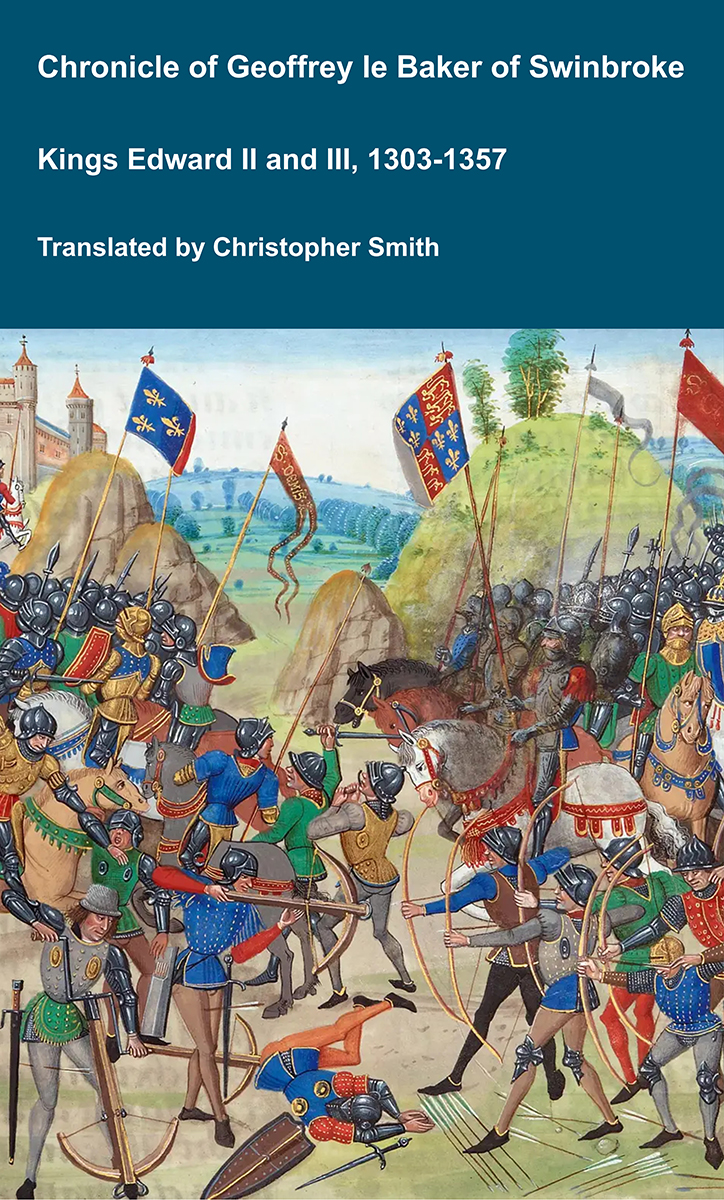
Chronicle of Geoffrey le Baker of Swinbroke
Baker was a secular clerk from Swinbroke, now Swinbrook, an Oxfordshire village two miles east of Burford. His Chronicle describes the events of the period 1303-1356: Gaveston, Bannockburn, Boroughbridge, the murder of King Edward II, the Scottish Wars, Sluys, Crécy, the Black Death, Winchelsea and Poitiers. To quote Herbert Bruce 'it possesses a vigorous and characteristic style, and its value for particular events between 1303 and 1356 has been recognised by its editor and by subsequent writers'. The book provides remarkable detail about the events it describes. Baker's text has been augmented with hundreds of notes, including extracts from other contemporary chronicles, such as the Annales Londonienses, Annales Paulini, Murimuth, Lanercost, Avesbury, Guisborough and Froissart to enrich the reader's understanding. The translation takes as its source the 'Chronicon Galfridi le Baker de Swynebroke' published in 1889, edited by Edward Maunde Thompson.
Available at Amazon in eBook and Paperback format.

On 27th April 1700 Thomas Bruce 3rd Earl Elgin 2nd Earl Ailesbury [aged 44] and Charlotte Argenteau Countess Elgin and Ailesbury [aged 21] were married at Brussels [Map]. She by marriage Countess Elgin, Countess Ailesbury. The difference in their ages was 22 years. He the son of Robert Bruce 2nd Earl Elgin 1st Earl Ailesbury.
On 31st January 1760 Mary Radclyffe [aged 46] died of smallpox in Brussels [Map].

On 28th October 1777 Henry Augustus Dillon Lee 13th Viscount Dillon was born to Charles Dillon Lee 12th Viscount Dillon [aged 31] and Henrietta Maria Phipps [aged 20] at Brussels [Map]. He a great x 3 grandson of King James II of England Scotland and Ireland.
On 1st February 1786 George Beauclerk 3rd Duke St Albans [aged 55] died at Brussels [Map]. His first cousin once removed George [aged 27] succeeded 4th Duke St Albans, 4th Earl Burford, 4th Baron Heddington.
On 18th February 1858 Louise Wettin was born to King Leopold II of Belgium [aged 22] in Brussels [Map]. She married her second cousin Ferdinand Philipp Saxe Coburg Gotha, son of August Victor Saxe Coburg Gotha and Princess Clémentine Orléans, and had issue.
On 16th September 1910 Mary Sophia Nevile [aged 90] died at Brussels [Map].