

Jean de Waurin's Chronicle of England Volume 6 Books 3-6: The Wars of the Roses
Jean de Waurin was a French Chronicler, from the Artois region, who was born around 1400, and died around 1474. Waurin’s Chronicle of England, Volume 6, covering the period 1450 to 1471, from which we have selected and translated Chapters relating to the Wars of the Roses, provides a vivid, original, contemporary description of key events some of which he witnessed first-hand, some of which he was told by the key people involved with whom Waurin had a personal relationship.
Available at Amazon in eBook and Paperback format.
Paternal Family Tree: Devereux
Maternal Family Tree: Ursula St Barbe 1532-1602
1613 Thomas Overbury Murder and Trial of his Murderers
1613 Marriage of Robert Carr 1st Earl Somerset and Frances Howard
In 1583 Philip Sidney [aged 28] and [his mother] Frances Walsingham Countess Essex [aged 16] were married. They were half sixth cousins.


In 1590 [his father] Robert Devereux 2nd Earl Essex [aged 24] and [his mother] Frances Walsingham Countess Essex [aged 23] were married. She by marriage Countess Essex. He the son of [his grandfather] Walter Devereux 1st Earl Essex and [his grandmother] Lettice Knollys Countess Essex and Leicester [aged 46]. They were half fourth cousin once removed.


On 11th January 1591 Robert Devereux 3rd Earl Essex was born to [his father] Robert Devereux 2nd Earl Essex [aged 25] and [his mother] Frances Walsingham Countess Essex [aged 24].
On 5th March 1599 [his brother-in-law] Roger Manners 5th Earl of Rutland [aged 22] and [his half-sister] Elizabeth Sidney Countess Rutland [aged 14] were married. She by marriage Countess of Rutland. Childless, unhappy and possibly not consummated. She the daughter of Philip Sidney and [his mother] Frances Walsingham Countess Essex [aged 32]. He the son of John Manners 4th Earl of Rutland and Elizabeth Charlton Countess Rutland.
On 5th August 1599 Alexander Radclyffe of Ordsall Hall [aged 26] died of wounds and fever in Ulster while campaigning with the [his father] Robert Devereux 2nd Earl Essex [aged 33] during the unsuccessful attempt to bring Ireland under English control. The Queen [aged 65] herself informed his twin sister of her brother's death.


On 25th February 1601 [his father] Robert Devereux 2nd Earl Essex [aged 35] was beheaded at Tower Green, Tower of London [Map] as a consequence of his involvement in the Essex Rebellion. Earl Essex, Viscount Hereford, Baron Bourchier and Baron Ferrers of Chartley forfeit. He was the last person to be executed at the Tower of London. It isn't clear whether his other titles Viscount Hereford, Baron Ferrers of Chartley and Baron Bourchier were forfeit.
In 1603 Robert Devereux 3rd Earl Essex [aged 11] and Frances Howard Countess Essex and Somerset [aged 12] were married. They were separated after the wedding given their young age. Essex went on a European tour from 1607 to 1609. When he returned she avoided him having fallen for Robert Carr 1st Earl Somerset [aged 16] whilst her husband was away. He was ill with smallpox. She sought an annulment with her father Robert Devereux 2nd Earl Essex and uncle Henry Howard 1st Earl of Northampton [aged 62] acting for her. She maintained the marriage had not been consummated and was examined by ten matrons and two midwives who found her hymen intact. It was widely rumoured at the time that Sir Thomas Monson's [aged 38] daughter was a substitute, which is possible because she had requested to be veiled during the examination "for modesty's sake". He maintained he was capable with other women, but was unable to consummate his marriage blaming her. She the daughter of Thomas Howard 1st Earl Suffolk [aged 41] and Catherine Knyvet Countess Suffolk [aged 39]. He the son of Robert Devereux 2nd Earl Essex and Frances Walsingham Countess Essex [aged 36]. They were fourth cousins.


In 1603 [his step-father] Richard Burke 4th Earl Clanricarde 1st Earl St Albans [aged 31] and [his mother] Frances Walsingham Countess Essex [aged 36] were married. He the son of Ulrick Burke 3rd Earl Clanricarde.
Around 1603 Robert Devereux 3rd Earl Essex [aged 11] educated at Eton College [Map].
In 1604 Robert Devereux 3rd Earl Essex [aged 12] was restored 3rd Earl Essex, 4th Viscount Hereford, 13th Baron Ferrers of Chartley, 10th Baron Bourchier although it isn't clear whether the latter three titles were forfeit when his father was executed in 1601. [his wife] Frances Howard Countess Essex and Somerset [aged 13] by marriage Countess Essex.
On 23rd December 1605 William Knollys 1st Earl Banbury [aged 61] and [his sister-in-law] Elizabeth Howard Countess Banbury [aged 22] were married. She by marriage Baroness Knollys. The difference in their ages was 39 years. She the daughter of [his father-in-law] Thomas Howard 1st Earl Suffolk [aged 44] and [his mother-in-law] Catherine Knyvet Countess Suffolk [aged 41]. They were third cousin once removed.


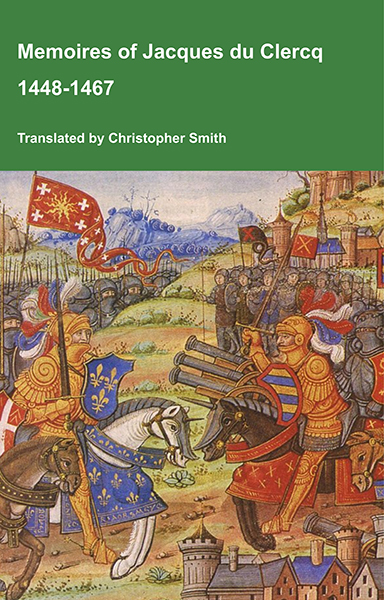
This is a translation of the 'Memoires of Jacques du Clercq', published in 1823 in two volumes, edited by Frederic, Baron de Reissenberg. In his introduction Reissenberg writes: 'Jacques du Clercq tells us that he was born in 1424, and that he was a licentiate in law and a counsellor to Philip the Good, Duke of Burgundy, in the castellany of Douai, Lille, and Orchies. It appears that he established his residence at Arras. In 1446, he married the daughter of Baldwin de la Lacherie, a gentleman who lived in Lille. We read in the fifth book of his Memoirs that his father, also named Jacques du Clercq, had married a lady of the Le Camelin family, from Compiègne. His ancestors, always attached to the counts of Flanders, had constantly served them, whether in their councils or in their armies.' The Memoires cover a period of nineteen years beginning in in 1448, ending in in 1467. It appears that the author had intended to extend the Memoirs beyond that date; no doubt illness or death prevented him from carrying out this plan. As Reissenberg writes the 'merit of this work lies in the simplicity of its narrative, in its tone of good faith, and in a certain air of frankness which naturally wins the reader’s confidence.' Du Clercq ranges from events of national and international importance, including events of the Wars of the Roses in England, to simple, everyday local events such as marriages, robberies, murders, trials and deaths, including that of his own father in Book 5; one of his last entries.
Available at Amazon in eBook and Paperback format.
Around 1607 Robert Devereux 3rd Earl Essex [aged 15] educated at Merton College, Oxford University.

On 1st December 1608 William Cecil 2nd Earl Salisbury [aged 17] and [his sister-in-law] Catherine Howard Countess Salisbury [aged 18] were married. She the daughter of [his father-in-law] Thomas Howard 1st Earl Suffolk [aged 47] and [his mother-in-law] Catherine Knyvet Countess Suffolk [aged 44]. He the son of Robert Cecil 1st Earl Salisbury [aged 45] and Elizabeth Brooke. They were fifth cousins.
After 24th March 1611 Robert Devereux 3rd Earl Essex [aged 20] was appointed Privy Counciller.
In 1612 [his brother-in-law] Theophilus Howard 2nd Earl Suffolk [aged 29] and Elizabeth Home Countess Suffolk [aged 13] were married. She the daughter of George Home 1st Earl Dunbar and Elizabeth Gordon Countess Dunbar [aged 37]. He the son of [his father-in-law] Thomas Howard 1st Earl Suffolk [aged 50] and [his mother-in-law] Catherine Knyvet Countess Suffolk [aged 48].
In 1612 [his half-sister] Elizabeth Sidney Countess Rutland [aged 27] died. She was buried at St Mary the Virgin Church, Bottesford, Leicestershire [Map].
On 24th May 1612 Robert Cecil 1st Earl Salisbury [aged 48] died at Marlborough, Wiltshire [Map]. His son William [aged 21] succeeded 2nd Earl Salisbury. [his sister-in-law] Catherine Howard Countess Salisbury [aged 22] by marriage Countess Salisbury.

Letters of the Court of James I 1613. 8th July 1613. London. Reverend Thomas Lorkin to Thomas Puckering 1st Baronet [aged 21].
Painters and poets may lie by privilege; but such as undertake to make relation of things that pass, should tell naught but truth. Pardon me, therefore, if I must now revoke what in my last letters I writ for certain, touching the swearing of Sir David Murray and Sir Robert Carr [aged 35] in his highness's bedchamber. I received it very confidently from Sir John Harrington's [aged 73] mouth. But I have found since, by my inquiry, that they only procured the king's warrant, which met with afterwards that opposition from the lords, as it rests yet doubtful whether and when it shall take effect. The prince's household is not yet settled; yesterday the council sat about it, and the opinion was that the king would then sign the book.
My Lord Stanhope's [aged 64]1 son [aged 20] is lately fallen lunatic; and the little hope that is conceived of his recovery makes divers of your friends think that it was your hard fortune to be no more forward in embracing those offers which were formerly made you out of that house.
You have heard long since, I suppose, of the great difference between my Lord of Essex [aged 22] and his [his wife] lady [aged 23], who hath most earnestly sued for a divorce, pretending the only cause to be of her husband's insufficiency; who confesseth it towards her, though he esteems himself well enough provided for any other. It was expected that a nullity of marriage should have been pronounced by my Lord of Canterbury [aged 50] at the end of last term, but the sentence is deferred to the term following; which, if it be given in favour of her, it is generally believed that a match shall be concluded between my Lord of Rochester [aged 26] and her: thereby to reconcile him and the house of Howard together, who are now far enough asunder.
The news of the great entertainment at the Palatine's I court is but newly arrived here. It consists chiefly in matter of good cheer, after the fashion of the country. They talk of I know not how many hundred tables which should be every day prepared; but you will easily proportion them out yourself, when you shall hear of the number of mouths, which were no fewer, every meal, than 6000. The same messenger brings tidings that her grace is with child, and that there wants not the concurrence of all sach tokens and probabilities as are usually observed in women in that state and condition.
The Duke of Lennox [aged 38]2 arrived in Paris on Saturday last, as we are informed here, having made that the way of his return home from Heidelberg. He pretends the occasion of his stay there to be, the seeking to obtain the command of the company of horse which our Prince Charles had, when he was but Duke of York. But, though made an absolute refusal of it before his coming, he having employed himself in that business by commission from our king, the true cause of his stay is thought to be a treaty of marriage between Prince Charles and Madame Christine, which, having been long time negociated by Sir Thomas Edraondes, is thought shall receive its final conclusion from him.
Sir Thomas Waller [deceased], governor of Dover Castle, is lately dead. His place is already disposed of; but I cannot say certainly how. Sir Thomas Somerset [aged 34]3 inquires very kindly after you, and you shall do well to omit no good means of entertaining his good opinion still.
Note 1. John, created an English baron by the title of Lord Stanhope of Harrington, May 4, 1605. He died March 9, 1621, leaving issue one daughter only. [Note. He left issue Charles Stanhope 2nd Baron Stanhope, Elizabeth Stanhope Lady Talmash and Catherine Stanhope Countess Leinster]
Note 2. Lodovick Stuart. He was high chamberlain and admiral of Scotland, and in 1601 was Bent by James ambassador to the court of France. In October, 1613, he was created Baron Setrington and Earl of Richmond. He filled the offices of master of the hoasehold, first gentleman of the bedchamber, was invested with the garter, and appointed commissioner to the parliament; and, in 1623, was further advanced to the dignities of the Earl of Newcastle and Duke of Richmond. Though twice married, the Duke of Lennox died without issue, in February. 1624.
Note 3. Third son of Edward, Earl of Worcester [aged 63]. He was afterwards created Viscount Somerset of Cassel (Cashel) in Ireland.


Letters of the Court of James I 1613. 12th August 1613. London. Reverend Thomas Lorkin to Thomas Puckering 1st Baronet [aged 21].
First, touching the business which you so particularly commended unto me at our last being together at Florence, Tuscany, I have had hitherto very small opportunity of dealing farther in it than pressing Mr. Newton [aged 33] for his advice and furtherance. For in this general absence of the court, when king, queen, and prince are all in several progresses, little or no means hath been yet offered. Sir Robert Cary [aged 53]1, as your brother telleth me, is the fittest man to be dealt with in that kind, to whom I shall most willingly likewise address myself, as having best means to him. Only I attend some further directions from Mr. Newton both for the nature of the place I should sue for, and how I should govern myself in my offers for the accomplishment of it.
For news, that which is of chiefest moment is this. There hath lately happened in the Palatine's court a strange quarrel between the English and Scots, and that in this manner and upon this occasion. Sir Andrew Keigh, a Scotsman, that is in some office about the Palatine, happening one day to contest with my Lady Harrington [aged 59]2 upon some point in her grace's presence, [he proceeded] to that insolency at the length, as he gave her the lie; and not content therewith (to verify that of the orator, "qui vere cundiæ fines semel transierit, eum benè et gnavitèr oportet esse impudentem," [Note. she who truly has once crossed the bounds of grace must be shameless]) fell to debase my lord [aged 73] likewise with very base and opprobrious speeches. Mr. Bushell, who, as I understand, was the only man of all my lord's followers that was then present, finding Keigh not long after in a fit place for that purpose, offered him the combat in defence of his lord's and lady's honour; and as both were ready to draw, another Scotsman, who was in Keigh's company, interposed himself, and suffered not them to proceed then any farther. Being thus parted, my Lord Harrington sent for Mr. Bushell to his chamber (whether to wish him to be quiet, or for what other occasion I know not). In the mean time, this Keigh [at the] head of four or five Scotsmen more, himself being provided, besides his sword, with a square bastinado and a dagger, the rest with the [sword] only, lies in wait to set apon Mr. Bashell at his return: [who, as he was] coming from my lord, and not dreaming of any such enterprise, and going to put his foot in his stirrup to mount up upon his horse, (for my lord's [lodging and his] were far asunder), lo! Keigh steps forth, striking him, [and with the] bastinado fells him: yet presently he recovered himself, and, offering to rise, received a second blow upon the head, and was felled a second time. Notwithstanding all this, he recovered himself again, and drew out his sword in his own defence, being all idone; when all the rest laid about him with their swords, and, being five to one, wounded him very grievously, as having run him through the body, and into divers parts no less than twelve times. During this conflict, Mr. Gray, another of my lord's gentlemen, coming forth, received a thrust in the hand, but not without leaving some of the marks likewise upon them. After that came her grace's coachman, and took part with Mr. Gray (for Mr. Bushell was now left for dead) and hurt two or three of the Scots; who, not daring to abide to fight any longer, partly for fear of others that might come in, and partly for that they supposed their chief enemy either dead or not likely to live, presently quitted the place, and betook themselves to flight. But there was suddenly way made after them, and they all brought back again. Sir Andrew Keigh was confined to his chamber under a sure guard, the rest committed to the ordinary prison; and a messenger presently despatched over into England to understand his majesty's pleasure touching this subject; who has scarcely as yet received the news thereof. Mr. Bushell nevertheless is yet living, and not without hope of recovery. My Lord and Lady Harrington purpose to return for England this month, and to bring him along with them, (which they may well do by water) if they find him any way able to endure it.
Upon their arrival. Sir John Harrington [aged 21]3 purposeth to go and take possession of his government in Guernsey [Map], which he hath lately obtained by an exchange which he hath made between it and a reversion of an office formerly granted him of being master in the King's Bench.
My Lord of Essex's [aged 22] cause hath had no hearings of late, and is remitted over to the 18th day of this next new month. Two new commissioners are adjoined to the former, viz., the Bishops of Winchester [aged 66]4 and Rochester [aged 51]5 that their voice in favour of the nullity may be able to counterpoise the contrary opposition of Canterbury and London.
The Lord Chief Justice Fleming [deceased] is lately dead, and Hobart and Montagu suitors for the place.
In my last letters I acquainted you with the stirs that were at Nismes upon occasion of M. Ferrier, some time their minister. M. le Conestable, who resides in those parts, hath made such a grievous complaint thereof unto the queen [aged 11]6, as she hath taken a resolution thereupon to translate, by way of punishment, the presidial seat of justice, which is there, to Beaucaire, a neighbour Catholic town, hard by; which, if it once come to be put in execution, is like to occasion far greater stirs in those quarters.
Note 1. Fourth son of Henry Cary Lord Hunsdon, and grandson of William Cary, Esq., who married Mary Boleyn, sister to Queen Anne Boleyn. Sir Robert Cary was created by King James I [aged 47], Lord Gary of Lepingdon, in Yorkshire, and by King Charles I [aged 12], Earl of Monmooth.
Note 2. Anne, daughter and sole heir of Robert Kelway, Esq, surveyor of the Court of Wards, and wife of Sir John Harrington, created 21st July, 1603, by King James the First, Lord Harrington of Exton in Rutland. He had the tuition of the Lady Elizabeth [aged 16], whom he attended, in April, 1613, to the Palatinate; and died in the same year.
Note 3. Son of Lord Harrington. He died in February, 1613-14.
Note 4. Dr. Bilson.
Note 5. Dr. John Buckridge.
Note 6. Queen of France.


Letters of the Court of James I 1613. 29th August 1613. London. Reverend Thomas Lorkin to Thomas Puckering 1st Baronet [aged 21].
Yoa may please to remember how, in some of my former letters, I made mention of my Lord of Essex's [aged 22] case, which was to rest in dependance till next term. But the king showed himself so affectionate in it, as the commissioners have been forced (to give his majesty satisfaction) to yield a more speedy hearing of it, which was done (though with little effect) upon last Wednesday. But it is believed generally that unless the commission be changed, the nullities which his majesty desireth will never be pronounced. For the Archbishop of Canterbury [aged 50] and the Bishop of London [aged 54], together with Dr. Bennet, and Dr. Edwards, who are like to have the greatest sway in deciding this controversy, are directly against it; insomuch as my Lord of Canterbury, being with his majesty at Windsor for some three or four days before the hearing, fell down upon his knees twice or thrice, to entreat his majesty that he might be dispensed with from being on the commission; which he would esteem a greater favour that all that he had received from him in being raised from a private condition, and in so short a space, to the highest dignity ecclesiastical. At the last hearing, my Lord of Rochester [aged 26] stayed here in town, as is supposed, to hear the success, and rode presently past unto the king, [to acquaint] his majesty thereof, and showeth himself so passionate in this business only in favour [of the [his wife] countess [aged 23],] with whom a new match would be presently concluded, if the old one were now abolished.
Sir Thomas Overbury [aged 32] is like to run a short course, being sick unto death1. The lieutenant of the Tower, and the physicians that were there about him, have subscribed their hands, that they hold him a man past all recovery.
Mr. Albert Morton [aged 29], secretary of Sir Henry Wotton, is to be sent presently ambassador to the Duke of Savoy [aged 51], and there [remain], which gives occasion of conjecture here that the old treaty of marriage is now [on foot] again; and that that other of France is like to fall to the ground. But in these [conjectures] haply it would be fit to be more sparing.
I received news lately from a gentleman, that heard it from Sir Ralph Winwood's [aged 50] own mouth, that the States are resolved to make war upon the King of Denmark, if either our king will join them, or otherwise be [persuaded] to stand by a neuter. Their quarrel is, for that the King of Denmark hath imposed a grievous tax upon all merchandize that pass the Sound, and he hath in effect blocked up that passage: for it is held that of every three ships that pass, one falls by this means to his share, which is a thing intolerable.
The differences between them of the Religion in France are grown so violent as the deputies'-general have petitioned the queen, in the name of all the provinces, for liberty to hold a general assembly for [consideration] and pacification of them. But they find this request to be nothing pleasing, nor without great difficulty to be obtained, out of a jealousy the States hath that they may grow to new complaints and demands, after the example of the last assembly.
There hath been lately a proposition of marriage between the daughter of M. D'Ancre, and M. De Villeroy's grand-child, who is the heir of his house; there having been a former intention of matching her with the young Duke D'Elboeuf, which gives occasion of great jealousy and suspicion to M. De Guise and his faction, fearing by this news that M. De Yilleroy will be disjoined from them.
Note 1. He died on the 15th of September following, from poison, which Rochester and his countess had caused to be administered in his food.
On 25th September 1613 Robert Devereux 3rd Earl Essex [aged 22] and Frances Howard Countess Essex and Somerset [aged 23] marriage annulled by King James I of England and Ireland and VI of Scotland [aged 47]. She married Robert Carr 1st Earl Somerset [aged 26] three months later.
On 26th December 1613 Robert Carr 1st Earl Somerset [aged 26] and [his former wife] Frances Howard Countess Essex and Somerset [aged 23] were married. She by marriage Countess Somerset. She the daughter of [his former father-in-law] Thomas Howard 1st Earl Suffolk [aged 52] and [his former mother-in-law] Catherine Knyvet Countess Suffolk [aged 49].
Her marriage with her first husband Robert Devereux 3rd Earl Essex [aged 22] had been annulled on the grounds of his impotence three months before causing something of a scandal.
In 1614 [his former brother-in-law] Thomas Howard 1st Earl Berkshire [aged 26] and Elizabeth Cecil Countess Berkshire [aged 18] were married. She the daughter of William Cecil 2nd Earl Exeter [aged 48] and Elizabeth Drury Countess Exeter [aged 35]. He the son of [his former father-in-law] Thomas Howard 1st Earl Suffolk [aged 52] and [his former mother-in-law] Catherine Knyvet Countess Suffolk [aged 50]. They were fourth cousins.
Abbot John Whethamstede’s Chronicle of the Abbey of St Albans
Abbot John Whethamstede's Register aka Chronicle of his second term at the Abbey of St Albans, 1451-1461, is a remarkable text that describes his first-hand experience of the beginning of the Wars of the Roses including the First and Second Battles of St Albans, 1455 and 1461, respectively, their cause, and their consequences, not least on the Abbey itself. His text also includes Loveday, Blore Heath, Northampton, the Act of Accord, Wakefield, and Towton, and ends with the Coronation of King Edward IV. In addition to the events of the Wars of the Roses, Abbot John, or his scribes who wrote the Chronicle, include details in the life of the Abbey such as charters, letters, land exchanges, visits by legates, and disputes, which provide a rich insight into the day-to-day life of the Abbey, and the challenges faced by its Abbot.
Available at Amazon in eBook and Paperback format.
In 1616 William Knollys 1st Earl Banbury [aged 72] was created 1st Viscount Wallingford. [his former sister-in-law] Elizabeth Howard Countess Banbury [aged 33] by marriage Viscountess Wallingford.

Diary of Anne Clifford. 12th May 1616. The 12th at night Grosvenort came hither and told me how my Lord [aged 27] had won £200 at the Cocking Match and that my Lord of Essex [aged 25] and Lord Willoughby who was on my Lord's side won a great deal and how there was some unkind words between my Lord and his side and Sir William Herbert and his side. This day my Lady Grantham sent me a letter about these businesses between my Uncle Cumberland and me and returned me an answer.
All this time my Lord was in London where he had all and infinite great resort coming to him. He went much abroad to Cocking, to Bowling Alleys, to Plays and Horse Races, and commended by all the world. I stayed in the country having many times a sorrowful and heavy heart, and being condemned by most folks because I would not consent to the agreements, so as I may truly say, I am like an owl in the desert.

On 3rd March 1617 [his brother-in-law] William Seymour 2nd Duke of Somerset [aged 29] and [his sister] Frances Devereux Duchess of Somerset [aged 17] were married at Drayton Bassett, Staffordshire [Map]. She the daughter of [his father] Robert Devereux 2nd Earl Essex and [his mother] Frances Walsingham Countess Essex [aged 50]. They were fourth cousins. He a great x 3 grandson of King Henry VII of England and Ireland.
Diary of Anne Clifford. 28th August 1617. The 28th Marsh came hither, he told me a rumour of my Brother Sackville's fighting and many other businesses of my Lord Essex [aged 26] and my Lord Paget.
In 1621 [his former brother-in-law] Thomas Howard 1st Earl Berkshire [aged 33] was created 1st Viscount Andover in Hampshire, 1st Baron Howard of Charlton in Wiltshire. Elizabeth Cecil Countess Berkshire [aged 25] by marriage Baroness Howard of Charlton in Wiltshire.
In 1622 [his half-brother] Ulick Burke 1st Marquess Clanricarde [aged 18] and [his sister-in-law] Anne Compton Lady Rushout were married. She the daughter of William Compton 1st Earl of Northampton and Elizabeth Spencer Countess Northampton [aged 46]. He the son of [his step-father] Richard Burke 4th Earl Clanricarde 1st Earl St Albans [aged 50] and [his mother] Frances Walsingham Countess Essex [aged 55].
In 1626 William Knollys 1st Earl Banbury [aged 82] was created 1st Earl Banbury. [his former sister-in-law] Elizabeth Howard Countess Banbury [aged 43] by marriage Countess Banbury.
On 7th February 1626 [his former brother-in-law] Thomas Howard 1st Earl Berkshire [aged 38] was created 1st Earl Berkshire. Elizabeth Cecil Countess Berkshire [aged 30] by marriage Countess Berkshire.

On 28th May 1626 [his former father-in-law] Thomas Howard 1st Earl Suffolk [aged 64] died at Charing Cross [Map]. He was buried at Waldon Priory and Abbey [Map]. His son [his former brother-in-law] Theophilus [aged 43] succeeded 2nd Earl Suffolk. Elizabeth Home Countess Suffolk [aged 27] by marriage Countess Suffolk.
In 1630 John Vaughan of Transgoed [aged 26] purchased for £4,300 eight granges of the dissolved monastery of Strata Florida from Robert Devereux 3rd Earl Essex [aged 38], who lent him £3,000 for the purpose. This substantial purchase apparently placed some strain on his finances, and resulted in litigation in Chancery. In 1631 Morgan Herbert of Cwmystwyth submitted a bill claiming that he and Vaughan's own father had agreed to lease part of the estate, only to find that it had been subsumed in the purchase. This case was settled out of court in 1632, when Herbert was granted the properties around Hafod in return for £300 and an annual rent.
This is a translation of the 'Memoires of Jacques du Clercq', published in 1823 in two volumes, edited by Frederic, Baron de Reissenberg. In his introduction Reissenberg writes: 'Jacques du Clercq tells us that he was born in 1424, and that he was a licentiate in law and a counsellor to Philip the Good, Duke of Burgundy, in the castellany of Douai, Lille, and Orchies. It appears that he established his residence at Arras. In 1446, he married the daughter of Baldwin de la Lacherie, a gentleman who lived in Lille. We read in the fifth book of his Memoirs that his father, also named Jacques du Clercq, had married a lady of the Le Camelin family, from Compiègne. His ancestors, always attached to the counts of Flanders, had constantly served them, whether in their councils or in their armies.' The Memoires cover a period of nineteen years beginning in in 1448, ending in in 1467. It appears that the author had intended to extend the Memoirs beyond that date; no doubt illness or death prevented him from carrying out this plan. As Reissenberg writes the 'merit of this work lies in the simplicity of its narrative, in its tone of good faith, and in a certain air of frankness which naturally wins the reader’s confidence.' Du Clercq ranges from events of national and international importance, including events of the Wars of the Roses in England, to simple, everyday local events such as marriages, robberies, murders, trials and deaths, including that of his own father in Book 5; one of his last entries.
Available at Amazon in eBook and Paperback format.
On 11th March 1630 Robert Devereux 3rd Earl Essex [aged 39] and Elizabeth Paulet Countess Essex were married. She by marriage Countess Essex. He the son of Robert Devereux 2nd Earl Essex and Frances Walsingham Countess Essex [aged 63]. They were fourth cousins.
On 25th May 1632 William Knollys 1st Earl Banbury [aged 88] died. His son Edward [aged 5] de jure 2nd Earl Banbury, 2nd Viscount Wallingford, 2nd Baron Knollys. Parliament disallowed the succession on the basis that Edward had been born when William was some eighty-two years old and Edward was, in fact, the son of Edward Vaux 4th Baron Vaux Harrowden [aged 43] whom Edward's [his former sister-in-law] mother [aged 49] subsequently married around a month after William's death.
Around 30th June 1632 Edward Vaux 4th Baron Vaux Harrowden [aged 43] and [his former sister-in-law] Elizabeth Howard Countess Banbury [aged 49] were married some five weeks after the death of her first husband William Knollys 1st Earl Banbury [deceased] on 25th May 1632. They, Edward and Elizabeth, when teenagers, had been subject to marriage negotiations which broke down as a consequence of the Gunpowder Plot and she had married William Knollys 1st Earl Banbury some thirty-nine years her senior. She the daughter of [his former father-in-law] Thomas Howard 1st Earl Suffolk and [his former mother-in-law] Catherine Knyvet Countess Suffolk [aged 68]. They were fifth cousin once removed.
On 23rd August 1632 [his former wife] Frances Howard Countess Essex and Somerset [aged 42] died.
On 17th February 1633 [his mother] Frances Walsingham Countess Essex [aged 66] died.
On 12th November 1635 [his step-father] Richard Burke 4th Earl Clanricarde 1st Earl St Albans [aged 63] died. His son Ulick [aged 31] succeeded 5th Earl Clanricarde, 2nd Earl St Albans. Thomas Wentworth 1st Earl Strafford [aged 42] was blamed for his death making an enemy of Ulick Burke 1st Marquess Clanricarde and his half-brother (they shared the same mother Frances Walsingham Countess Essex) Robert Devereux 3rd Earl Essex [aged 44].


In 1641 Philip Herbert 4th Earl Pembroke 1st Earl Montgomery [aged 56] struck Henry Howard 15th or 22nd Earl of Arundel 5th Earl of Surrey 2nd Earl Norfolk [aged 32] with a cane during a Meeting in the House of Lords. King Charles I of England, Scotland and Ireland [aged 40] replaced him as Lord Chamberlain with Robert Devereux 3rd Earl Essex [aged 49].


On 23rd October 1642 the Battle of Edge Hill was fought at Edge Hill [Map]. The Royal army was commanded by King Charles I of England, Scotland and Ireland [aged 41] (with his son King Charles II of England Scotland and Ireland [aged 12] present), Prince Rupert Palatinate Simmern 1st Duke Cumberland [aged 22] and Richard Spencer [aged 49] commanded the army that included Maurice Palatinate Simmern [aged 21], Richard Byron 2nd Baron Byron [aged 36], Lucius Carey 2nd Viscount Falkland [aged 32], Charles Cavendish [aged 22], Henry Newton aka Puckering 3rd Baronet [aged 24], Spencer Compton 2nd Earl of Northampton [aged 41], Thomas Salusbury 2nd Baronet [aged 30], John Byron 1st Baron Byron [aged 43] and William Feilding 1st Earl Denbigh [aged 55].
George Stewart 9th Seigneur D'Aubigny [aged 24] was killed.
Of the Parliamentary army Basil Feilding 2nd Earl Denbigh [aged 34] and Robert Devereux 3rd Earl Essex [aged 51]. Oliver St John 5th Baron St John [aged 39] was wounded.
Samuel Sandes [aged 27] commanded a troop of horse.
Richard Sandes [aged 26] was killed.
Thomas Strickland [aged 20] was knighted on the field for his gallantry.
Henry Hunloke 1st Baronet [aged 24] was knighted by King Charles I of England, Scotland and Ireland.
William Dugdale [aged 37] witnessed the battle and subsequently surveyed the battlefield.
John Hinton [aged 38] was present.
Edward Verney [aged 52] was killed.
John Assheton [aged 29] was killed.
Robert Bertie 1st Earl Lindsey [aged 59] was killed. His son Montagu [aged 34] succeeded 2nd Earl Lindsey, 15th Baron Willoughby de Eresby.
William Pennyman 1st Baronet [aged 35] commanded a regiment, of which he served as Colonel, which he led for the King.
Edward Stradling 2nd Baronet [aged 42] fought for the King, was captured imprisoned for seven months, and died a month after his release.
On 20th September 1643 the First Battle of Newbury was fought at Newbury, Berkshire [Map] with King Charles I of England, Scotland and Ireland [aged 42] commanding the Royalist army and Robert Devereux 3rd Earl Essex [aged 52] commanding the victorious Parliamentary army. For King Charles I of England, Scotland and Ireland John Byron 1st Baron Byron [aged 44] fought with distinction.
Henry Bertie was killed.
Robert Dormer 1st Earl Carnarvon [aged 33] was killed. His son Charles [aged 10] succeeded 2nd Earl Carnarvon, 3rd Baron Dormer of Wyng in Buckinghamshire, 3rd Baronet Dormer of Wyng in Buckinghamshire.
William Villiers 2nd Viscount Grandison [aged 29] was killed. His brother John succeeded 3rd Viscount Grandison.
Edward Villiers [aged 23] fought.
Lucius Carey 2nd Viscount Falkland [aged 33] was killed. His son Lucius [aged 11] succeeded 3rd Viscount Falkland.
Richard Neville [aged 28] served under the Earl Carnarvon. Carnarvon was killed and Neville took up the command as a Colonel of Horse.
Major General Charles Fleetwood [aged 25] was wounded.


On 17th June 1644 William Sydenham [aged 29] was appointed Governor of Weymouth by Robert Devereux 3rd Earl Essex [aged 53].
On 14th September 1646 Robert Devereux 3rd Earl Essex [aged 55] died. He was buried at Westminster Abbey [Map]. Earl Essex extinct. His half first cousin twice removed Walter [aged 71] succeeded 5th Viscount Hereford. Baron Ferrers of Chartley, Baron Bourchier abeyant.
Around 1647 Thomas Higgons [aged 23] and [his former wife] Elizabeth Paulet Countess Essex were married.
This is a translation of the 'Memoires of Jacques du Clercq', published in 1823 in two volumes, edited by Frederic, Baron de Reissenberg. In his introduction Reissenberg writes: 'Jacques du Clercq tells us that he was born in 1424, and that he was a licentiate in law and a counsellor to Philip the Good, Duke of Burgundy, in the castellany of Douai, Lille, and Orchies. It appears that he established his residence at Arras. In 1446, he married the daughter of Baldwin de la Lacherie, a gentleman who lived in Lille. We read in the fifth book of his Memoirs that his father, also named Jacques du Clercq, had married a lady of the Le Camelin family, from Compiègne. His ancestors, always attached to the counts of Flanders, had constantly served them, whether in their councils or in their armies.' The Memoires cover a period of nineteen years beginning in in 1448, ending in in 1467. It appears that the author had intended to extend the Memoirs beyond that date; no doubt illness or death prevented him from carrying out this plan. As Reissenberg writes the 'merit of this work lies in the simplicity of its narrative, in its tone of good faith, and in a certain air of frankness which naturally wins the reader’s confidence.' Du Clercq ranges from events of national and international importance, including events of the Wars of the Roses in England, to simple, everyday local events such as marriages, robberies, murders, trials and deaths, including that of his own father in Book 5; one of his last entries.
Available at Amazon in eBook and Paperback format.
In 1656 [his former wife] Elizabeth Paulet Countess Essex died.

John Evelyn's Diary. 8th July 1656. Hence to Ipswich, Suffolk [Map], doubtless one of the sweetest, most pleasant, well-built towns in England. It has twelve fair churches, many noble houses, especially the Lord Devereux's; a brave quay, and commodious harbor, being about seven miles from the main; an ample market place. Here was born the great Cardinal Wolsey, who began a palace here, which was not finished.
Samuel Pepys' Diary. 24th January 1669. By and by the King [aged 38] comes out, and so I took coach, and followed his coaches to my Lord Keeper's, at Essex House, where I never was before, since I saw my old Lord Essex lie in state when he was dead; a large, but ugly house. Here all the Officers of the Navy attended, and by and by were called in to the King and Cabinet, where my Lord, who was ill, did lie upon the bed, as my old Lord Treasurer, or Chancellor [aged 59], heretofore used to; and the business was to know in what time all the King's ships might be repaired, fit for service. The Surveyor answered, in two years, and not sooner. I did give them hopes that, with supplies of money suitable, we might have them all fit for sea some part of the summer after this. Then they demanded in what time we could set out forty ships. It was answered, as they might be chosen of the newest and most ready, we could, with money, get forty ready against May. The King seemed mighty full that we should have money to do all that we desired, and satisfied that, without it, nothing could be done: and so, without determining any thing, we were dismissed; and I doubt all will end in some little fleete this year, and those of hired merchant-men, which would indeed be cheaper to the King, and have many conveniences attending it, more than to fit out the King's own; and this, I perceive, is designed, springing from Sir W. Coventry's [aged 41] counsel; and the King and most of the Lords, I perceive, full of it, to get the King's fleete all at once in condition for service.


State Trials and Proceedings for High Treason. After he had received the said Commission he commanded an O Yes to be made, by one of the Serjeants at Arms, for a general silence: and then delivered the said Commission to sir Thomas Fenshaw, Clerk of the Crown, to be openly read. Which being done, Mr. Maxwell kneeled down and presented his lordship with a white staff verge of state, which he gave to one of the Serjeants at Arms, who held the same up by the cloth of state on the right hand thereof. And after the Commission was read, and the staff received as aforesaid, his grace commanded a solemn O Yes to be made; and then gave leave to all the lords, the peers, and the judges, and to all privy counsellors there present, to be covered; and command was given, that none under that degree should keep on their hats upon pain of imprisonment. And then the peers were severally called by thieir names, and each of them answered particularly, viz. 1. Lord Weston, Lord High Treasurer of England; 2. Earl of Manchester, Lord Privy Seal; 3, Eari of Arundel and Surrey, Earl Marshal; 4. Earl of Pembroke and Montgomery Lord Chamberlain; 5. Earl of Kent; 6. Earl of Worcester; 7. Earl of Bedford; 8. Earl of Essex; 9. Earl of Dorset; 10. Earl of Salisbury; 11. Earl of Leicester; 12. Earl of Warwick; 18. Earl of Cariisle; 14. Earl of Holland; 15. Earl of Berks; 16. Earl of Denbigh;. 17. Viscount Wimbledon; 18. Visc. Conway; 19. Visc. Dorchester; 20. Visc. Wentworth; 21. Lord Percy; 22. Lord Strange; 23. Lord Clifford; 24. Lord Petre; 25. Lord North; 26. Lord Goring; 27. Lord Howard.


Kings Wessex: Great x 17 Grand Son of King Edmund "Ironside" I of England
Kings Gwynedd: Great x 14 Grand Son of Owain "Great" King Gwynedd
Kings Seisyllwg: Great x 20 Grand Son of Hywel "Dda aka Good" King Seisyllwg King Deheubarth
Kings Powys: Great x 15 Grand Son of Maredudd ap Bleddyn King Powys
Kings Godwinson: Great x 18 Grand Son of King Harold II of England
Kings England: Great x 8 Grand Son of King Edward III of England
Kings Scotland: Great x 16 Grand Son of King Duncan I of Scotland
Kings Franks: Great x 24 Grand Son of Charles "Charlemagne aka Great" King of the Franks King Lombardy Holy Roman Emperor
Kings France: Great x 18 Grand Son of Hugh I King of the Franks
Kings Duke Aquitaine: Great x 22 Grand Son of Ranulf I Duke Aquitaine
Great x 4 Grandfather: Walter Devereux Baron Ferrers of Chartley  8 x Great Grand Son of King John of England
Great x 3 Grandfather: John Devereux 9th Baron Ferrers of Chartley 7 x Great Grand Son of King Edward I of England
Great x 4 Grandmother: Anne Ferrers 8th Baroness Ferrers Chartley  6 x Great Grand Daughter of King Edward I of England
Great x 2 Grandfather: Walter Devereux 1st Viscount Hereford 4 x Great Grand Son of King Edward III of England
Great x 4 Grandfather: William Bourchier Viscount Bourchier  2 x Great Grand Son of King Edward III of England
Great x 3 Grandmother: Cecily Bourchier Baroness Ferrers Chartley 3 x Great Grand Daughter of King Edward III of England
Great x 4 Grandmother: Anne Woodville Viscountess Bourchier  6 x Great Grand Daughter of King Henry III of England
Great x 1 Grandfather: Richard Devereux 5 x Great Grand Son of King Edward III of England
Great x 4 Grandfather: John Grey  5 x Great Grand Son of King Edward I of England
Great x 3 Grandfather: Thomas Grey 1st Marquess Dorset 6 x Great Grand Son of King Edward I of England
Great x 4 Grandmother: Elizabeth Woodville Queen Consort England 6 x Great Grand Daughter of King Henry III of England
Great x 2 Grandmother: Mary Grey Baroness Ferrers Chartley 4 x Great Grand Daughter of King Edward III of England
Great x 4 Grandfather: William Bonville 6th Baron Harington  6 x Great Grand Son of King Edward I of England
Great x 3 Grandmother: Cecily Bonville Marchioness Dorset 3 x Great Grand Daughter of King Edward III of England
Great x 4 Grandmother: Katherine Neville Baroness Bonville and Hastings  2 x Great Grand Daughter of King Edward III of England
GrandFather: Walter Devereux 1st Earl Essex 6 x Great Grand Son of King Edward III of England
Great x 4 Grandfather: William Hastings 1st Baron Hastings  9 x Great Grand Son of King Henry I "Beauclerc" England
Great x 3 Grandfather: Edward Hastings 2nd Baron Hastings Baron Botreaux, Hungerford and Moleyns 3 x Great Grand Son of King Edward III of England
Great x 4 Grandmother: Katherine Neville Baroness Bonville and Hastings 2 x Great Grand Daughter of King Edward III of England
Great x 2 Grandfather: George Hastings 1st Earl Huntingdon 4 x Great Grand Son of King Edward III of England
Great x 4 Grandfather: Thomas Hungerford  7 x Great Grand Son of King Henry III of England
Great x 3 Grandmother: Mary Hungerford Baroness Hastings, 4th Baroness Hungerford, 5th Baroness Botreaux and 2nd Baroness Moleyns 4 x Great Grand Daughter of King Edward III of England
Great x 4 Grandmother: Anne Percy 3 x Great Grand Daughter of King Edward III of England
Great x 1 Grandmother: Dorothy Hastings 5 x Great Grand Daughter of King Edward III of England
Great x 4 Grandfather: Humphrey Stafford  2 x Great Grand Son of King Edward III of England
Great x 3 Grandfather: Henry Stafford 2nd Duke of Buckingham 3 x Great Grand Son of King Edward III of England
Great x 4 Grandmother: Margaret Beaufort  2 x Great Grand Daughter of King Edward III of England
Great x 2 Grandmother: Anne Stafford Countess Huntingdon 4 x Great Grand Daughter of King Edward III of England
Great x 4 Grandfather: Richard Woodville 1st Earl Rivers
Great x 3 Grandmother: Catherine Woodville Duchess Buckingham and Bedford 6 x Great Grand Daughter of King Henry III of England
Great x 4 Grandmother: Jacquetta of Luxemburg Duchess Bedford  5 x Great Grand Daughter of King Henry III of England
Father: Robert Devereux 2nd Earl Essex 7 x Great Grand Son of King Edward III of England
Great x 4 Grandfather: Richard Knollys 
Great x 3 Grandfather: Robert Knollys
Great x 4 Grandmother: Margaret Doyley
Great x 2 Grandfather: Robert Knollys
Great x 4 Grandfather: John Troutbeck
Great x 3 Grandmother: Elizabeth Troutbeck
Great x 1 Grandfather: Francis Knollys
Great x 2 Grandmother: Lettice Peniston
GrandMother: Lettice Knollys Countess Essex and Leicester 6 x Great Grand Daughter of King Edward III of England
Great x 4 Grandfather: William Carey  4 x Great Grand Son of King Edward I of England
Great x 3 Grandfather: Thomas Carey 5 x Great Grand Son of King Edward I of England
Great x 4 Grandmother: Anna Fulford
Great x 2 Grandfather: William Carey 4 x Great Grand Son of King Edward III of England
Great x 4 Grandfather: Robert Spencer of Spencer Combe 
Great x 3 Grandmother: Margaret Spencer 3 x Great Grand Daughter of King Edward III of England
Great x 4 Grandmother: Eleanor Beaufort Countess Ormonde 2 x Great Grand Daughter of King Edward III of England
Great x 1 Grandmother: Catherine Carey 5 x Great Grand Daughter of King Edward III of England
Great x 4 Grandfather: William Boleyn  8 x Great Grand Son of King John of England
Great x 3 Grandfather: Thomas Boleyn 1st Earl Wiltshire and Ormonde 6 x Great Grand Son of King Edward I of England
Great x 4 Grandmother: Margaret Butler  5 x Great Grand Daughter of King Edward I of England
Great x 2 Grandmother: Mary Boleyn 7 x Great Grand Daughter of King Edward I of England
Great x 4 Grandfather: Thomas Howard 2nd Duke of Norfolk  5 x Great Grand Son of King Edward I of England
Great x 3 Grandmother: Elizabeth Howard Countess of Wiltshire and Ormonde 6 x Great Grand Daughter of King Edward I of England
Great x 4 Grandmother: Elizabeth Tilney Countess of Surrey  8 x Great Grand Daughter of King John of England
Robert Devereux 3rd Earl Essex 8 x Great Grand Son of King Edward III of England
Great x 2 Grandfather: James Walsingham
Great x 1 Grandfather: William Walsingham
Great x 3 Grandfather: Walter Writtle
Great x 2 Grandmother: Eleanor Writtle
GrandFather: Francis Walsingham 8 x Great Grand Son of King Edward I of England
Great x 4 Grandfather: Thomas Denny 
Great x 3 Grandfather: William Denny
Great x 2 Grandfather: Edmund Denny
Great x 1 Grandmother: Joyce Denny 7 x Great Grand Daughter of King Edward I of England
Great x 4 Grandfather: William Troutbeck
Great x 3 Grandfather: Robert Troutbeck 5 x Great Grand Son of King Edward I of England
Great x 4 Grandmother: Margaret Stanley Baroness Grey Codnor  4 x Great Grand Daughter of King Edward I of England
Great x 2 Grandmother: Mary Troutbeck 6 x Great Grand Daughter of King Edward I of England
Mother: Frances Walsingham Countess Essex 9 x Great Grand Daughter of King Edward I of England
Great x 4 Grandfather: Thomas St Barbe
Great x 3 Grandfather: John St Barbe
Great x 2 Grandfather: Richard St Barbe
Great x 1 Grandfather: Henry St Barbe of Ashington Somerset
GrandMother: Ursula St Barbe