

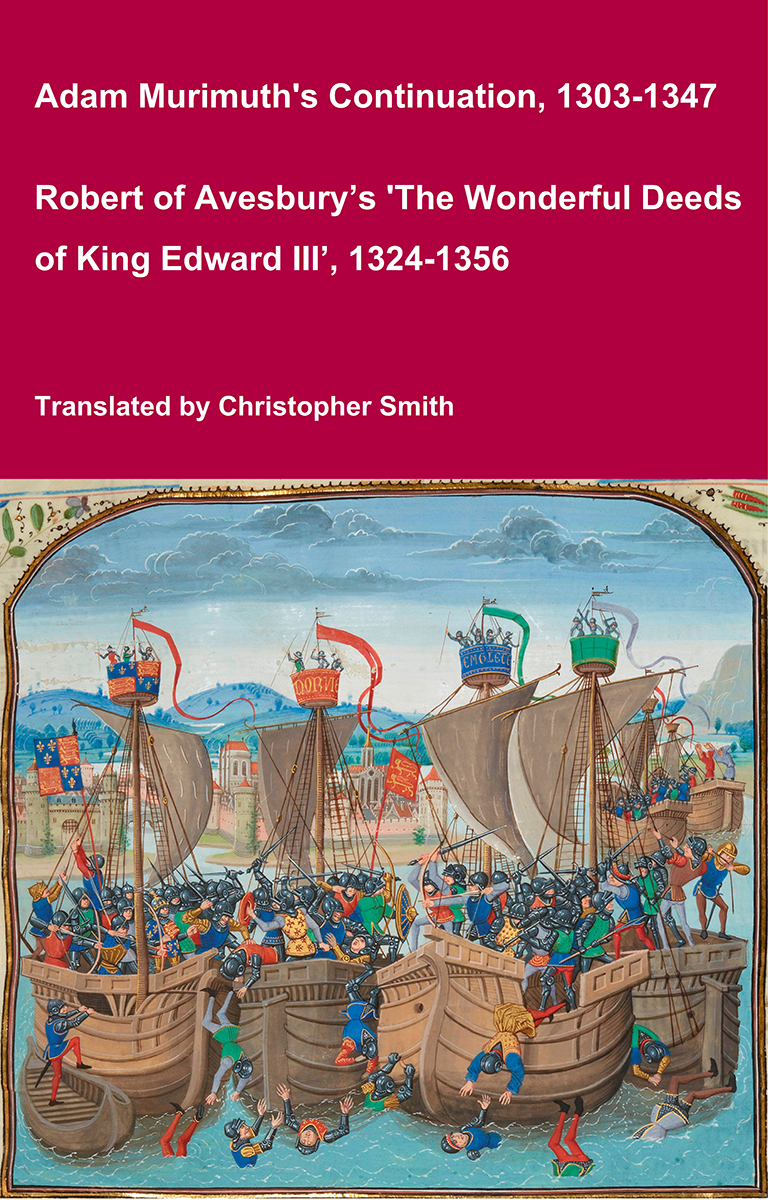
Adam Murimuth's Continuation and Robert of Avesbury’s 'The Wonderful Deeds of King Edward III'
This volume brings together two of the most important contemporary chronicles for the reign of Edward III and the opening phases of the Hundred Years’ War. Written in Latin by English clerical observers, these texts provide a vivid and authoritative window into the political, diplomatic, and military history of fourteenth-century England and its continental ambitions. Adam Murimuth Continuatio's Chronicarum continues an earlier chronicle into the mid-fourteenth century, offering concise but valuable notices on royal policy, foreign relations, and ecclesiastical affairs. Its annalistic structure makes it especially useful for establishing chronology and tracing the development of events year by year. Complementing it, Robert of Avesbury’s De gestis mirabilibus regis Edwardi tertii is a rich documentary chronicle preserving letters, treaties, and official records alongside narrative passages. It is an indispensable source for understanding Edward III’s claim to the French crown, the conduct of war, and the mechanisms of medieval diplomacy. Together, these works offer scholars, students, and enthusiasts a reliable and unembellished account of a transformative period in English and European history. Essential for anyone interested in medieval chronicles, the Hundred Years’ War, or the reign of Edward III.
Available at Amazon in eBook and Paperback format.
Collared Urn is in Prehistoric Artefacts.
Wiltshire Archaeological Magazine 1907 V35 Pages 1-20. No. 17. Nine feet almost due south of the skeleton and 1ft. 2in. below the present surface, a vessel of the cinerary urn type was disclosed. It had been crushed into several pieces by the weight of the earth above, and was also slightly damaged by the workman's pick; it has, however, been repaired and is now complete. It stood in an upright position, but with no signs of ashes or of burnt material of any sort inside it, nor was there any sign of an interment, burnt or unburnt, near it1. Immediately beneath it the earth was a little reddened and discoloured as if by fire, and there were a few specks of charcoal; but the traces of fire were slight, and quite local. The vessel might be chosen as typical of a cinerary urn from its general shape and heavy overhanging rim, which latter feature Canon Greenwell (age 86) says may be regarded as the principal characteristic of this class of urn2. But in spite of its form, as it contained no bones or ashes, one is forced to the conclusion that it may have served the purpose of a food vessel, and that it had probably contained some form of food offering made to the dead at some time subsequent to the burial, and during or after the piling up of the barrow.
Note 1. Canon Greenwell says: "In a few instances a sepulchral vase has occurred in a barrow not in close proximity with any interment," British Barrows, p. 61.


Collared urn decorated with vertical lines around rim and 2 rows of cord impressed chevrons around collar bordered by two cord impressed lines at top and bottom, found upright in cist with no cremated remains. Collection of [Map].
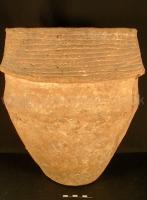
Wiltshire Museum. DZSWS:STHEAD.176. 1 Collared Urn with high shoulders and decorated with 10 cord impressed lines around overhanging collar, found with a primary cremation inside in bowl barrow Durrington G11 [Map], excavated by William Cunnington.
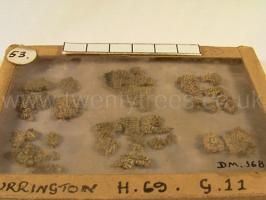
Wiltshire Museum. DZSWS:STHEAD.205. 22 fragments of a coarse linen cloth bag (or casts of cloth formed by lime carbonate) woven with double thread, found wrapping a primary cremation in an MBA collared urn in bowl barrow Durrington G11 [Map], excavated by William Cunnington.
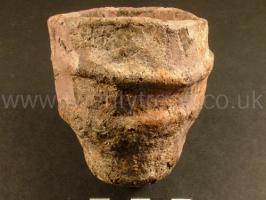
Wiltshire Museum. DZSWS:STHEAD.240. 1 miniature cup with two shoulder ridges, found with an (MBA) collared urn and secondary cremation in bowl barrow Durrington G36 [Map], excavated by William Cunnington.