Chronicle of a Bourgeois of Valenciennes
Récits d’un bourgeois de Valenciennes aka The Chronicle of a Bourgeois of Valenciennes is a vivid 14th-century vernacular chronicle written by an anonymous urban chronicler from Valenciennes in the County of Hainaut. It survives in a manuscript that describes local and regional history from about 1253 to 1366, blending chronology, narrative episodes, and eyewitness-style accounts of political, military, and social events in medieval France, Flanders, and the Low Countries. The work begins with a chronological framework of events affecting Valenciennes and its region under rulers such as King Philip VI of France and the shifting allegiances of local nobility. It includes accounts of conflicts, sieges, diplomatic manoeuvres, and the impact of broader struggles like the Hundred Years’ War on urban life in Hainaut. Written from the perspective of a burgher (bourgeois) rather than a monastery or royal court, the chronicle offers a rare lay viewpoint on high politics and warfare, reflecting how merchants, townspeople, and civic institutions experienced the turbulence of the 13th and 14th centuries. Its narrative style combines straightforward reporting of events with moral and civic observations, making it a valuable source for readers interested in medieval urban society, regional politics, and the lived experience of war and governance in pre-modern Europe.
Available at Amazon in eBook and Paperback format.
Cushion Stones is in Tools.
Cushion Stones are belived to have acted as a portable anvil for copper working.
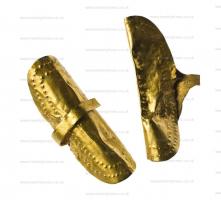
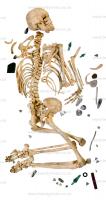
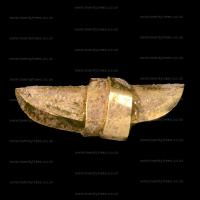
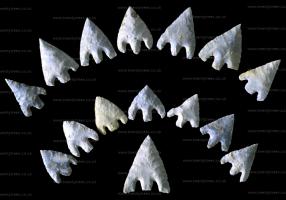
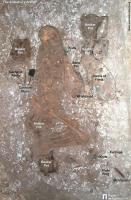
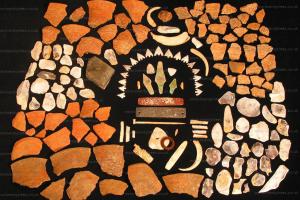
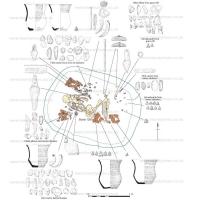
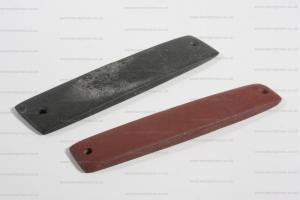
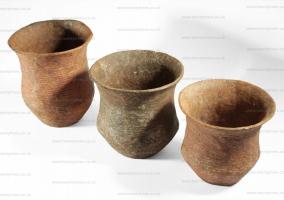
The Amesbury Archer [Map] is the remains of a man aged around forty at the time of his death from the Alps who was buried in Amesbury around 2300BC and discovered in May 2002 during the development of new housing. He is named 'The Archer' as a consequence of the large number of arrowheads found with him. His grave contained the largest number of artefacts of any grave of a similar period including the earliest known gold objects in England, five beaker funerary pots, three tiny copper knives, sixteen barbed flint arrowheads, a kit of flint-knapping, metalworking tools including cushion stones and some boar tusks. On his forearm was a black stone wrist guard. A similar red wrist guard was by his knees with a shale belt ring and a pair of earrings, the oldest gold objects found in England. An eroded hole in his jaw showed that he had suffered from an abscess, and his missing left kneecap suggests that he had an injury that left him with a painful lingering bone infection. His remains are on display in the Salisbury and South Wiltshire Museum [Map].
The Amesbury Archer's Companion is the remains of a man raised locally aged between twenty-five and thirty at the time of his death buried around 2300BC near to the Amesbury Archer. He appears to be related to the Amesbury Archer as they shared a rare hereditary anomaly, calcaneonavicular coalition, fusing of the calcaneus and of the navicular tarsal (foot bones). Inside his jaw were found a pair of gold earrings or hair ornaments in the same style as the Amesbury Archer's.
Photos sourced from Salisbury and South Wiltshire Museum [Map] and Wessex Archaeology.