The Deeds of the Dukes of Normandy
The Gesta Normannorum Ducum [The Deeds of the Dukes of Normandy] is a landmark medieval chronicle tracing the rise and fall of the Norman dynasty from its early roots through the pivotal events surrounding the Norman Conquest of England. Originally penned in Latin by the monk William of Jumièges shortly before 1060 and later expanded at the behest of William the Conqueror, the work chronicles the deeds, politics, battles, and leadership of the Norman dukes, especially William’s own claim to the English throne. The narrative combines earlier historical sources with firsthand information and oral testimony to present an authoritative account of Normandy’s transformation from a Viking settlement into one of medieval Europe’s most powerful realms. William’s history emphasizes the legitimacy, military prowess, and governance of the Norman line, framing their expansion, including the conquest of England, as both divinely sanctioned and noble in purpose. Later chroniclers such as Orderic Vitalis and Robert of Torigni continued the history, extending the coverage into the 12th century, providing broader context on ducal rule and its impact. Today this classic work remains a foundational source for understanding Norman identity, medieval statesmanship, and the historical forces that reshaped England and Western Europe between 800AD and 1100AD.
Available at Amazon in eBook and Paperback format.
Macehead is in Prehistoric Artefacts.
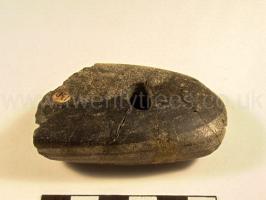
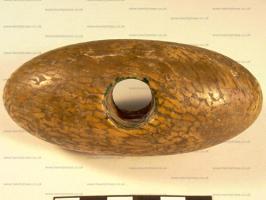
Wiltshire Museum. DZSWS:STHEAD.130. 1 polished stone macehead of greenstone, ground to an oblong oval shape and pierced by a small, almost central, hole (unfinished), from material in Bowl Barrow G13 Winterbourne Stoke [Map], excavated by William Cunnington.
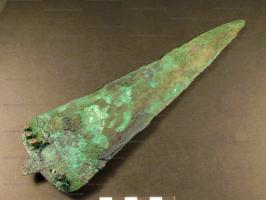
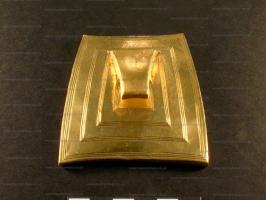
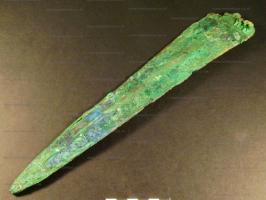
Bush Barrow aka Normanton 158 aka Wilsford G5 [Map] is a Bronze Age Round Barrow. In 1808 Bush Barrow [Map] was excavated by William Cunnington. It contained a male skeleton with a collection of funerary goods that make it one of the richest burials in Britain. The grave goods include a large 'lozenge'-shaped sheet of gold, a sheet gold belt plate, three bronze daggers, a bronze axe, a stone macehead and bronze rivets.
All the following items are in the collection of [Map] and normally on display. The photographs and information is sourced from Devizes Museum website.
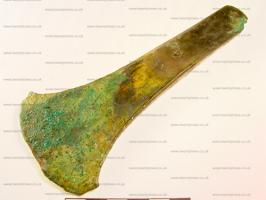
Bronze flanged axehead with traces of coarse cloth visible on the blade, found with a primary male inhumation (near the shoulders). Length 159 mm; width 67 mm; height 10 mm.
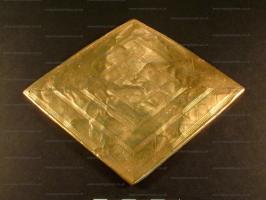
Gold lozenge-shaped breast plate made of thin gold covering a wooden plaque and decorated with four nested lozenge-shaped bands of four engraved lines each, the central one of which contains a chequered design with a zigzag design between the outer two bands, perforated at both ends, found with a primary male inhumation (over chest). Length 184 mm; width 156 mm; height 5 mm.
Polished oval macehead made from a fossil coral, perforated through the middle and containing traces of bronze. Found with a male inhumation (by right side) and possibly forming a sceptre. Length 100 mm; width 44 mm; height 40 mm.
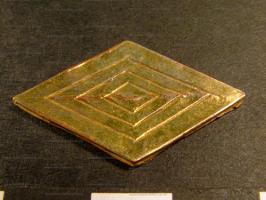
Miniature gold lozenge-shaped ornament decorated with three nested lozenge-shaped lines (engraved), found with a primary male inhumation (by right side). Length 31 mm; width 19 mm; height 2 mm.
Copper dagger (Amorico British Class 1a) with a small tang, six rivets and parts of a wooden sheath adhering to the blade (originally with a handle inset with thousands of gold pins), found with a primary male inhumation (near right arm). Length 272 mm; width 80 mm; height 21 mm.
Gold belt hook decorated with four nested rectangular bands of three engraved lines, found with a primary male inhumation (near right arm). Length 77 mm; width 71 mm; height 16 mm.
Bronze dagger (the largest found in Wiltshire) with 6 rivet holes (three remaining) and parts of a wooden sheath adhereing to the blade, decorated with a rounded ridge. Length 330 mm; width 65 mm; height 20mm.