

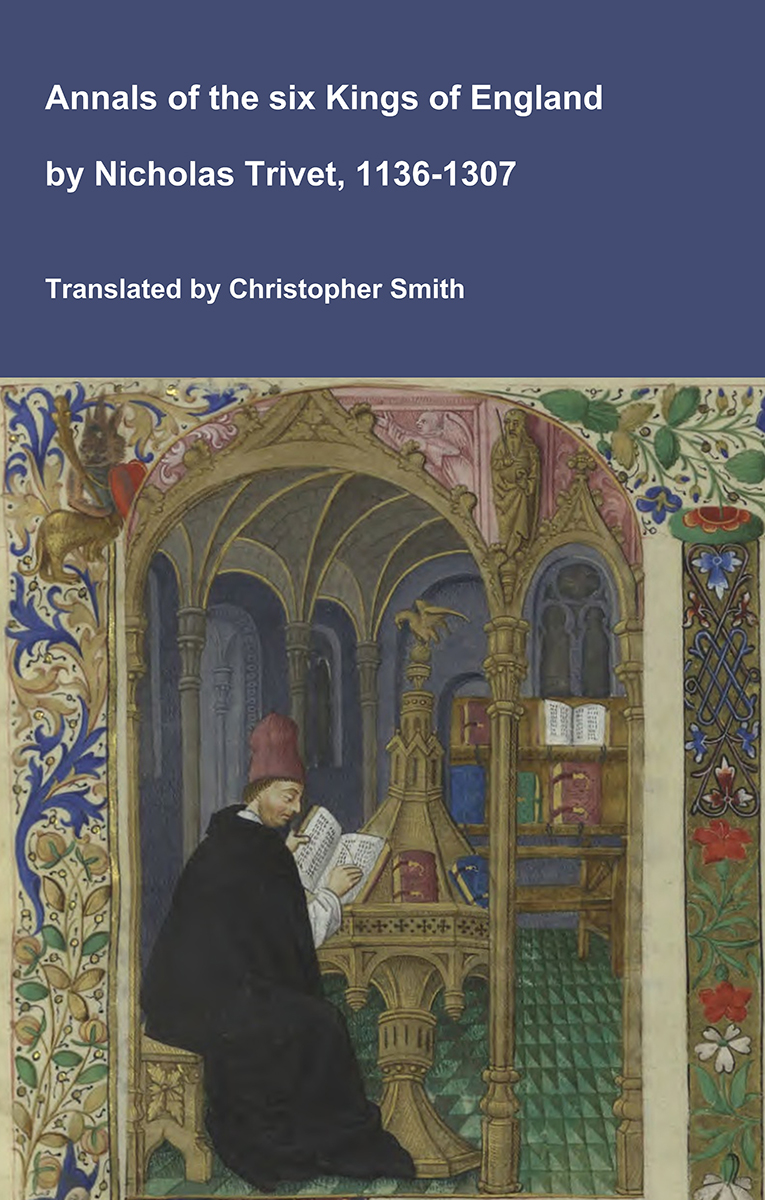
Annals of the six Kings of England by Nicholas Trivet
Translation of the Annals of the Six Kings of England by that traces the rise and rule of the Angevin aka Plantagenet dynasty from the mid-12th to early 14th century. Written by the Dominican scholar Nicholas Trivet, the work offers a vivid account of English history from the reign of King Stephen through to the death of King Edward I, blending political narrative with moral reflection. Covering the reigns of six monarchs—from Stephen to Edward I—the chronicle explores royal authority, rebellion, war, and the shifting balance between crown, church, and nobility. Trivet provides detailed insight into defining moments such as baronial conflicts, Anglo-French rivalry, and the consolidation of royal power under Edward I, whose reign he describes with particular immediacy. The Annals combines careful year-by-year reporting with thoughtful interpretation, presenting history not merely as a sequence of events but as a moral and political lesson. Ideal for readers interested in medieval history, kingship, and the origins of the English state, this chronicle remains a valuable and accessible window into the turbulent world of the Plantagenet kings.
Available at Amazon in eBook and Paperback format.
In 1593 Bishop Robert Crichton was born at Dunkeld.
Around 1639 [his son] Robert Crichton was born to Bishop Robert Crichton [aged 46].
Samuel Pepys' Diary. 3rd April 1663. Waked betimes and talked half an hour with my father, and so I rose and to my office, and about 9 o'clock by water from the Old Swan [Map] to White Hall and to chappell, which being most monstrous full, I could not go into my pew, but sat among the quire. Dr. Creeton [aged 70], the Scotchman, preached a most admirable, good, learned, honest and most severe sermon, yet comicall, upon the words of the woman concerning the Virgin, "Blessed is the womb that bare thee (meaning Christ) and the paps that gave thee suck; and he answered, Nay; rather is he blessed that heareth the word of God, and keepeth it". He railed bitterly ever and anon against John Calvin, and his brood, the Presbyterians, and against the present term, now in use, of "tender consciences". He ripped up Hugh Peters (calling him the execrable skellum1 ), his preaching and stirring up the maids of the city to bring in their bodkins and thimbles.
Note 1. A villain or scoundrel; the cant term for a thief.
Samuel Pepys' Diary. 25th March 1664. Lady-day. Up and by water to White Hall, and there to chappell; where it was most infinite full to hear Dr. Critton [aged 71]. Being not knowne, some great persons in the pew I pretended to, and went in, did question my coming in. I told them my pretence; so they turned to the orders of the chappell, which hung behind upon the wall, and read it; and were satisfied; but they did not demand whether I was in waiting or no; and so I was in some fear lest he that was in waiting might come and betray me. The Doctor preached upon the thirty-first of Jeremy, and the twenty-first and twenty-second verses, about a woman compassing a man; meaning the Virgin conceiving and bearing our Saviour. It was the worst sermon I ever heard him make, I must confess; and yet it was good, and in two places very bitter, advising the King [aged 33] to do as the Emperor Severus did, to hang up a Presbyter John (a short coat and a long gowne interchangeably) in all the Courts of England. But the story of Severus was pretty, that he hanged up forty senators before the Senate house, and then made a speech presently to the Senate in praise of his owne lenity; and then decreed that never any senator after that time should suffer in the same manner without consent of the Senate: which he compared to the proceeding of the Long Parliament against my Lord Strafford. He said the greatest part of the lay magistrates in England were Puritans, and would not do justice; and the Bishopps, their powers were so taken away and lessened, that they could not exercise the power they ought. He told the King and the ladies plainly, speaking of death and of the skulls and bones of dead men and women1, how there is no difference; that nobody could tell that of the great Marius or Alexander from a pyoneer; nor, for all the pains the ladies take with their faces, he that should look in a charnels-house could not distinguish which was Cleopatra's, or fair Rosamond's, or Jane Shoare's.
Note 1. The preacher appears to have had the grave scene in "Hamlet" in his mind, as he gives the same illustration of Alexander as Hamlet does.


On 25th May 1670 Bishop Robert Crichton [aged 77] was elected Bishop of Bath and Wells.
In 1672 Bishop Robert Crichton [aged 79] died.
John Evelyn's Diary. 14th September 1673. Dr. Creighton [aged 34], son to the late eloquent Bishop of Bath and Wells, preached to the Household on Isaiah, lvii. 8.