

Chronicle of a Bourgeois of Valenciennes
Récits d’un bourgeois de Valenciennes aka The Chronicle of a Bourgeois of Valenciennes is a vivid 14th-century vernacular chronicle written by an anonymous urban chronicler from Valenciennes in the County of Hainaut. It survives in a manuscript that describes local and regional history from about 1253 to 1366, blending chronology, narrative episodes, and eyewitness-style accounts of political, military, and social events in medieval France, Flanders, and the Low Countries. The work begins with a chronological framework of events affecting Valenciennes and its region under rulers such as King Philip VI of France and the shifting allegiances of local nobility. It includes accounts of conflicts, sieges, diplomatic manoeuvres, and the impact of broader struggles like the Hundred Years’ War on urban life in Hainaut. Written from the perspective of a burgher (bourgeois) rather than a monastery or royal court, the chronicle offers a rare lay viewpoint on high politics and warfare, reflecting how merchants, townspeople, and civic institutions experienced the turbulence of the 13th and 14th centuries. Its narrative style combines straightforward reporting of events with moral and civic observations, making it a valuable source for readers interested in medieval urban society, regional politics, and the lived experience of war and governance in pre-modern Europe.
Available at Amazon in eBook and Paperback format.
Around 1754 Grace Dalrymple was born to [her father] Hew Dalrymple [aged 27].
Diary of Caroline Girlie. Grace Dalrymple [aged 17], the youngest of three daughters of Hew Dalrymple, Esq., a branch of, and next in succession to, the noble family of Stair, was born in Scotland, about 1765. Her father, a barrister, established his reputation by gaining for the plaintiff the celebrated Douglas and Hamilton cause, which Horace Walpole notices as one of the most remarkable of that period. He was afterwards appointed Attorney-Greneral to the Grrenadas. He deserted his wife, a woman of remaa-kable beauty, a daughter of an officer in the army, who returned to her father's house, which she never afterwards quitted, and where she gave birth to this her youngest daughter, Grace Dalrymple. This child was afterwards sent for her education to a convent, in France, where she remained for some years, being withdrawn wheii she was about the age of fifteen, and brought to her father's house. At that time it was not the custom, as in these later days, for young persons to mix in evening festivities; but at one of the suppers given at her father's house, Miss Dalrymple was introduced. On this occasion, Sir [her future husband] John Elliott [aged 35] was present, a man older than her father; who was so struck with her beauty that he made her an offer of marriage, which was accepted by her with the same inconsiderate haste with which it was proffered. Such an unsuitable and ill-assorted marriage, as might naturally be supposed, was productive of nothing but unhappiness. There was such a total dissimilarity of tastes, as well as of age, that there never existed any affection between them.
On 19th April 1771 John Eliot 1st Baronet [aged 35] and Grace Dalrymple [aged 17] were married. She commenced an affair with Arthur Annesley [aged 26]. Eliot sued Annesley for criminal conversation [adultery] and received £12,000 in damages before successfully obtaining a divorce.
In 1774 [her father] Hew Dalrymple [aged 47] died.
Diary of Caroline Girlie. Grace Dalrymple [aged 21], now Mrs. Elliott, mixed much in general society; and being so exquisitely lovely, very soon found admirers amongst those more suited to her age. In an evil hour for her, she unhappily became entangled in an intrigue; and her husband, after some indecent treatment, resorted to a court of law at once to procure a divorce, and to punish the author of their mutual wrongs. The first object was easily obtained, while the second resulted in a verdict of £12,000 damages. In the mean time her brother removed her to a convent in France, assigning as a reason for the course which had been adopted, that the lady was about to contract an unsuitable marriage.

In 1776 Grace Dalrymple [aged 22] became the mistress of George Cholmondeley [aged 26] for around three years.
Diary of Caroline Girlie. Here Mrs. Elliott [aged 22] remained until she was brought over to England by Lord Cholmondeley [aged 26] . She was subsequently introduced to the Prince of Wales [aged 13], who had been struck with the exquisite beauty of her portrait, which he had accidentally seen at Houghton. So celebrated was she for her personal charms that there are several portraits of her by eminent painters still in existence, among others, one by Cosway, which embellishes this volume, another, by Gainsborough, at Lord Cholmondeley's.


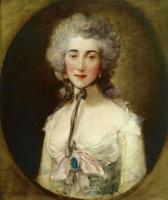
Around 1778 . Thomas Gainsborough [aged 50]. Portrait of the Grace Dalrymple [aged 24].
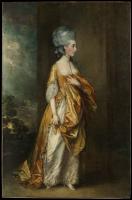
Around 1778 . Thomas Gainsborough [aged 50]. Portrait of the Grace Dalrymple [aged 24].
Chronicle of a Bourgeois of Valenciennes
Récits d’un bourgeois de Valenciennes aka The Chronicle of a Bourgeois of Valenciennes is a vivid 14th-century vernacular chronicle written by an anonymous urban chronicler from Valenciennes in the County of Hainaut. It survives in a manuscript that describes local and regional history from about 1253 to 1366, blending chronology, narrative episodes, and eyewitness-style accounts of political, military, and social events in medieval France, Flanders, and the Low Countries. The work begins with a chronological framework of events affecting Valenciennes and its region under rulers such as King Philip VI of France and the shifting allegiances of local nobility. It includes accounts of conflicts, sieges, diplomatic manoeuvres, and the impact of broader struggles like the Hundred Years’ War on urban life in Hainaut. Written from the perspective of a burgher (bourgeois) rather than a monastery or royal court, the chronicle offers a rare lay viewpoint on high politics and warfare, reflecting how merchants, townspeople, and civic institutions experienced the turbulence of the 13th and 14th centuries. Its narrative style combines straightforward reporting of events with moral and civic observations, making it a valuable source for readers interested in medieval urban society, regional politics, and the lived experience of war and governance in pre-modern Europe.
Available at Amazon in eBook and Paperback format.
In 1782 Grace Dalrymple [aged 28] began a short affair with the Prince of Wales [aged 19]. She had a daughter, Georgiana Augusta Frederica Seymour, which she claimed was fathered by the Prince of Wales although he did not recognise the child.
Around 1786 Grace Dalrymple [aged 32] became one of the mistresses of Louis Philippe II Duke of Orléans [aged 38]. The Duke granted her a home on the Rue Miromesnil and a property in Meudon, to the south of Paris. During this period Elliott also pursued liaisons with the Duke de Fitz-James and the Prince of Conde.
On 8th November 1787 [her husband] John Eliot 1st Baronet [aged 51] died at Brocket Hall, Hertfordshire [Map], the seat of his friend Penistone Lamb 1st Viscount Melbourne [aged 42]. He was buried at St Etheldreda's Church, Hatfield [Map]. Baronet Eliot of Pebbles extinct.

On 16th May 1823 Grace Dalrymple [aged 69] died.
Diary of Caroline Girlie. 1859. The following narrative of the Life of Mrs. Dalrymple Elliott, during some of the most eventful scenes of the great French Revolution, was composed at the express desire of his Majesty King Greorge the Third. Mr. (afterwards Sir David) Dundas, physician to the king, was also Mrs. Ellott's medical attendant; and was in the hahit of relating, during his visits to the Eoyal Family, some of the incidents and anecdotes which that lady had communicated to him at various times, in the course of conversation. The King became so much interested that he desired Mr. Dundas to request Mrs. Elliott to commit to paper the story of her Life in Paris, and to send it to him. "With this intimation she readily complied, and accordingly the narrative was conveyed by Mr. Dundas to Windsor, sheet by sheet as it was written by her during her residence at Twickenham, after her return from France, at the Peace of Amiens, in 1801.