

William of Worcester's Chronicle of England
William of Worcester, born around 1415, and died around 1482 was secretary to John Fastolf, the renowned soldier of the Hundred Years War, during which time he collected documents, letters, and wrote a record of events. Following their return to England in 1440 William was witness to major events. Twice in his chronicle he uses the first person: 1. when writing about the murder of Thomas, 7th Baron Scales, in 1460, he writes '… and I saw him lying naked in the cemetery near the porch of the church of St. Mary Overie in Southwark …' and 2. describing King Edward IV's entry into London in 1461 he writes '… proclaimed that all the people themselves were to recognize and acknowledge Edward as king. I was present and heard this, and immediately went down with them into the city'. William’s Chronicle is rich in detail. It is the source of much information about the Wars of the Roses, including the term 'Diabolical Marriage' to describe the marriage of Queen Elizabeth Woodville’s brother John’s marriage to Katherine, Dowager Duchess of Norfolk, he aged twenty, she sixty-five or more, and the story about a paper crown being placed in mockery on the severed head of Richard, 3rd Duke of York.
Available at Amazon in eBook and Paperback format.
In 1736 John Eliot 1st Baronet was born in Edinburgh.
On 6th November 1759 John Eliot 1st Baronet [aged 23] graduated with an M.D. from the University of St Andrews.
On 30th September 1762 John Eliot 1st Baronet [aged 26] was admitted as a licentiate of the College of Physicians of London.
Diary of Caroline Girlie. Grace Dalrymple [aged 17], the youngest of three daughters of Hew Dalrymple, Esq., a branch of, and next in succession to, the noble family of Stair, was born in Scotland, about 1765. Her father, a barrister, established his reputation by gaining for the plaintiff the celebrated Douglas and Hamilton cause, which Horace Walpole notices as one of the most remarkable of that period. He was afterwards appointed Attorney-Greneral to the Grrenadas. He deserted his wife, a woman of remaa-kable beauty, a daughter of an officer in the army, who returned to her father's house, which she never afterwards quitted, and where she gave birth to this her youngest daughter, Grace Dalrymple. This child was afterwards sent for her education to a convent, in France, where she remained for some years, being withdrawn wheii she was about the age of fifteen, and brought to her father's house. At that time it was not the custom, as in these later days, for young persons to mix in evening festivities; but at one of the suppers given at her father's house, Miss Dalrymple was introduced. On this occasion, Sir John Elliott [aged 35] was present, a man older than her father; who was so struck with her beauty that he made her an offer of marriage, which was accepted by her with the same inconsiderate haste with which it was proffered. Such an unsuitable and ill-assorted marriage, as might naturally be supposed, was productive of nothing but unhappiness. There was such a total dissimilarity of tastes, as well as of age, that there never existed any affection between them.
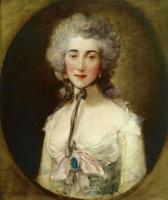
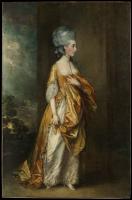
On 19th April 1771 John Eliot 1st Baronet [aged 35] and Grace Dalrymple [aged 17] were married. She commenced an affair with Arthur Annesley [aged 26]. Eliot sued Annesley for criminal conversation [adultery] and received £12,000 in damages before successfully obtaining a divorce.
On 25th July 1778 John Eliot 1st Baronet [aged 42] was created 1st Baronet Eliot of Pebbles.
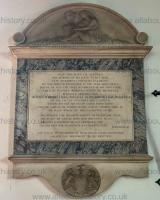
On 8th November 1787 John Eliot 1st Baronet [aged 51] died at Brocket Hall, Hertfordshire [Map], the seat of his friend Penistone Lamb 1st Viscount Melbourne [aged 42]. He was buried at St Etheldreda's Church, Hatfield [Map]. Baronet Eliot of Pebbles extinct.

On 16th May 1823 [his former wife] Grace Dalrymple [aged 69] died.