

Chronicle of Geoffrey le Baker of Swinbroke
Baker was a secular clerk from Swinbroke, now Swinbrook, an Oxfordshire village two miles east of Burford. His Chronicle describes the events of the period 1303-1356: Gaveston, Bannockburn, Boroughbridge, the murder of King Edward II, the Scottish Wars, Sluys, Crécy, the Black Death, Winchelsea and Poitiers. To quote Herbert Bruce 'it possesses a vigorous and characteristic style, and its value for particular events between 1303 and 1356 has been recognised by its editor and by subsequent writers'. The book provides remarkable detail about the events it describes. Baker's text has been augmented with hundreds of notes, including extracts from other contemporary chronicles, such as the Annales Londonienses, Annales Paulini, Murimuth, Lanercost, Avesbury, Guisborough and Froissart to enrich the reader's understanding. The translation takes as its source the 'Chronicon Galfridi le Baker de Swynebroke' published in 1889, edited by Edward Maunde Thompson.
Available at Amazon in eBook and Paperback format.
 Gilmour Place, Edinburgh
 1 South Bridge, Edinburgh
 Rome, Italy
 St Katherine's Church, Rowsley
 St Mary's Church Tickhill Doncaster
 115 Ebury Street, Chester Square
 Kensal Green Cemetery
William Calder Marshall is in Sculptors.
On 28th February 1811 [his father] William Marshall and [his mother] Annie Calder were married at St Cuthbert's Church, Edinburgh.
On 18th March 1813 William Calder Marshall was born to William Marshall and Annie Calder, probably at Gilmour Place, Edinburgh [Map]. His father was a Goldsmith who had a shop at 1 South Bridge, Edinburgh [Map]. He attended the Edinburgh Royal High School and Edinburgh University before enrolling at the Edinburgh Trustees Academy in 1830.
In 1834 William Calder Marshall [aged 20] enrolled in the Royal Academy where he studied under Francis Leggatt Chantrey [aged 52] and Edward Hodges Baily [aged 45]. In 1835 he was awarded a Silver Medal by the Royal Academy.
In 1836 William Calder Marshall [aged 22] travelled to Rome, Italy [Map] where he studied for two years.
On 14th February 1842 William Calder Marshall [aged 28] and Marianne Lawrie were married at St Cuthbert's Church, Edinburgh. She died a month later.
In March 1842 [his wife] Marianne Lawrie died.
In 1844 William Calder Marshall [aged 30] was appointed Associate of the Royal Academy. He participated in an exhibition held at Westminster Hall to select artists to decorate the rebuilt Palace of Westminster. It proved to be the turning point of his career, leading to many commissions for public monuments not only for the new Houses of Parliament - for which he made statues of the Lord Chancellors Clarendon and Somers, and of Chaucer.
On 10th June 1845 William Calder Marshall [aged 32] and Margaret Calder [aged 28] were married at St Cuthbert's Church, Edinburgh. The same church in which he had married his first wife three years previously.
In 1848 William Calder Marshall [aged 34] sculpted a statue of the poet Thomas Campbell for Westminster Abbey, 1862, the inventor Samuel Crompton for Bolton, Lancashire and, in 1856, the philanthropist Thomas Coram, who created the London Foundling Hospital, for the central pier of the hospital's gateway at Coram Fields.
In 1852 William Calder Marshall [aged 38] was appointed Academician of the Royal Academy.
On or before 22nd December 1852 [his daughter] Elizabeth Calder Marshall was born to William Calder Marshall [aged 39] and [his wife] Margaret Calder [aged 36]. She was baptised on 22nd December 1852 at St Michael's Church Pimlico who were described as living at 47 Ebury Street, Chester Square.
Abbot John Whethamstede’s Chronicle of the Abbey of St Albans
Abbot John Whethamstede's Register aka Chronicle of his second term at the Abbey of St Albans, 1451-1461, is a remarkable text that describes his first-hand experience of the beginning of the Wars of the Roses including the First and Second Battles of St Albans, 1455 and 1461, respectively, their cause, and their consequences, not least on the Abbey itself. His text also includes Loveday, Blore Heath, Northampton, the Act of Accord, Wakefield, and Towton, and ends with the Coronation of King Edward IV. In addition to the events of the Wars of the Roses, Abbot John, or his scribes who wrote the Chronicle, include details in the life of the Abbey such as charters, letters, land exchanges, visits by legates, and disputes, which provide a rich insight into the day-to-day life of the Abbey, and the challenges faced by its Abbot.
Available at Amazon in eBook and Paperback format.
On 7th April 1854 Catherine Louise Georgina Marlay [aged 23] died from childbirth three weeks after giving birth to her daughter Edith Katherine Manners [deceased] who had died at twelve days old. She was buried at Highgate Cemetery on 15th April 1854. Monument by William Calder Marshall [aged 41] erected in 1862 in a chapel at St Katherine's Church, Rowsley [Map] built for the purpose commissioned by her husband John Manners [aged 35], the future 7th Duke of Rutland.


In 1863 William Calder Marshall [aged 49] produced three biblical reliefs for St. Paul's Cathedral: Unto me Men Gave Ear and Waited, and Kept Silence at my Counsel; For I am a Man under Authority, Having Soldiers under Me; and the Memorial for Captain Edward Mowbray Lyons of the Royal Navy.
On 7th October 1871 Louise Blanche Howard [aged 29] died from childbirth six weeks after the birth of a child who had died the same or next day after birth. The Foljambe Tomb. Monument in St Mary's Church Tickhill Doncaster [Map] commissioned by her husband Cecil George Savile Foljambe 1st Earl Liverpool [aged 24] who had numerous monuments erected in her memory in places associated with her. Sculpted by William Calder Marshall [aged 58].
Louise Blanche Howard: On 22nd February 1842 she was born to Frederick Howard and Fanny Cavendish. On 22nd July 1869 Cecil George Savile Foljambe 1st Earl Liverpool and she were married. On 21st February 1877 Cecil George Savile Foljambe 1st Earl Liverpool and Susan Louisa Cavendish Countess Liverpool were married. She was a first cousin of his first wife Louise Blanche Howard.


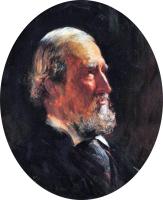
1883. John Pettie [aged 43]. Portrait of William Calder Marshall [aged 69].
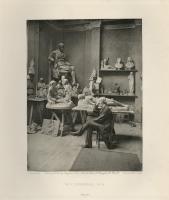
1884. William Calder Marshall [aged 70] by J. P. Mayall from "Artists at Home".
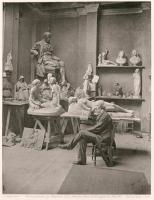
Around 1884. Joseph Parkin Mayall [aged 45]. Portrait of William Calder Marshall [aged 70].

1885. Photograph of William Calder Marshall [aged 71].
On 19th May 1887 [his wife] Margaret Calder [aged 70] died. She was buried at Kensal Green Cemetery [Map].
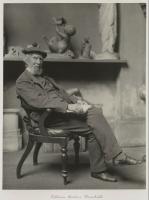
1889. Photograph of William Calder Marshall [aged 75] by Ralph Winwood Robinson, published by C. Whittingham & Co.
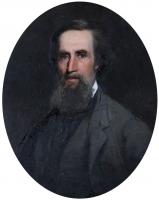
Before 1890 Patrick Allan aka Fraser [aged 76]. Portrait of William Calder Marshall [aged 76].
In 1890 William Calder Marshall [aged 76] retired from the Royal Academy and exhibited there for the last time the following year. In his lifetime, he had exhibited some 120 works at the Academy, the largest contribution of any Victorian sculptor
The History of William Marshal was commissioned by his son shortly after William’s death in 1219 to celebrate the Marshal’s remarkable life; it is an authentic, contemporary voice. The manuscript was discovered in 1861 by French historian Paul Meyer. Meyer published the manuscript in its original Anglo-French in 1891 in two books. This book is a line by line translation of the first of Meyer’s books; lines 1-10152. Book 1 of the History begins in 1139 and ends in 1194. It describes the events of the Anarchy, the role of William’s father John, John’s marriages, William’s childhood, his role as a hostage at the siege of Newbury, his injury and imprisonment in Poitou where he met Eleanor of Aquitaine and his life as a knight errant. It continues with the accusation against him of an improper relationship with Margaret, wife of Henry the Young King, his exile, and return, the death of Henry the Young King, the rebellion of Richard, the future King Richard I, war with France, the death of King Henry II, and the capture of King Richard, and the rebellion of John, the future King John. It ends with the release of King Richard and the death of John Marshal.
Available at Amazon in eBook and Paperback format.
On 16th June 1894 William Calder Marshall [aged 81] died at his home 115 Ebury Street, Chester Square [Map]. He was buried at Kensal Green Cemetery [Map] in the same grave as his [his former wife] wife who had died seven years before.