

Chronicle of Walter of Guisborough
A canon regular of the Augustinian Guisborough Priory, Yorkshire, formerly known as The Chronicle of Walter of Hemingburgh, describes the period from 1066 to 1346. Before 1274 the Chronicle is based on other works. Thereafter, the Chronicle is original, and a remarkable source for the events of the time. This book provides a translation of the Chronicle from that date. The Latin source for our translation is the 1849 work edited by Hans Claude Hamilton. Hamilton, in his preface, says: 'In the present work we behold perhaps one of the finest samples of our early chronicles, both as regards the value of the events recorded, and the correctness with which they are detailed; Nor will the pleasing style of composition be lightly passed over by those capable of seeing reflected from it the tokens of a vigorous and cultivated mind, and a favourable specimen of the learning and taste of the age in which it was framed.'
Available at Amazon in eBook and Paperback format.
Ayrshire is in Scotland.
Around 1836 James Currie was born in Ayr.
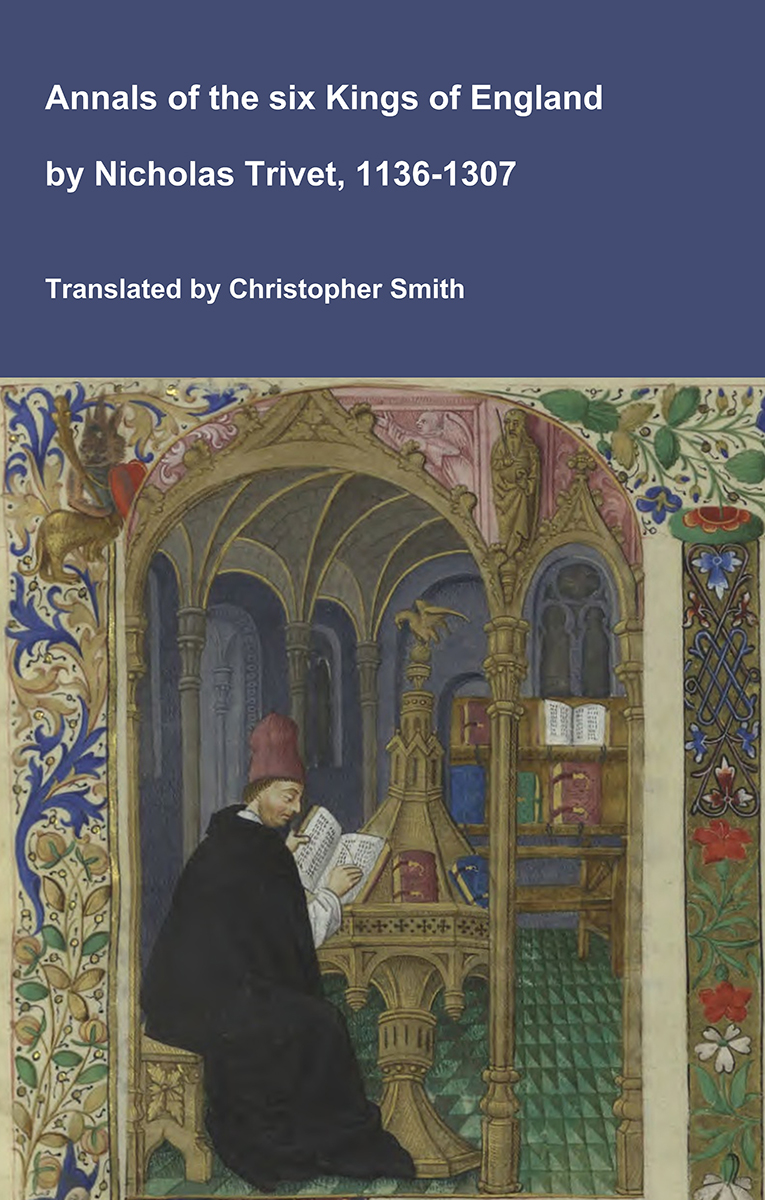 Annals of Six Kings of England by Nicholas Trivet [1258-1328]. After this the town of St Andrews was laid waste, none offering resistance. Thence the English, passing through the forest of Selkirk, came to the castle of Ayr, which Robert de Brus, fleeing, burned and left empty, and, passing through the valley of Annandale, they took the castle of Lochmaben. When the king had come to Carlisle, the Earls of Hereford and Norfolk, having obtained leave, returned to their own lands. The king, however, proceeding first to Durham, then as far as Tynemouth, and thence to Geddington near Beverley, there kept the feast of the Nativity of the Lord, after which he directed his journey towards the southern parts of the kingdom.
Post hæc vastata est villa S. Andreæ, nemine resistente. Exinde per forestam de Selkirke venerunt Anglici ad castrum de Are, quod Robertus de Brus fugiens incendit, vacuumque reliquit; transeuntesque per vallem Anandiæ ceperunt castrum de'Loumaban. Cum autem venisset rex Carleolum, comites Herfordiæ et Marescalli licentia accepta ad propria redierunt. Rex vero primo Dunelmiam, deinde usque Tinemue, et inde usque Godhingam juxta Beverlacum progressus, ibidem Natalis Domini festum peregit. Post quod versus partes regni australes iter suum direxit.
In 1315 Alexander Stewart was born to Alan Stewart [aged 43] at Dreghorn. He married before 26th August 1374 Joanna Baird of Galston and had issue.
In 1362 Elizabeth Stewart Countess Crawford was born to King Robert II of Scotland [aged 45] and Euphemia Ross Queen Consort Scotland at Dundonald Castle. She a great x 4 granddaughter of King John of England. She married before 1387 her half first cousin once removed David Lindsay 1st Earl Crawford and had issue.
In 1611 Thomas Hamilton of Priestfield [aged 76] died at Dunlop.
On 24th October 1769 Alexander Montgomerie 10th Earl Eglinton [aged 46] was shot and killed by an excise officer or Gaudger (Scots) named Mungo Campbell following a dispute about the latter's right to bear arms on the Earl's grounds. The Earl died from his abdominal wounds late that evening at one o'clock on the morning of the 25th October 1769 at Eglinton Castle. His brother Archibald [aged 43] succeeded 11th Earl Eglinton.
John Brown, tide-officer or tide-waiter (a customs officer who boarded and inspected incoming ships) at Saltcoats, gave evidence that on the day of the earl's death, Tuesday 24 October 1769, he was on duty and walking with Mungo Campbell "They passed through the grounds of Montfodd, and thereafter crossed a burn, which is the march between Montfodd and the earl of Eglintoun's property, and went through lord Eglintoun's ground towards the sea."
The trial of Mungo Campbell, before the High Court of Justiciary in Scotland, for the murder of Alexander Earl of Eglintoun. Extracted from the records of the court:
That the earl faid to him, That he might have a right to carry a gun, but not upon his lands, without his liberty. That the pannel upon this faid to the earl, I beg your lordfhip's pardon: or, I beg your pardon. That at this time lord Eglintoun was difmounted from his horfe, and advancing nearer the pannel, who again was retiring fometimes backwards, at other times tideways, having his mufket dill pointed at the earl. But the deponent did not obferve whether he had his hand upon the cock or not; neither drd the deponent hear any threatnings uled by the pannel againft the earl. Depones, whein the pannel was retreating, he fell clofe by where the deponent was fitting on his horfe, and by his fall frightened the deponent's horfe, fo that the horfe reeled a little; during which time the deponent did not obferve the pannel, but immediately thereafter, having got -his horfe fettled, he faw the pannel half fitting half lying, and faw him point his gun towards Lord Eglintoun, and immediately fire it. — That at this time lord Eglintoun was within two or three yards of the pannel. That upon this lord Eglintoun gave three or four loud cries, that he was gone. Depones, that the pannel fired his gun without putting it to his fhoulder, but raifed the butt above his haunch, and pointed it at the earl.
Campbell was convicted of murder but hanged himself with a silk scarf provided by his friends before the sentence could be carried out.
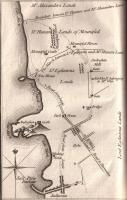
A map of the lands of Montfode and Ardrossan in 1769 showing the details of the incident.
Alexander Montgomerie 10th Earl Eglinton: On 10th February 1723 he was born to Alexander Montgomerie 9th Earl Eglinton and Susanna Kennedy Countess Winton. On 18th February 1729 Alexander Montgomerie 9th Earl Eglinton died. His son Alexander succeeded 10th Earl Eglinton.

On 16th December 1853 Theresa Howe Newcomen [aged 44] died at Eglinton Castle.
In 1340 Henry Douglas was born to John Douglas [aged 37] and Agnes Fraham at Lugton. He married Margery Stewart and had issue.
In 1470 David Kennedy 1st Earl Cassilis was born to John Kennedy 2nd Lord Kennedy [aged 15] and Elizabeth Montgomerie [aged 31] at Maybole. He married (1) before 29th September 1494 Agnes Borthwick (2) before 1509 his half second cousin Grisel aka Margaret Boyd Countess Cassilis, daughter of Thomas Boyd 1st Earl Arran and Mary Stewart Countess Arran.
Around 1470 Katherine Kennedy was born to John Kennedy 2nd Lord Kennedy [aged 15] and Elizabeth Montgomerie [aged 31] at Maybole. She married in or before 1491 her first cousin Thomas Kennedy 3rd of Bargany and had issue.
The History of William Marshal was commissioned by his son shortly after William’s death in 1219 to celebrate the Marshal’s remarkable life; it is an authentic, contemporary voice. The manuscript was discovered in 1861 by French historian Paul Meyer. Meyer published the manuscript in its original Anglo-French in 1891 in two books. This book is a line by line translation of the first of Meyer’s books; lines 1-10152. Book 1 of the History begins in 1139 and ends in 1194. It describes the events of the Anarchy, the role of William’s father John, John’s marriages, William’s childhood, his role as a hostage at the siege of Newbury, his injury and imprisonment in Poitou where he met Eleanor of Aquitaine and his life as a knight errant. It continues with the accusation against him of an improper relationship with Margaret, wife of Henry the Young King, his exile, and return, the death of Henry the Young King, the rebellion of Richard, the future King Richard I, war with France, the death of King Henry II, and the capture of King Richard, and the rebellion of John, the future King John. It ends with the release of King Richard and the death of John Marshal.
Available at Amazon in eBook and Paperback format.
In 1271 Robert Bruce Earl Carrick [aged 27] and Marjorie Carrick 3rd Countess Carrick [aged 18] were married at Turnberry Castle. He by marriage Earl Carrick. She the daughter of Niall Carrick 2nd Earl Carrick and Margaret Stewart Countess Carrick. They were third cousins. He a great x 4 grandson of King Henry I "Beauclerc" England.
On 11th July 1274 King Robert the Bruce I of Scotland was born to Robert Bruce Earl Carrick [aged 31] and Marjorie Carrick 3rd Countess Carrick [aged 21] at Turnberry Castle. He married (1) 1296 his fifth cousin Isabella Mar, daughter of Donald Mar 7th Earl of Mar and Elen ferch Llewellyn Aberffraw Countess Huntingdon and Mar, and had issue (2) 1302 his fifth cousin once removed Elizabeth Burgh Queen Consort Scotland, daughter of Richard "Red Earl" Burgh 2nd Earl of Ulster and Margaret Burgh Countess Ulster, and had issue.