

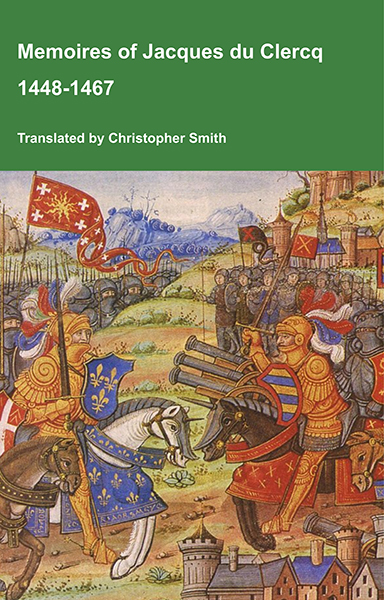
This is a translation of the 'Memoires of Jacques du Clercq', published in 1823 in two volumes, edited by Frederic, Baron de Reissenberg. In his introduction Reissenberg writes: 'Jacques du Clercq tells us that he was born in 1424, and that he was a licentiate in law and a counsellor to Philip the Good, Duke of Burgundy, in the castellany of Douai, Lille, and Orchies. It appears that he established his residence at Arras. In 1446, he married the daughter of Baldwin de la Lacherie, a gentleman who lived in Lille. We read in the fifth book of his Memoirs that his father, also named Jacques du Clercq, had married a lady of the Le Camelin family, from Compiègne. His ancestors, always attached to the counts of Flanders, had constantly served them, whether in their councils or in their armies.' The Memoires cover a period of nineteen years beginning in in 1448, ending in in 1467. It appears that the author had intended to extend the Memoirs beyond that date; no doubt illness or death prevented him from carrying out this plan. As Reissenberg writes the 'merit of this work lies in the simplicity of its narrative, in its tone of good faith, and in a certain air of frankness which naturally wins the reader’s confidence.' Du Clercq ranges from events of national and international importance, including events of the Wars of the Roses in England, to simple, everyday local events such as marriages, robberies, murders, trials and deaths, including that of his own father in Book 5; one of his last entries.
Available at Amazon in eBook and Paperback format.
St Andrew's Cathedral Priory is in St Andrew's [Map].
On 4th August 1279 Bishop William Fraser was elected Bishop of St Andrews.
In 1297 Bishop William de Lamberton was consecrated Bishop of St Andrews.
John of Fordun's Chronicle. 111. Stirling Castle [Map] besieged by the King of England
Just after Easter, in the year 1304, that same king besieged Strivelyn [Map] Castle for three months without a break. For this siege, he commanded all the lead of the refectory of Saint Andrews [Map] to be pulled down, and had it taken away for the use of his engines. At last, the aforesaid castle was surrendered [20th July 1304] and delivered unto him on certain conditions, drawn up in writing, and sealed with his seal. But when he had got the castle, the king [aged 64] belied his troth, and broke through the conditions: for William Oliphant, the warden thereof, he threw bound into prison in London, and kept him a long time in thrall. The same year, when both great and small in the kingdom of Scotland (except William Wallace alone) had made their submission unto him; when the surrendered castles and fortified towns, which had formerly been broken down and knocked to pieces, had been all rebuilt, and he had appointed wardens of his own therein; and after all and sundry of Scottish birth had tendered him homage, the king, with the Prince of Wales [aged 19], and his whole army, returned to England. He left, however, the chief warden as his lieutenant, to amend and control the lawlessness of all the rest, both Scots and English. He did not show his face in Scotland after this.
On 25th March 1306, King Robert the Bruce I of Scotland [aged 31] was crowned King Scotland at Scone Abbey [Map] by Bishop of St Andrews and Bishop Robert Wishart. Elizabeth Burgh Queen Consort Scotland [aged 22] was crowned Queen Consort Scotland. Christopher Seton [aged 28] and Bishop David de Moravia were present. He was wearing royal robes and vestments previously hidden from the English by Bishop Robert Wishart.
The following day, 26th March 1306, King Robert the Bruce I of Scotland was crowned by Isabella Countess Buchan whose family held the hereditary right to place the crown on the King's head; she had arrived too late for the coronation the day before. The right was held by her brother Duncan Fife 4th Earl Fife [aged 18] who was under-age and held by the English so she assumed the right in his place.
On 30th April 1388 Archbishop Alexander Neville [aged 47] was translated to Bishop of St Andrews. He never took possession of the see because the Scots acknowledged the Avignon papacy with their own candidate, Bishop Walter Trail.
Around May 1497 King James IV of Scotland [aged 24] nominated his brother James of Ross [aged 21] to be Archbishop of St Andrews. James of Ross was a minor, and so the revenues of the archbishopric would be controlled by King James.
In 1538 James Stewart 1st Earl of Moray Regent [aged 7] was appointed Prior of St Andrew's securing his income.


On 28th November 1547 Archbishop John Hamilton [aged 35] was appointed ArchBishop of St Andrews.
Around August 1548 Cardinal David Beaton was consecrated as ArchBishop of St Andrews.
Bishop Roger Beaumont was appointed Bishop of St Andrews.
Bishop Walter Trail was appointed Bishop of St Andrews.
William of Worcester's Chronicle of England
William of Worcester, born around 1415, and died around 1482 was secretary to John Fastolf, the renowned soldier of the Hundred Years War, during which time he collected documents, letters, and wrote a record of events. Following their return to England in 1440 William was witness to major events. Twice in his chronicle he uses the first person: 1. when writing about the murder of Thomas, 7th Baron Scales, in 1460, he writes '… and I saw him lying naked in the cemetery near the porch of the church of St. Mary Overie in Southwark …' and 2. describing King Edward IV's entry into London in 1461 he writes '… proclaimed that all the people themselves were to recognize and acknowledge Edward as king. I was present and heard this, and immediately went down with them into the city'. William’s Chronicle is rich in detail. It is the source of much information about the Wars of the Roses, including the term 'Diabolical Marriage' to describe the marriage of Queen Elizabeth Woodville’s brother John’s marriage to Katherine, Dowager Duchess of Norfolk, he aged twenty, she sixty-five or more, and the story about a paper crown being placed in mockery on the severed head of Richard, 3rd Duke of York.
Available at Amazon in eBook and Paperback format.
Archbishop Alexander Stewart was appointed ArchBishop of St Andrews.