

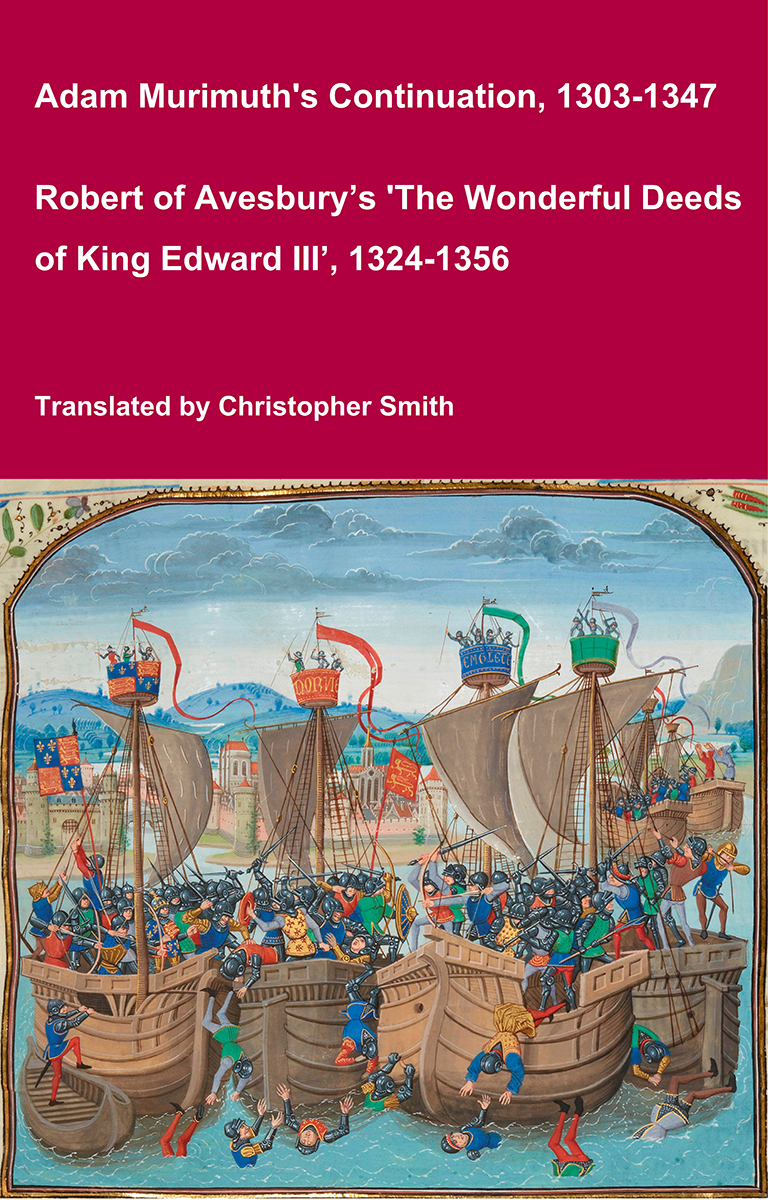
Adam Murimuth's Continuation and Robert of Avesbury’s 'The Wonderful Deeds of King Edward III'
This volume brings together two of the most important contemporary chronicles for the reign of Edward III and the opening phases of the Hundred Years’ War. Written in Latin by English clerical observers, these texts provide a vivid and authoritative window into the political, diplomatic, and military history of fourteenth-century England and its continental ambitions. Adam Murimuth Continuatio's Chronicarum continues an earlier chronicle into the mid-fourteenth century, offering concise but valuable notices on royal policy, foreign relations, and ecclesiastical affairs. Its annalistic structure makes it especially useful for establishing chronology and tracing the development of events year by year. Complementing it, Robert of Avesbury’s De gestis mirabilibus regis Edwardi tertii is a rich documentary chronicle preserving letters, treaties, and official records alongside narrative passages. It is an indispensable source for understanding Edward III’s claim to the French crown, the conduct of war, and the mechanisms of medieval diplomacy. Together, these works offer scholars, students, and enthusiasts a reliable and unembellished account of a transformative period in English and European history. Essential for anyone interested in medieval chronicles, the Hundred Years’ War, or the reign of Edward III.
Available at Amazon in eBook and Paperback format.
Viscount Falkland is in Viscount.
In 1620 Henry Carey 1st Viscount Falkland [aged 45] was created 1st Viscount Falkland. Elizabeth Tanfield Duchess Bridgewater [aged 35] by marriage Viscountess Falkland.


In or before 1632 Lucius Carey 2nd Viscount Falkland [aged 21] and Lettice Moryson Viscountess Falkland were married. She by marriage Viscountess Falkland.


Before September 1633 Henry Carey 1st Viscount Falkland [aged 58] broke his leg which subsequently had to be amputated; he died as a consequence. He was buried on 25th September 1633 at Aldenham, Hertfordshire. His son Lucius [aged 23] succeeded 2nd Viscount Falkland.
On 20th September 1643 the First Battle of Newbury was fought at Newbury, Berkshire [Map] with King Charles I of England, Scotland and Ireland [aged 42] commanding the Royalist army and Robert Devereux 3rd Earl Essex [aged 52] commanding the victorious Parliamentary army. For King Charles I of England, Scotland and Ireland John Byron 1st Baron Byron [aged 44] fought with distinction.
Henry Bertie was killed.
Robert Dormer 1st Earl Carnarvon [aged 33] was killed. His son Charles [aged 10] succeeded 2nd Earl Carnarvon, 3rd Baron Dormer of Wyng in Buckinghamshire, 3rd Baronet Dormer of Wyng in Buckinghamshire.
William Villiers 2nd Viscount Grandison [aged 29] was killed. His brother John succeeded 3rd Viscount Grandison.
Edward Villiers [aged 23] fought.
Lucius Carey 2nd Viscount Falkland [aged 33] was killed. His son Lucius [aged 11] succeeded 3rd Viscount Falkland.
Richard Neville [aged 28] served under the Earl Carnarvon. Carnarvon was killed and Neville took up the command as a Colonel of Horse.
Major General Charles Fleetwood [aged 25] was wounded.


In September 1649 Lucius Carey 3rd Viscount Falkland [aged 17] died. His brother Henry [aged 15] succeeded 4th Viscount Falkland.
On 14th April 1653 Henry Carey 4th Viscount Falkland [aged 19] and Rachel Hungerford Viscountess Falkland [aged 18] were married at Black Bourton, Bampton. She by marriage Viscountess Falkland.
On 2nd April 1663 Henry Carey 4th Viscount Falkland [aged 29] died. He was buried at St Michael & All Angels Church, Great Tew [Map]. His son Anthony [aged 7] succeeded 5th Viscount Falkland.
Before 24th May 1694 Anthony Carey 5th Viscount Falkland [aged 38] and Rebecca Lytton Viscountess Falkland were married. She by marriage Viscountess Falkland.
On 24th May 1694 Anthony Carey 5th Viscount Falkland [aged 38] died of smallpox. He was buried at Westminster Abbey [Map]. His second cousin Lucius [aged 6] succeeded 6th Viscount Falkland.
On 5th October 1704 Lucius Carey 6th Viscount Falkland [aged 17] and Dorothy Molyneux Viscountess Falkland were married. She by marriage Viscountess Falkland.
William of Worcester's Chronicle of England
William of Worcester, born around 1415, and died around 1482 was secretary to John Fastolf, the renowned soldier of the Hundred Years War, during which time he collected documents, letters, and wrote a record of events. Following their return to England in 1440 William was witness to major events. Twice in his chronicle he uses the first person: 1. when writing about the murder of Thomas, 7th Baron Scales, in 1460, he writes '… and I saw him lying naked in the cemetery near the porch of the church of St. Mary Overie in Southwark …' and 2. describing King Edward IV's entry into London in 1461 he writes '… proclaimed that all the people themselves were to recognize and acknowledge Edward as king. I was present and heard this, and immediately went down with them into the city'. William’s Chronicle is rich in detail. It is the source of much information about the Wars of the Roses, including the term 'Diabolical Marriage' to describe the marriage of Queen Elizabeth Woodville’s brother John’s marriage to Katherine, Dowager Duchess of Norfolk, he aged twenty, she sixty-five or more, and the story about a paper crown being placed in mockery on the severed head of Richard, 3rd Duke of York.
Available at Amazon in eBook and Paperback format.
On 31st December 1730 Lucius Carey 6th Viscount Falkland [aged 43] died. His son Lucius [aged 23] succeeded 7th Viscount Falkland.
On 27th February 1785 Lucius Charles Carey 7th Viscount Falkland [aged 78] died. His grandson Henry [aged 19] succeeded 8th Viscount Falkland.
On 28th May 1796 Henry Thomas Cary 8th Viscount Falkland [aged 30] died unmarried at the White Lion Inn. His brother Charles [aged 27] succeeded 9th Viscount Falkland.
On 25th August 1802 Charles John Cary 9th Viscount Falkland [aged 33] and Christiana Anton Viscountess Falkland were married at St Clement Danes Church, Westminster [Map]. She by marriage Viscountess Falkland.
On 28th February 1809 Charles John Cary 9th Viscount Falkland [aged 40] was shot through the groing during a duel with Arthur Annesley Roberts aka Powell. On 2nd March 1809 Charles John Cary 9th Viscount Falkland died from wounds received duelling. His son Lucius [aged 5] succeeded 10th Viscount Falkland. He was buried at the Grosvenor Chapel, Mayfair.
Saint James's Chronicle, 7 March 1809:
Various erroneous statements have appeared, respecting the unfortunate duel betwixt Lord Falkland and Mr Powell; but the following particulars we are told, may be relied on: Lord Falkland dined at Mr Powell's house with a large party on the Saturday preceding the duel. The party broke up early, and Lord F and Mr P went to the opera together, having drunk a good deal of wine.
They returned from the opera to Stephen's Hotel, Bond Street, and parted as they had met, intimate friends, but in a state of inebriety. It was after this that Lord Falkland visited the Mount coffee house. On Sunday evening, Lord F looked in at Stephens's again and espying his friend, Mr Powell, he accosted him, in words, similar to these 'What! Drunk again tonight, Pogey?' and it is understood neither was at this time perfectly sober.
Mr Powell did not relish the mode in which he had been accosted, and after a retort, Lord F snatched a cane from a gentleman's hand, and used it about his friend. The waiter and some gentlemen present, extricated Mr Powell, who retired; but the waiter met his Lordship's displeasure. On the following morning Lord Falkland went to Mr Powell's house, and apologised, by asking that gentleman's pardon, an attributing his rash conduct to inebriety. Mr Powell observed that he could not accept of his Lordship's apology, unless made at Stephen's before the persons who were present at the outrage, or to make a public one in another way.
Lord Falkland could not accede to this proposition; but in the afternoon of the same day (Monday), Captain Cotton waited on him from Mr Powell, to state that if he (Lord F) would allow Captain C to make the public apology for him at Mr Powell's house, and shortly after Mr Powell sent him challenge.
Lord F appeared much hurt after he had receive the challenge, and he did not take his wine as usual, at dinner, on Monday, on which day Mr P. and others, who dined on the Saturday at his house, were to have dined with Lord Falkland His Lordship did not go to bed on Monday night, but threw himself on his sofa, and gave strict orders to his servant to call him, to be at the Admiralty at eight o'clock in the morning.
The parties met at Golder's Green, at eleven o'clock, attended by their seconds, and two surgeons. By etiquette Mr P. fired first and inflicted the mortal wound. Lord F stood for above a minute in his position; and then threw his pistol away without discharging its contents. It is well understood that his Lordship never intended to fire at his antagonist, for he was aware he had done wrong, but he conceived his honour called him to the field, rather than make the apology required. On the arrival of his Lordship on the stones in a post chaise, he requested of Mr B. his second, to stop the chaise, as he could not bear the sensation it occasioned, but requested to be conveyed home in a hammock on the men's shoulders.
During the stoppage of the chaise, Mr Powell and Captain C, his second, overtook them, and the latter gentleman, on ascertaining the cause of the stoppage, observed, that Powell's house was near at hand, and Lord F instantly expressed a desire to go there in preference to any other house, for the world would then be convinced he owed no animosity to his antagonist.
On Mr Heaviside examining the wound, his Lordship observed that he wish to know the state of it candidly. He had seen many wounds cured on board ship, and he begged of the surgeon to treat him in the way a ship's surgeon would a wounded sailor. He vomited freely, and wished to know if there was no probability of throwing up the ball. Once Mr Heaviside having done what he could he requested as a favour, that he would go to Dorant's, and make his lady acquainted with his real state; this was done, and Lady F soon arrived at Devonshire place.
His Lordship suffered greatly the first twelve hours, but his pain was eased, and he died gradually, while his Lady, who was attentively watching him at his bedside, thought he was sleeping.
The deceased was appointed to a 74 gunship, which is to take Lord Amherst to Sicily. His Lady whom he married in the West Indies in the year 1803, was the daughter of a merchant of the first respectability. She has three sons and a daughter, the eldest boy begin only five years old, and who succeeds to the title of Lord Falkland. Mr Powell is a man of considerable fortune. He was separated from his Lady some time since, and she now lives on an annuity of £500 a year at Ramsgate.
On 12th March 1884 Lucius Cary 10th Viscount Falkland [aged 80] died. His brother Plantagenet [aged 77] succeeded 11th Viscount Falkland, 2nd Baron Hunsdon of Scutterskelfe in the County of York.
On 1st February 1886 Admiral Plantagenet Cary 11th Viscount Falkland [aged 79] died without issue. His nephew Byron [aged 40] succeeded 12th Viscount Falkland, 3rd Baron Hunsdon of Scutterskelfe in the County of York.
On 10th January 1922 Byron Cary 12th Viscount Falkland [aged 76] died. His son Lucius [aged 41] succeeded 13th Viscount Falkland, 4th Baron Hunsdon of Scutterskelfe in the County of York.
On 24th July 1961 Lucius Cary 13th Viscount Falkland [aged 80] died. His son Lucius [aged 56] succeeded 14th Viscount Falkland.
On 16th March 1984 Lucius Cary 14th Viscount Falkland [aged 79] died. His son Lucius [aged 48] succeeded 15th Viscount Falkland, 5th Baron Hunsdon of Scutterskelfe in the County of York.