

The Deeds of the Dukes of Normandy
The Gesta Normannorum Ducum [The Deeds of the Dukes of Normandy] is a landmark medieval chronicle tracing the rise and fall of the Norman dynasty from its early roots through the pivotal events surrounding the Norman Conquest of England. Originally penned in Latin by the monk William of Jumièges shortly before 1060 and later expanded at the behest of William the Conqueror, the work chronicles the deeds, politics, battles, and leadership of the Norman dukes, especially William’s own claim to the English throne. The narrative combines earlier historical sources with firsthand information and oral testimony to present an authoritative account of Normandy’s transformation from a Viking settlement into one of medieval Europe’s most powerful realms. William’s history emphasizes the legitimacy, military prowess, and governance of the Norman line, framing their expansion, including the conquest of England, as both divinely sanctioned and noble in purpose. Later chroniclers such as Orderic Vitalis and Robert of Torigni continued the history, extending the coverage into the 12th century, providing broader context on ducal rule and its impact. Today this classic work remains a foundational source for understanding Norman identity, medieval statesmanship, and the historical forces that reshaped England and Western Europe between 800AD and 1100AD.
Available at Amazon in eBook and Paperback format.
Arthur Foord Hughes is in Painters.
In October 1855 [his father] Arthur Hughes (age 23) and [his mother] Tryphena Foord (age 26) were married. His brother [his uncle] Edward Hughes (age 27) was married to her older sister [his aunt] Harriet Foord (age 29). An example of Marriage of Two Sets of Siblings. They had five children including painter Arthur Foord Hughes.

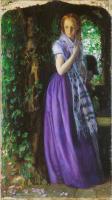
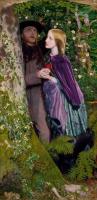
In 1856 Arthur Foord Hughes was born to [his father] Arthur Hughes (age 23) and [his mother] Tryphena Foord (age 27) in Pimlico.
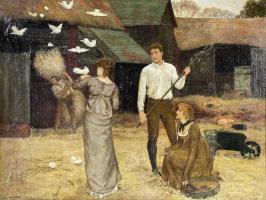
1873. Arthur Foord Hughes (age 17). "Farmyard Doves".
In 1891 Arthur Foord Hughes (age 35) and Elizabeth Jones (age 27) were married. He the son of Arthur Hughes (age 58) and Tryphena Foord (age 62).
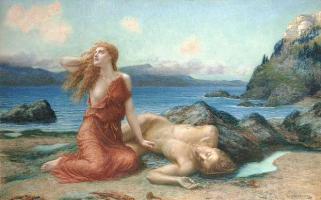
1899. Arthur Foord Hughes (age 43). "The finding of Leander".
In 1901 Arthur Foord Hughes (age 45) and [his wife] Elizabeth Jones (age 37) are living at 7 Albert Mansions, Albert Bridge Road, Battersea.
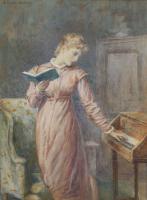
1914. Arthur Foord Hughes (age 58). "A lady reading while playing the spinet".
On 22nd December 1915 [his father] Arthur Hughes (age 83) died in Kew Green, London. He was buried in Richmond Cemetery.
In March 1921 [his mother] Tryphena Foord (age 92) died.
Jean de Waurin's Chronicle of England Volume 6 Books 3-6: The Wars of the Roses
Jean de Waurin was a French Chronicler, from the Artois region, who was born around 1400, and died around 1474. Waurin’s Chronicle of England, Volume 6, covering the period 1450 to 1471, from which we have selected and translated Chapters relating to the Wars of the Roses, provides a vivid, original, contemporary description of key events some of which he witnessed first-hand, some of which he was told by the key people involved with whom Waurin had a personal relationship.
Available at Amazon in eBook and Paperback format.

Before 1934. Arthur Foord Hughes (age 77). "A Summer's Day".
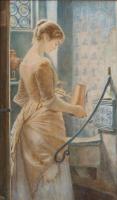
Before 1934. Arthur Foord Hughes (age 77). "Below Stairs".
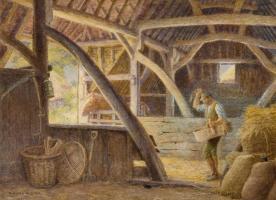
Before 1934. Arthur Foord Hughes (age 77). "A farmer in his barn".
On 20th July 1934 Arthur Foord Hughes (age 78) died.
28th July 1934. Hastings and St Leonards Observer.
Sussex Artist. Death of Mr A Foord Hughes (deceased)
STUDENT OF WINDMILLS. Sussex art circles have suffered a severe loss by the death of Mr. Arthur Foord Hughes, which occurred in a Hastings nursing home last Friday, at the age of 77. He had been in failing health for some time. Mr. Hughes's delicate watercolours were well known locally. He painted practically everv windmill in Sussex, and it was one of his sorrows that these picturesque landmarks were fast disappearing from the face of the countryside. Within few weeks of his birth in London October 9th. 1856. he sat as an unconscious model for Dante Gabriel Rossetti, though his career almost came to an untimely end soon afterwards when Ruskin prepared to seat himself on the couch where the infant lay! His father was the painter of important works to seen in the Tate Gallery and collections at Birmingham, Bournemouth and Oxford, and was also the original illustrator of "Tom Brown's School Days," for which young Hughes sat, rather reluctantly it is said, as the model of the boy hero.
ACADEMY DISTINCTION. But although he probably resented these temporary curtailments of liberty, the boy made up his mind at an early age to concentrate art as a career. After leaving King's College School, he pursued his artistic education at Heatherleys, the Slade and finally the Royal Academy, where in he gained the silver medal for the best drawing.
His love of Sussex was deeply rooted and for some years he lived in a delightful cottage at Pett, touring the whole county in search of scenes worthy of his brush. Later on he moved with his wife to home of the late Harry Furniss at High Wickham, overlooking Old Hastings. He published a book on Sussex windmills, containing a wealth of interesting information and copiously illustrated with his charming water-colours. Two of his best pictures were The Finding of Leander,' sold at the New Gallery, and "The Gleaner," hung at the Academy.
 Become a Member via our Buy Me a Coffee page to read more.
GrandFather: Edward Hughes
Father: Arthur Hughes
GrandFather: Robert Foord
Mother: Tryphena Foord