

William of Worcester's Chronicle of England
William of Worcester, born around 1415, and died around 1482 was secretary to John Fastolf, the renowned soldier of the Hundred Years War, during which time he collected documents, letters, and wrote a record of events. Following their return to England in 1440 William was witness to major events. Twice in his chronicle he uses the first person: 1. when writing about the murder of Thomas, 7th Baron Scales, in 1460, he writes '… and I saw him lying naked in the cemetery near the porch of the church of St. Mary Overie in Southwark …' and 2. describing King Edward IV's entry into London in 1461 he writes '… proclaimed that all the people themselves were to recognize and acknowledge Edward as king. I was present and heard this, and immediately went down with them into the city'. William’s Chronicle is rich in detail. It is the source of much information about the Wars of the Roses, including the term 'Diabolical Marriage' to describe the marriage of Queen Elizabeth Woodville’s brother John’s marriage to Katherine, Dowager Duchess of Norfolk, he aged twenty, she sixty-five or more, and the story about a paper crown being placed in mockery on the severed head of Richard, 3rd Duke of York.
Available at Amazon in eBook and Paperback format.
Before 14th September 1603 Edward Vaughan and Letitia Stedman of Strata Florida were married.
On the same day his son John Vaughan of Transgoed and Jane Stedman were married.
On 14th September 1603 John Vaughan of Transgoed was born to [his father] Edward Vaughan and [his mother] Letitia Stedman of Strata Florida.
Between 1613 and 1618 John Vaughan of Transgoed [aged 9] was educated at Worcester School.
Between 1618 and 1621 John Vaughan of Transgoed [aged 14] was educated at Christ Church College, Oxford University.
In 1621 John Vaughan of Transgoed [aged 17] entered the Inner Temple. He was called to the bar in 1630 and became a Bencher in 1664.
In 1628 John Vaughan of Transgoed [aged 24] was elected MP Cardigan. There is some uncertainty about his becoming an MP at this time.
In 1630 John Vaughan of Transgoed [aged 26] purchased for £4,300 eight granges of the dissolved monastery of Strata Florida from Robert Devereux 3rd Earl Essex [aged 38], who lent him £3,000 for the purpose. This substantial purchase apparently placed some strain on his finances, and resulted in litigation in Chancery. In 1631 Morgan Herbert of Cwmystwyth submitted a bill claiming that he and Vaughan's own father had agreed to lease part of the estate, only to find that it had been subsumed in the purchase. This case was settled out of court in 1632, when Herbert was granted the properties around Hafod in return for £300 and an annual rent.
In 1635 [his son] Edward Vaughan was born to John Vaughan of Transgoed [aged 31] and [his wife] Jane Stedman [aged 17]. He married before 7th December 1667 Letitia Hooker and had issue.
In 1635 [his father] Edward Vaughan died. His son John Vaughan of Transgoed [aged 31] succeeded to his estates and was charged with securing marriages for his two sisters as well as the guardianship of his nine-year-old stepbrother, Edward.
Abbot John Whethamstede’s Chronicle of the Abbey of St Albans
Abbot John Whethamstede's Register aka Chronicle of his second term at the Abbey of St Albans, 1451-1461, is a remarkable text that describes his first-hand experience of the beginning of the Wars of the Roses including the First and Second Battles of St Albans, 1455 and 1461, respectively, their cause, and their consequences, not least on the Abbey itself. His text also includes Loveday, Blore Heath, Northampton, the Act of Accord, Wakefield, and Towton, and ends with the Coronation of King Edward IV. In addition to the events of the Wars of the Roses, Abbot John, or his scribes who wrote the Chronicle, include details in the life of the Abbey such as charters, letters, land exchanges, visits by legates, and disputes, which provide a rich insight into the day-to-day life of the Abbey, and the challenges faced by its Abbot.
Available at Amazon in eBook and Paperback format.
In April 1640 John Vaughan of Transgoed [aged 36] was elected MP Cardigan.
In November 1640 John Vaughan of Transgoed [aged 37] was elected MP Cardigan.
In 1660 John Vaughan of Transgoed [aged 56] was appointed steward of Mefenydd and four other Crown lordships in Cardiganshire.
In April 1661 John Vaughan of Transgoed [aged 57] was elected MP Cardiganshire.
In 1662 John Vaughan of Transgoed [aged 58] was one of three nominated to discuss the suitability of translating the new Prayer Book into Welsh.
Samuel Pepys' Diary. 28th March 1664. At last, at past 4 o'clock I heard that the Parliament was not up yet, and so walked to Westminster Hall [Map], and there found it so, and meeting with Sir J. Minnes [aged 65], and being very hungry, went over with him to the Leg, and before we had cut a bit, the House rises, however we eat a bit and away to St. James's and there eat a second part of our dinner with Mr. Coventry [aged 36] and his brother Harry [aged 45], Sir W. Batten [aged 63] and Sir W. Pen [aged 42]. The great matter today in the House hath been, that Mr. Vaughan [aged 60], the great speaker, is this day come to towne, and hath declared himself in a speech of an houre and a half, with great reason and eloquence, against the repealing of the Bill for Triennial Parliaments; but with no successe: but the House have carried it that there shall be such Parliaments, but without any coercive power upon the King [aged 33], if he will bring this Act. But, Lord! to see how the best things are not done without some design; for I perceive all these gentlemen that I was with to-day were against it (though there was reason enough on their side); yet purely, I could perceive, because it was the King's mind to have it; and should he demand any thing else, I believe they would give it him. But this the discontented Presbyters, and the faction of the House will be highly displeased with; but it was carried clearly against them in the House. We had excellent good table-talke, some of which I have entered in my book of stories.


Samuel Pepys' Diary. 13th May 1664. In the Painted Chamber [Map] I heard a fine conference between some of the two Houses upon the Bill for Conventicles. The Lords would be freed from having their houses searched by any but the Lord Lieutenant of the County; and upon being found guilty, to be tried only by their peers; and thirdly, would have it added, that whereas the Bill says, "That that, among other things, shall be a conventicle wherein any such meeting is found doing any thing contrary to the Liturgy of the Church of England", they would have it added, "or practice". The Commons to the Lords said, that they knew not what might hereafter be found out which might be called the practice of the Church of England; for there are many things may be said to be the practice of the Church, which were never established by any law, either common, statute, or canon; as singing of psalms, binding up prayers at the end of the Bible, and praying extempore before and after sermon: and though these are things indifferent, yet things for aught they at present know may be started, which may be said to be the practice of the Church which would not be fit to allow. For the Lords' priviledges, Mr. Walter told them how tender their predecessors had been of the priviledges of the Lords; but, however, where the peace of the Kingdom stands in competition with them, they apprehend those priviledges must give place. He told them that he thought, if they should owne all to be the priviledges of the Lords which might be demanded, they should be led like the man (who granted leave to his neighbour to pull off his horse's tail, meaning that he could not do it at once) that hair by hair had his horse's tail pulled off indeed: so the Commons, by granting one thing after another, might be so served by the Lords. Mr. Vaughan [aged 60], whom I could not to my grief perfectly hear, did say, if that they should be obliged in this manner to, exempt the Lords from every thing, it would in time come to pass that whatever (be [it] never so great) should be voted by the Commons as a thing penall for a commoner, the contrary should be thought a priviledge to the Lords: that also in this business, the work of a conventicle being but the work of an hour, the cause of a search would be over before a Lord Lieutenant, who may be many miles off, can be sent for; and that all this dispute is but about £100; for it is said in the Act, that it shall be banishment or payment of £100. I thereupon heard the Duke of Lenox [aged 25] say, that there might be Lords who could not always be ready to lose £100, or some such thing: They broke up without coming to any end in it. There was also in the Commons' House a great quarrel about Mr. Prin [aged 64], and it was believed that he should have been sent to the Towre, for adding something to a Bill (after it was ordered to be engrossed) of his own head-a Bill for measures for wine and other things of that sort, and a Bill of his owne bringing in; but it appeared he could not mean any hurt in it. But, however, the King [aged 33] was fain to write in his behalf, and all was passed over.
 Become a Member via our Buy Me a Coffee page to read more.
Samuel Pepys' Diary. 25th November 1664. Thence I home, calling my wife, and at Sir W. Batten's [aged 63] hear that the House have given the King [aged 34] £2,500,000 to be paid for this warr, only for the Navy, in three years' time; which is a joyfull thing to all the King's party I see, but was much opposed by Mr. Vaughan [aged 61] and others, that it should be so much.
Samuel Pepys' Diary. 24th December 1665. Then to church, and placed myself in the Parson's pew under the pulpit, to hear Mrs. Chamberlain in the next pew sing, who is daughter to Sir James Bunch, of whom I have heard much, and indeed she sings very finely, and from church met with Sir W. Warren and he and I walked together talking about his and my businesses, getting of money as fairly as we can, and, having set him part of his way home, I walked to my Lord Bruncker [aged 45], whom I heard was at Alderman Hooker's [aged 53], hoping to see and salute Mrs. Lethulier [aged 22], whom I did see in passing, but no opportunity of beginning acquaintance, but a very noble lady she is, however the silly alderman got her. Here we sat talking a great while, Sir The. Biddulph [aged 53] and Mr. Vaughan [aged 62], a son-in-law of Alderman Hooker's. Hence with my Lord Bruncker home and sat a little with him and so home to bed.
Samuel Pepys' Diary. 13th February 1666. Up, and all the morning at the office. At noon to the 'Change [Map], and thence after business dined at the Sheriffe's [Hooker] [aged 54], being carried by Mr. Lethulier [aged 33], where to my heart's content I met with his wife [aged 23], a most beautifull fat woman. But all the house melancholy upon the sickness of a daughter of the house in childbed, Mr. Vaughan's [aged 62] lady [aged 48]. So all of them undressed, but however this lady a very fine woman. I had a salute of her, and after dinner some discourse the Sheriffe and I about a parcel of tallow I am buying for the office of him.
Samuel Pepys' Diary. 3rd July 1666. At noon dined at home, Balty's [aged 26] wife with us, and in very good humour I was and merry at dinner, and after dinner a song or two, and so I abroad to my Lord Treasurer's [aged 59] (sending my sister home by the coach), while I staid there by appointment to have met my Lord Bellasses [aged 52] and Commissioners of Excise, but they did not meet me, he being abroad. However Mr. Finch, one of the Commissioners, I met there, and he and I walked two houres together in the garden, talking of many things; sometimes of Mr. Povy [aged 52], whose vanity, prodigality, neglect of his business, and committing it to unfit hands hath undone him and outed him of all his publique employments, and the thing set on foot by an accidental revivall of a business, wherein he had three or fours years ago, by surprize, got the Duke of Yorke [aged 32] to sign to the having a sum of money paid out of the Excise, before some that was due to him, and now the money is fallen short, and the Duke never likely to be paid. This being revived hath undone Povy. Then we fell to discourse of the Parliament, and the great men there: and among others, Mr. Vaughan [aged 62], whom he reports as a man of excellent judgement and learning, but most passionate and 'opiniastre'. He had done himself the most wrong (though he values it not), that is, the displeasure of the King [aged 36] in his standing so long against the breaking of the Act for a trienniall parliament; but yet do believe him to be a most loyall gentleman. He told me Mr. Prin's [aged 66] character; that he is a man of mighty labour and reading and memory, but the worst judge of matters, or layer together of what he hath read, in the world; which I do not, however, believe him in; that he believes him very true to the King in his heart, but can never be reconciled to episcopacy; that the House do not lay much weight upon him, or any thing he says. He told me many fine things, and so we parted, and I home and hard to work a while at the office and then home and till midnight about settling my last month's accounts wherein I have been interrupted by public business, that I did not state them two or three days ago, but I do now to my great joy find myself worth above £5600, for which the Lord's name be praised!


Become a Member via our Buy Me a Coffee page to read more.
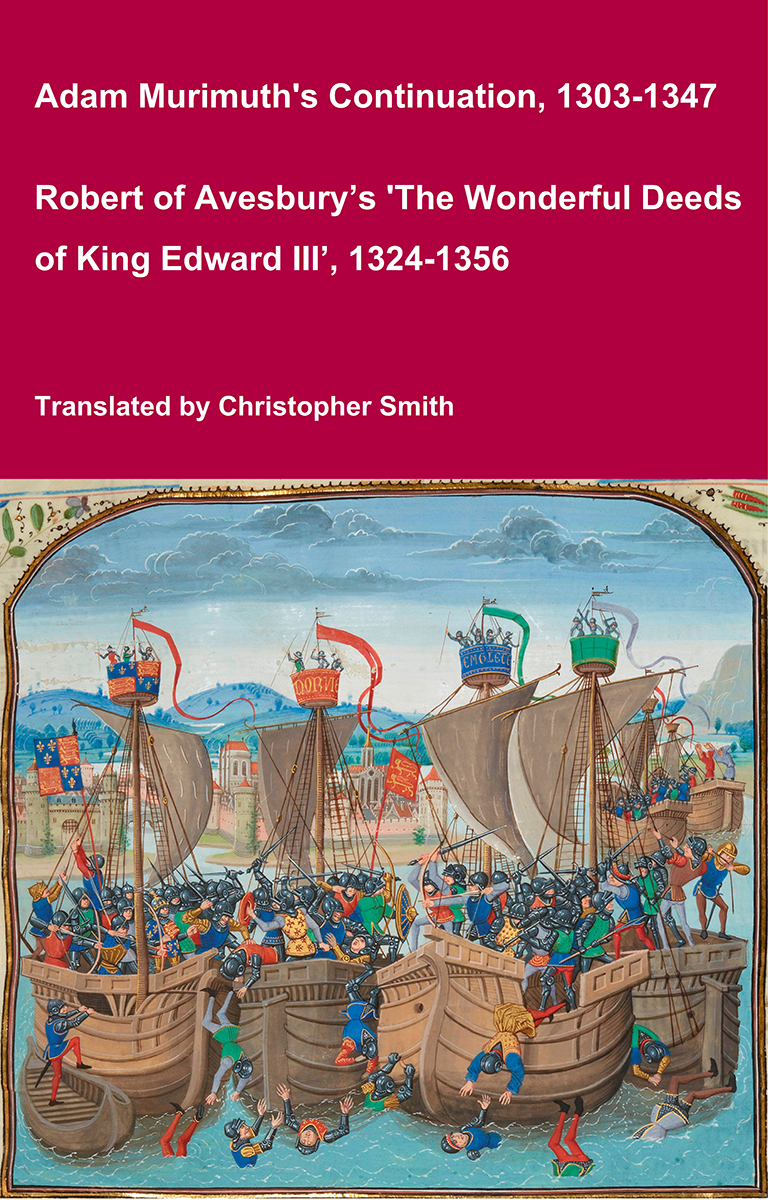
Adam Murimuth's Continuation and Robert of Avesbury’s 'The Wonderful Deeds of King Edward III'
This volume brings together two of the most important contemporary chronicles for the reign of Edward III and the opening phases of the Hundred Years’ War. Written in Latin by English clerical observers, these texts provide a vivid and authoritative window into the political, diplomatic, and military history of fourteenth-century England and its continental ambitions. Adam Murimuth Continuatio's Chronicarum continues an earlier chronicle into the mid-fourteenth century, offering concise but valuable notices on royal policy, foreign relations, and ecclesiastical affairs. Its annalistic structure makes it especially useful for establishing chronology and tracing the development of events year by year. Complementing it, Robert of Avesbury’s De gestis mirabilibus regis Edwardi tertii is a rich documentary chronicle preserving letters, treaties, and official records alongside narrative passages. It is an indispensable source for understanding Edward III’s claim to the French crown, the conduct of war, and the mechanisms of medieval diplomacy. Together, these works offer scholars, students, and enthusiasts a reliable and unembellished account of a transformative period in English and European history. Essential for anyone interested in medieval chronicles, the Hundred Years’ War, or the reign of Edward III.
Available at Amazon in eBook and Paperback format.
Samuel Pepys' Diary. 18th July 1666. Thence with him home; and there by appointment I find Dr. Fuller [aged 58], now Bishop of Limericke, in Ireland; whom I knew in his low condition at Twittenham. I had also by his desire Sir W. Pen [aged 45], and with him his lady [aged 42] and daughter [aged 15], and had a good dinner, and find the Bishop the same good man as ever; and in a word, kind to us, and, methinks, one of the comeliest and most becoming prelates in all respects that ever I saw in my life. During dinner comes an acquaintance of his, Sir Thomas Littleton [aged 45]; whom I knew not while he was in my house, but liked his discourse; and afterwards, by Sir W. Pen, do come to know that he is one of the greatest speakers in the House of Commons, and the usual second to the great Vaughan [aged 62]. So was sorry I did observe him no more, and gain more of his acquaintance.
Samuel Pepys' Diary. 13th June 1667. In the evening comes Mr. Pelling, and several others, to the office, and tell me that never were people so dejected as they are in the City all over at this day; and do talk most loudly, even treason; as, that we are bought and sold-that we are betrayed by the Papists, and others, about the King [aged 37]; cry out that the office of the Ordnance hath been so backward as no powder to have been at Chatham, Kent [Map] nor Upnor Castle, Kent [Map] till such a time, and the carriages all broken; that Legg is a Papist; that Upnor [Map], the old good castle built by Queen Elizabeth, should be lately slighted; that the ships at Chatham, Kent [Map] should not be carried up higher. They look upon us as lost, and remove their families and rich goods in the City; and do think verily that the French, being come down with his army to Dunkirke, it is to invade us, and that we shall be invaded. Mr. Clerke, the solicitor, comes to me about business, and tells me that he hears that the King hath chosen Mr. Pierpont [aged 59] and Vaughan [aged 63] of the West, Privy-councillors; that my Chancellor [aged 58] was affronted in the Hall this day, by people telling him of his Dunkirke house; and that there are regiments ordered to be got together, whereof to be commanders my Lord Fairfax [aged 55], Ingoldsby [aged 49], Bethell, Norton, and Birch [aged 51], and other Presbyterians; and that Dr. Bates will have liberty to preach. Now, whether this be true or not, I know not; but do think that nothing but this will unite us together.


Samuel Pepys' Diary. 29th July 1667. But presently comes down the House of Commons, the King [aged 37] having made then a very short and no pleasing speech to them at all, not at all giving them thanks for their readiness to come up to town at this busy time; but told them that he did think he should have had occasion for them, but had none, and therefore did dismiss them to look after their own occasions till October; and that he did wonder any should offer to bring in a suspicion that he intended to rule by an army, or otherwise than by the laws of the land, which he promised them he would do; and so bade them go home and settle the minds of the country in that particular; and only added, that he had made a peace which he did believe they would find reasonable, and a good peace, but did give them none of the particulars thereof. Thus they are dismissed again to their general great distaste, I believe the greatest that ever Parliament was, to see themselves so fooled, and the nation in certain condition of ruin, while the King, they see, is only governed by his lust, and women, and rogues about him. The Speaker, they found, was kept from coming in the morning to the House on purpose, till after the King was come to the House of Lords, for fear they should be doing anything in the House of Commons to the further dissatisfaction of the King and his courtiers. They do all give up the Kingdom for lost that I speak to; and do hear what the King says, how he and the Duke of York [aged 33] do do what they can to get up an army, that they may need no more Parliaments: and how my Baroness Castlemayne [aged 26] hath, before the late breach between her and the King, said to the King that he must rule by an army, or all would be lost, and that Bab. May [aged 39] hath given the like advice to the King, to crush the English gentlemen, saying that £300 a-year was enough for any man but them that lived at Court. I am told that many petitions were provided for the Parliament, complaining of the wrongs they have received from the Court and courtiers, in city and country, if the Parliament had but sat: and I do perceive they all do resolve to have a good account of the money spent before ever they give a farthing more: and the whole kingdom is everywhere sensible of their being abused, insomuch that they forced their Parliament-men to come up to sit; and my cozen Roger [aged 50] told me that (but that was in mirth) he believed, if he had not come up, he should have had his house burned. The Kingdom never in so troubled a condition in this world as now; nobody pleased with the peace, and yet nobody daring to wish for the continuance of the war, it being plain that nothing do nor can thrive under us. Here I saw old good Mr. Vaughan [aged 63], and several of the great men of the Commons, and some of them old men, that are come 200 miles, and more, to attend this session-of Parliament; and have been at great charge and disappointments in their other private business; and now all to no purpose, neither to serve their country, content themselves, nor receive any thanks from the King. It is verily expected by many of them that the King will continue the prorogation in October, so as, if it be possible, never to have [this] Parliament more. My Lord Bristoll [aged 54] took his place in the House of Lords this day, but not in his robes; and when the King come in, he withdrew but my Lord of Buckingham [aged 39] was there as brisk as ever, and sat in his robes; which is a monstrous thing, that a man proclaimed against, and put in the Tower [Map], and all, and released without any trial, and yet not restored to his places.
Become a Member via our Buy Me a Coffee page to read more.
Before 7th December 1667 [his son] Edward Vaughan [aged 32] and [his daughter-in-law] Letitia Hooker were married.
Samuel Pepys' Diary. 23rd February 1668. Thence by coach, with Brisband, to Sir G. Carteret's [aged 58], in Lincoln's Inn Fields, and there dined: a good dinner and good company; and after dinner he and I alone, discoursing of my Lord Sandwich's [aged 42] matters; who hath, in the first business before the House, been very kindly used beyond expectation, the matter being laid by, till his coming home and old Mr. Vaughan [aged 64] did speak for my Lord, which I am mighty glad of. The business of the prizes is the worst that can be said, and therein I do fear something may lie hard upon him; but, against this, we must prepare the best we can for his defence.

Samuel Pepys' Diary. 6th March 1668. Up betimes, and with Sir Prince to Sir W. Coventry's [aged 40] chamber: where the first word he said to me was, "Good-morrow, Mr. Pepys, that must be Speaker of the Parliament-house:" and did protest I had got honour for ever in Parliament. He said that his brother [aged 49], that sat by him, admires me; and another gentleman said that I could not get less than £1000 a-year if I would put on a gown and plead at the Chancery-bar; but, what pleases me most, he tells me that the Sollicitor-Generall did protest that he thought I spoke the best of any man in England. After several talks with him alone, touching his own businesses, he carried me to White Hall, and there parted; and I to the Duke of York's [aged 34] lodgings, and find him going to the Park, it being a very fine morning, and I after him; and, as soon as he saw me, he told me, with great satisfaction, that I had converted a great many yesterday, and did, with great praise of me, go on with the discourse with me. And, by and by, overtaking the King [aged 37], the King and Duke of York come to me both; and he [the King] said, "Mr. Pepys, I am very glad of your success yesterday"; and fell to talk of my well speaking; and many of the Lords there. My Lord Barkeley [aged 66] did cry the up for what they had heard of it; and others, Parliament-men there, about the King, did say that they never heard such a speech in their lives delivered in that manner. Progers, of the Bedchamber, swore to me afterwards before Brouncker [aged 48], in the afternoon, that he did tell the King that he thought I might teach the Sollicitor-Generall. Every body that saw me almost come to me, as Joseph Williamson [aged 34] and others, with such eulogys as cannot be expressed. From thence I went to Westminster Hall [Map], where I met Mr. G. Montagu [aged 45], who come to me and kissed me, and told me that he had often heretofore kissed my hands, but now he would kiss my lips: protesting that I was another Cicero, and said, all the world said the same of me. Mr. Ashburnham [aged 64], and every creature I met there of the Parliament, or that knew anything of the Parliament's actings, did salute me with this honour:-Mr. Godolphin [aged 33];-Mr. Sands, who swore he would go twenty mile, at any time, to hear the like again, and that he never saw so many sit four hours together to hear any man in his life, as there did to hear me; Mr. Chichly [aged 53],-Sir John Duncomb,-and everybody do say that the Kingdom will ring of my abilities, and that I have done myself right for my whole life: and so Captain Cocke [aged 51], and others of my friends, say that no man had ever such an opportunity of making his abilities known; and, that I may cite all at once, Mr. Lieutenant of the Tower did tell me that Mr. Vaughan [aged 64] did protest to him, and that, in his hearing it, said so to the Duke of Albemarle [aged 59], and afterwards to W. Coventry, that he had sat twenty-six years in Parliament and never heard such a speech there before: for which the Lord God make me thankful! and that I may make use of it not to pride and vain-glory, but that, now I have this esteem, I may do nothing that may lessen it! I spent the morning thus walking in the Hall, being complimented by everybody with admiration: and at noon stepped into the Legg with Sir William Warren, who was in the Hall, and there talked about a little of his business, and thence into the Hall a little more, and so with him by coach as far as the Temple [Map] almost, and there 'light, to follow my Lord Brouncker's coach, which I spied, and so to Madam Williams's, where I overtook him, and agreed upon meeting this afternoon, and so home to dinner, and after dinner with W. Pen [aged 46], who come to my house to call me, to White Hall, to wait on the Duke of York, where he again and all the company magnified me, and several in the Gallery: among others, my Lord Gerard [aged 50], who never knew me before nor spoke to me, desires his being better acquainted with me; and [said] that, at table where he was, he never heard so much said of any man as of me, in his whole life. We waited on the Duke of York, and thence into the Gallery, where the House of Lords waited the King's coming out of the Park, which he did by and by; and there, in the Vane-room, my Lord Keeper delivered a message to the King, the Lords being about him, wherein the Barons of England, from many good arguments, very well expressed in the part he read out of, do demand precedence in England of all noblemen of either of the King's other two kingdoms, be their title what it will; and did shew that they were in England reputed but as Commoners, and sat in the House of Commons, and at conferences with the Lords did stand bare. It was mighty worth my hearing: but the King did only say that he would consider of it, and so dismissed them.


Become a Member via our Buy Me a Coffee page to read more.
Samuel Pepys' Diary. 6th April 1668. Betimes I to Alderman Backewell [aged 50], and with him to my Lord Ashly's [aged 46], where did a little business about Tangier, and to talk about the business of certificates, wherein, contrary to what could be believed, the King [aged 37] and Duke of York [aged 34] themselves, in my absence, did call for some of the Commissioners of the Treasury, and give them directions about the business [of the certificates], which I, despairing to do any thing on a Sunday, and not thinking that they would think of it themselves, did rest satisfied, and stayed at home all yesterday, leaving it to do something in this day; but I find that the King and Duke of York had been so pressing in it, that my Lord Ashly was more forward with the doing of it this day, than I could have been. And so I to White Hall with Alderman Backewell in his coach, with Mr. Blany; my Lord's Secretary: and there did draw up a rough draught of what order I would have, and did carry it in, and had it read twice and approved of, before my Lord Ashly and three more of the Commissioners of the Treasury, and then went up to the Council-chamber, where the Duke of York, and Prince Rupert [aged 48], and the rest of the Committee of the Navy were sitting: and I did get some of them to read it there: and they would have had it passed presently, but Sir John Nicholas desired they would first have it approved by a full Council: and, therefore, a Council Extraordinary was readily summoned against the afternoon, and the Duke of York run presently to the King, as if now they were really set to mind their business, which God grant! So I thence to Westminster, and walked in the Hall and up and down, the House being called over to-day, and little news, but some talk as if the agreement between France and Spain were like to be, which would be bad for us, and at noon with Sir Herbert Price [aged 63] to Mr. George Montagu's [aged 45] to dinner, being invited by him in the hall, and there mightily made of, even to great trouble to me to be so commended before my face, with that flattery and importunity, that I was quite troubled with it. Yet he is a fine gentleman, truly, and his lady a fine woman; and, among many sons that I saw there, there was a little daughter that is mighty pretty, of which he is infinite fond: and, after dinner, did make her play on the gittar and sing, which she did mighty prettily, and seems to have a mighty musical soul, keeping time with most excellent spirit. Here I met with Mr. Brownlow, my old schoolfellow, who come thither, I suppose, as a suitor to one of the young ladies that were there, and a sober man he seems to be. But here Mr. Montagu did tell me how Mr. Vaughan [aged 64], in that very room, did say that I was a great man, and had great understanding, and I know not what, which, I confess, I was a little proud of, if I may believe him. Here I do hear, as a great secret, that the King, and Duke of York and Duchesse, and my Baroness Castlemayne [aged 27], are now all agreed in a strict league, and all things like to go very current, and that it is not impossible to have my Lord Clarendon [aged 59], in time, here again. But I do hear that my Baroness Castlemayne is horribly vexed at the late libell1, the petition of the poor whores about the town, whose houses were pulled down the other day. I have got one of them, but it is not very witty, but devilish severe against her and the King and I wonder how it durst be printed and spread abroad, which shews that the times are loose, and come to a great disregard of the King, or Court, or Government.
Note 1. "The Poor Whores' Petition to the most splendid, illustrious, serene and eminent Lady of Pleasure the Countess of Castlemayne, &c., signed by us, Madam Cresswell and Damaris Page, this present 25th day of March, 1668". This sham petition occasioned a pretended answer, entitled, "The Gracious Answer of the Most Illustrious Lady of Pleasure, the Countess of Castlem.... to the Poor Whores' Petition". It is signed, "Given at our Closset, in King Street, Westminster, die Veneris, April 24, 1668. Castlem...". Compare Evelyn, April 2nd, 1668.
Become a Member via our Buy Me a Coffee page to read more.
Samuel Pepys' Diary. 19th May 1668. Up, and called on Mr. Pierce, who tells me that after all this ado Ward is come to town, and hath appeared to the Commissioners of Accounts and given such answers as he thinks will do every body right, and let the world see that their great expectations and jealousies have been vain in this matter of the prizes. The Commissioners were mighty inquisitive whether he was not instructed by letters or otherwise from hence from my Lord Sandwich's [aged 42] friends what to say and do, and particularly from me, which he did wholly deny, as it was true, I not knowing the man that I know of. He tells me also that, for certain, Mr. Vaughan [aged 64] is made Lord Chief justice, which I am glad of. He tells me, too; that since my Lord of Ormond's [aged 57] coming over, the King [aged 37] begins to be mightily reclaimed, and sups every night with great pleasure with the Queene [aged 58]: and yet, it seems, he is mighty hot upon the Duchess of Richmond [aged 20]; insomuch that, upon Sunday was se'nnight, at night, after he had ordered his Guards and coach to be ready to carry him to the Park, he did, on a sudden, take a pair of oars or sculler, and all alone, or but one with him, go to Somersett House [Map], and there, the garden-door not being open, himself clamber over the walls to make a visit to her, which is a horrid shame. He gone, I to the office, where we sat all the morning, Sir W. Pen [aged 47] sick of the gout comes not out.
On 20th May 1668 John Vaughan of Transgoed [aged 64] was knighted and appointed Serjeant at Law.
On 23rd May 1668 John Vaughan of Transgoed [aged 64] was appointed Chief Justice of the Common Pleas. He won lasting fame for his important decision in Bushell's Case, that juries were not to be fined for returning a verdict against the direction of the judge.
On 10th December 1674 John Vaughan of Transgoed [aged 71] died at Serjeants' Inn. He was buried at Temple Church, London [Map] on 22nd December 1674. His marble monument was destroyed in WWII. Edward Stillingfleet [aged 39] preached his funeral sermon. His son Edward Vaughan [aged 39] inherited a Cardiganshire estate worth £1,200 each year.


Before 1680 [his former wife] Jane Stedman [aged 61] died.
Father: Edward Vaughan 
GrandFather: John Steadman of Strata Florida
Mother: Letitia Stedman of Strata Florida