

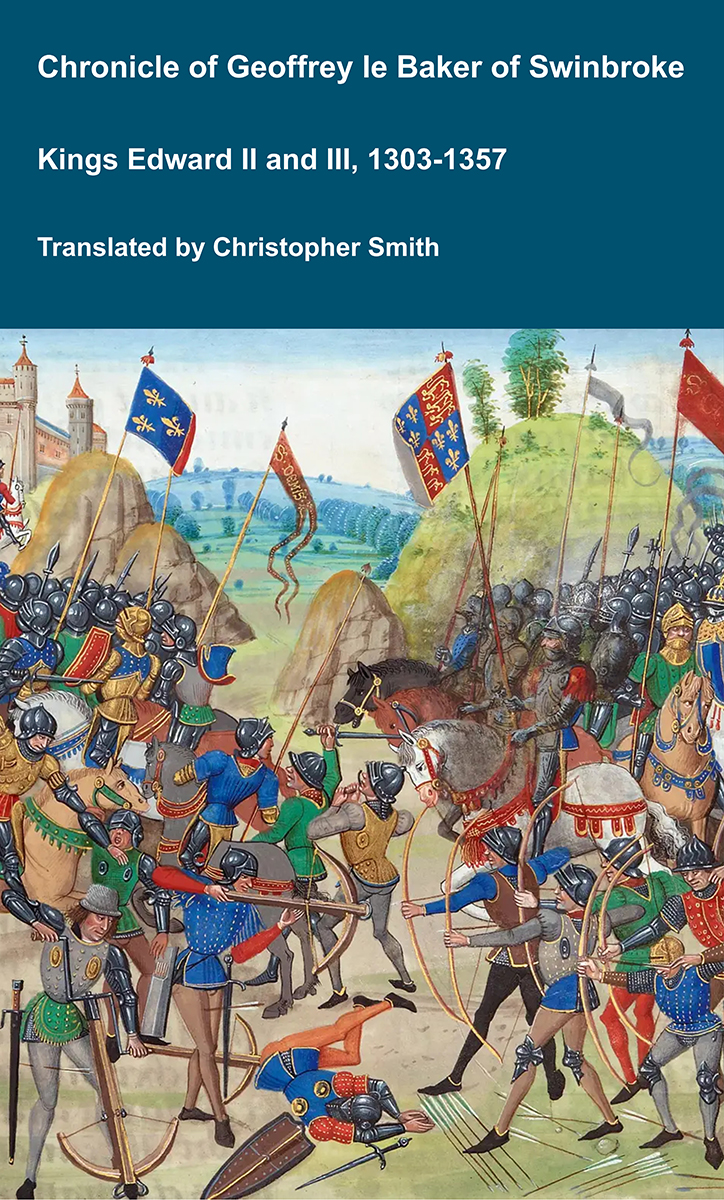
Chronicle of Geoffrey le Baker of Swinbroke
Baker was a secular clerk from Swinbroke, now Swinbrook, an Oxfordshire village two miles east of Burford. His Chronicle describes the events of the period 1303-1356: Gaveston, Bannockburn, Boroughbridge, the murder of King Edward II, the Scottish Wars, Sluys, Crécy, the Black Death, Winchelsea and Poitiers. To quote Herbert Bruce 'it possesses a vigorous and characteristic style, and its value for particular events between 1303 and 1356 has been recognised by its editor and by subsequent writers'. The book provides remarkable detail about the events it describes. Baker's text has been augmented with hundreds of notes, including extracts from other contemporary chronicles, such as the Annales Londonienses, Annales Paulini, Murimuth, Lanercost, Avesbury, Guisborough and Froissart to enrich the reader's understanding. The translation takes as its source the 'Chronicon Galfridi le Baker de Swynebroke' published in 1889, edited by Edward Maunde Thompson.
Available at Amazon in eBook and Paperback format.
Paternal Family Tree: Glynne
In 1566 William Glynne was born to [his father] Thomas Glynne.
In 1578 William Glynne (age 12) educated at University College, Oxford University.
In 1593 William Glynne (age 27) was elected MP Anglesey.
In 1597 William Glynne (age 31) was appointed High Sheriff of Anglesey.
Before 1602 William Glynne (age 35) and Jane Griffith were married.
In 1602 [his son] John Glynne was born to William Glynne (age 36) and [his wife] Jane Griffith at Glynllifon. He married (1) before 20th January 1638 Frances Squib and had issue (2) after 19th October 1646 Anne Manning Lady Lawley and had issue.
In 1606 William Glynne (age 40) was knighted.
In 1608 [his father] Thomas Glynne died.
In 1618 William Glynne (age 52) was appointed High Sheriff of Anglesey.
In 1620 William Glynne (age 54) died.
Chronicle of Walter of Guisborough
A canon regular of the Augustinian Guisborough Priory, Yorkshire, formerly known as The Chronicle of Walter of Hemingburgh, describes the period from 1066 to 1346. Before 1274 the Chronicle is based on other works. Thereafter, the Chronicle is original, and a remarkable source for the events of the time. This book provides a translation of the Chronicle from that date. The Latin source for our translation is the 1849 work edited by Hans Claude Hamilton. Hamilton, in his preface, says: 'In the present work we behold perhaps one of the finest samples of our early chronicles, both as regards the value of the events recorded, and the correctness with which they are detailed; Nor will the pleasing style of composition be lightly passed over by those capable of seeing reflected from it the tokens of a vigorous and cultivated mind, and a favourable specimen of the learning and taste of the age in which it was framed.'
Available at Amazon in eBook and Paperback format.
[his son] Thomas Glynne was born to William Glynne and Jane Griffith.