

Jean de Waurin's Chronicle of England Volume 6 Books 3-6: The Wars of the Roses
Jean de Waurin was a French Chronicler, from the Artois region, who was born around 1400, and died around 1474. Waurin’s Chronicle of England, Volume 6, covering the period 1450 to 1471, from which we have selected and translated Chapters relating to the Wars of the Roses, provides a vivid, original, contemporary description of key events some of which he witnessed first-hand, some of which he was told by the key people involved with whom Waurin had a personal relationship.
Available at Amazon in eBook and Paperback format.
Beaumaris, Anglesey is in Anglesey.
See: Baron Hill, Beaumaris, Beaumaris Castle [Map], Cremlyn Burial Mound [Map], St Marys and St Nicholas Church Beaumaris [Map], Trefor Burial Chamber [Map].
On 7th September 1450 Richard Plantagenet 3rd Duke of York (age 38) returned from Ireland landing at Beaumaris, Anglesey. He arrived in London on 27th September 1450.
On 26th January 1547 Richard Bulkeley of Beaumaris (age 46) died. He was buried at Beaumaris, Anglesey.
On 28th June 1621 Richard Bulkeley (age 88) died at Beaumaris, Anglesey. He was buried at Beaumaris, Anglesey.
On 16th October 1688 Robert Bulkeley 2nd Viscount Bulkeley died at Beaumaris, Anglesey. His son Richard succeeded 3rd Viscount Bulkeley of Cashel in Tipperary. Elizabeth White Viscountess Bulkeley by marriage Viscountess Bulkeley of Cashel in Tipperary.
In 1689 and 1681 William Williams 1st Baronet (age 55) was elected MP Beaumaris.
In 1690 Thomas Bulkeley (age 57) was elected MP Beaumaris.
On 31st August 1704 Richard Bulkeley 3rd Viscount Bulkeley was buried at Beaumaris, Anglesey.
On 18th April 1707 Richard Bulkeley 5th Viscount Bulkeley was baptised at Beaumaris, Anglesey.
In 1784 Hugh Fortescue 1st Earl Fortescue (age 30) was elected MP Beaumaris.
In 1796 Thomas Wynn 1st Baron Newborough (age 60) was elected MP Beaumaris.
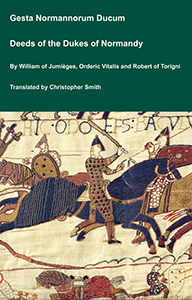
The Deeds of the Dukes of Normandy
The Gesta Normannorum Ducum [The Deeds of the Dukes of Normandy] is a landmark medieval chronicle tracing the rise and fall of the Norman dynasty from its early roots through the pivotal events surrounding the Norman Conquest of England. Originally penned in Latin by the monk William of Jumièges shortly before 1060 and later expanded at the behest of William the Conqueror, the work chronicles the deeds, politics, battles, and leadership of the Norman dukes, especially William’s own claim to the English throne. The narrative combines earlier historical sources with firsthand information and oral testimony to present an authoritative account of Normandy’s transformation from a Viking settlement into one of medieval Europe’s most powerful realms. William’s history emphasizes the legitimacy, military prowess, and governance of the Norman line, framing their expansion, including the conquest of England, as both divinely sanctioned and noble in purpose. Later chroniclers such as Orderic Vitalis and Robert of Torigni continued the history, extending the coverage into the 12th century, providing broader context on ducal rule and its impact. Today this classic work remains a foundational source for understanding Norman identity, medieval statesmanship, and the historical forces that reshaped England and Western Europe between 800AD and 1100AD.
Available at Amazon in eBook and Paperback format.
In 1847 General George Augustus Frederick Paget (age 28) was elected MP Beaumaris which seat he held until 1857.
In 1857 William Owen Stanley (age 54) was elected MP Beaumaris.
On 29th December 1873 Oswald Mosley 5th Baronet was born to Oswald Mosley 4th Baronet (age 25) at Beaumaris, Anglesey. He married 12th December 1895 Katharine Maud Edwards-Heathcote and had issue.
James Bulkeley was elected MP Beaumaris.
Archaeologia Volume 29 Section X. The following account of Edward's marriage is taken from MS. Lansd. 210. The date of this occurrence is unfortunately not known, nor have I been able to supply the deficiency:—
In thys same yer kyng Edward sent hys trusty frende, the Erle of Warwyk, and other imbasseturs into France to conclowde a maryage for hym with the lady Bona, that was syster to the French quene, a lady of excelent bewté, wech he concludyd in the kynges name, the wech besenys afterward dyd cawse cevylle war and moch meschef; for Kyng Edward had changyd hys mende, or the Erle cam whom agayn, and was maryed to the lady Elsabyth Gray, dawter to Rycharde Lord Revers, woch was maryd befor to Ser John Gray, knight, by whom she had ij. cheldren, Thomas and Richard."
It will be recollected that Queen Margaret visited France to obtain succour for King Henry. The following very curious narrative, which is taken from MS. Lambeth, 448, throws great light on the way Edward was made acquainted with her designs:—
Blyssyt be God! diverse of owre adversaryes be owrethrowyn, and we undyrstond the prevyte and fals ymaginacions of the French party. Also ther is oon callyt John Worby, of Mortlond, a spye, in the county of Herteford, servaunt to Sere John Russel, in the county of Wyscetre, takyn be the Lord Suthwell, and the seid a spye ther takyn, hath confessyt that Kyng Herry, late Kyng of England, in dede but not in ryth, and sche that was Queyn Margarete hys wyf, and Edward hyr son, the duk of Brytayn, Edward the Duk of Burgoyn, Syr Wylliam Taylbos, the Lord Roos, Sir Richard Tunstall, Thomas Ormond, Sir W. Catisby, Thomas Fytze Harry—thes lordes and knytes be in Scotlond with the Scottes. The Duk of Excetre, Erl of Penbrok, the Baron of Burford, John Ayne—thes schal lond at Bumeryes be the appoyment of Robert Gald, Captene of the Duk of Burgoyne. Duk Herry of Calabere, the Lord Hungyrford, the Lord Mortone, the Duk of Somersete, with lx. m1. men of Spayn, thes schal londyn in the coost of Norfolk and Suffolk. The Lord Lewys, the Duk of Spayne, Herry the Dolfyn of Franch, Ser John Fosbrew, Ser John Russel of Wycetre, Ser Thomas Burtayn, the erlys brothere of Denschyre, Ser Thomas Cornwaylys; thes lordes and knytes schal londyn at Sanewych by the appoyment. Than comyng after thes lordes and knytes byfore wryten to assiste them with al the powre possibille they may make; the Kyng of Fraunce with a c. m'; the Kyng of Denmarke with xx. m1; the Kyng of Aragon 1. m'; the Kyng of Slavern with xx. M!; the Kyng of Cesyl with xxv. m'; the Kyng of Portyngale with x. m'; the whych be appoyntyt to enter the reme of Inglond.
In 1618 Richard Bulkeley (age 85) built at Baron Hill, Beaumaris.
Beaumaris Castle is also in Castles in Anglesey.
The Welsh Castles and Towns of Edward I comprise a number of castles, some with associated planned towns, commissioned as a means of containing the Welsh. They included, from east to west, Flint Castle [Map], Rhuddlan [Map], Conwy Castle [Map], Beaumaris Castle [Map], Caernarfon Castle [Map], Harlech Castle [Map] and Aberystwyth Castle [Map]. Those not on the coast include Chirk Castle [Map], Denbigh Castle and Town Walls [Map] and Builth Castle [Map]. Arguably, Holt Castle [Map] and Criccieth Castle [Map] should be included.
In 1440 William Bulkeley (age 22) was appointed Constable of Beaumaris Castle.
In March 1449 Eleanor Cobham Duchess of Gloucester (age 49) was imprisoned at the Beaumaris Castle [Map].
On 7th July 1452 Eleanor Cobham Duchess of Gloucester (age 52) died at Beaumaris Castle [Map].
Henrici Quinti, Angliæ Regis, Gesta, is a first-hand account of the Agincourt Campaign, and subsequent events to his death in 1422. The author of the first part was a Chaplain in King Henry's retinue who was present from King Henry's departure at Southampton in 1415, at the siege of Harfleur, the battle of Agincourt, and the celebrations on King Henry's return to London. The second part, by another writer, relates the events that took place including the negotiations at Troye, Henry's marriage and his death in 1422.
Available at Amazon in eBook and Paperback format.
In 1654 William Wray 1st Baronet (age 29) was appointed Deputy Governor of Beaumaris Castle.