

Chronicle of Abbot Ralph of Coggeshall
The Chronicle of Abbot Ralph of Coggeshall (Chronicon Anglicanum) is an indispensable medieval history that brings to life centuries of English and European affairs through the eyes of a learned Cistercian monk. Ralph of Coggeshall, abbot of the Abbey of Coggeshall in Essex in the early 13th century, continued and expanded his community’s chronicle, documenting events from the Norman Conquest of 1066 into the tumultuous reign of King Henry III. Blending eyewitness testimony, careful compilation, and the monastic commitment to record-keeping, this chronicle offers a rare narrative of political intrigue, royal power struggles, and social upheaval in England and beyond. Ralph’s work captures the reigns of pivotal figures such as Richard I and King John, providing invaluable insights into their characters, decisions, and the forces that shaped medieval rule. More than a simple annal, Chronicon Anglicanum conveys the texture of medieval life and governance, making it a rich source for scholars and readers fascinated by English history, monastic authorship, and the shaping of the medieval world.
Available at Amazon in eBook and Paperback format.
Capel Garmon Chambered Tomb is in Betws-y-Coed [Map], Prehistoric Wales Neolithic Burials.
Capel Garmon Chambered Tomb [Map]. A 16ft/5m passageway leads to a triple burial chamber with a large capstone over the western compartment. Surrounding the structure is a ring of stones marking the outline of a nearly 100ft/30m earthen mound which originally covered it.
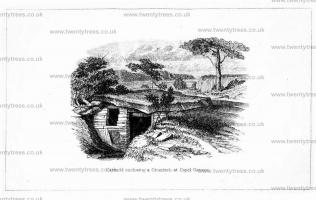
Archaeologia Cambrensis 1854 Frontspiece. Cromlech at Capel Garmon [Map]
Archaeologia Cambrensis 1927 Pages 1-43. "Tynycord Cromlech - Capel Garmon, Denbighshire [Map]."
"This is a remarkably fine specimen of an Ancient sepulchral chamber in excellent preservation. It was once embedded in a tumulus or carnedd, as was the case with most of our cistveini and Cromlechau. The incumbent heap has been half removed for building walls.... The Leading outline of the tumulus is elliptical, its greatest diameter at the base being 20 yards, its east 13 yards. It has been reduced in size within living memory. Level with the present surface of the mound is the denuded roof of the Cromlech, a flat slab of marvellous size and symmetry. Its form is rhomboid, or symewhat lozenge-shaped, its greatest length 14 feet 7 inches, its breadth 11 feet 4 inches... exceeding, I apprehend, in superficial measure any Cromlech in Wales. Its average thickness is about 15 inches. Under one end or apex is the entrance to the cell pointing to the South West, opposite the other at a distance of 2½ yards is a circle 2 yards in diameter, composed of seven stones about 2 feet out of the ground, at unequal distances, as if some of them had been removed. A line drawn lengthways over the large slab from the entrance of the cell would intersect this circle. There are no other traces of systematic arrangement outside the monument. A deep lane, 4 yards long, which appearsto have been once a covered way, leads to the entrance of the chamber. This has been converted into a stable by a former tenant and provided with a door and window, and with a manger at the end opposite the door. The shape of the chamber inclines to a pentagon, the doorway forming one side. Its height at the door is 5 ft. 5 inches, at the middle 5 ft. 7 inches, gradually increasing towards the opposite end. The supporters, which partly form the walls of the stable, are five in number, and measure respectively 5 ft. 5 inches high by 4 broad; 5 ft. by 2 ft.; 6 ft. by 3 ft. 4 inches; 5 ft. 9 inches by 2 ft., and 5 ft. by 3 ft. 6 inches. They stand at regular distances and the intervening spaces have been built up with a wall of small stones, a few of which, by their aged, greenish colour, seem composed of a broken portion of the Cromlech. The floor is paved; some of tae supporters appear disturbed from their original position and somewhat broken. Still, so neatly and free from damage, on the whole, has the conversion been made from the sepulchre of a hero to a stable for colts that no one would wish the work undone nor the integrity of the structure better secured."
"All the stones of the Cromlech are of the argillaceous stone, or flags, with which the country abounds. Someone has been barbarous enough to attempt to blast the large cover stone. But the hole being bored too deep the underside of the stone gave way, the laminæ being forced out in concentric circles, diminishing upwards and presenting an object, that if unexplained, might perplex an antiquary."
Archaeologia Cambrensis 1927 Pages 1-43. The Capel Garmon Chambered Long Cairn [Map]. By W. J. Hemp, FSA.